
Is Tea Hydrating? What Science Actually Says (And Which Teas Hydrate Best)
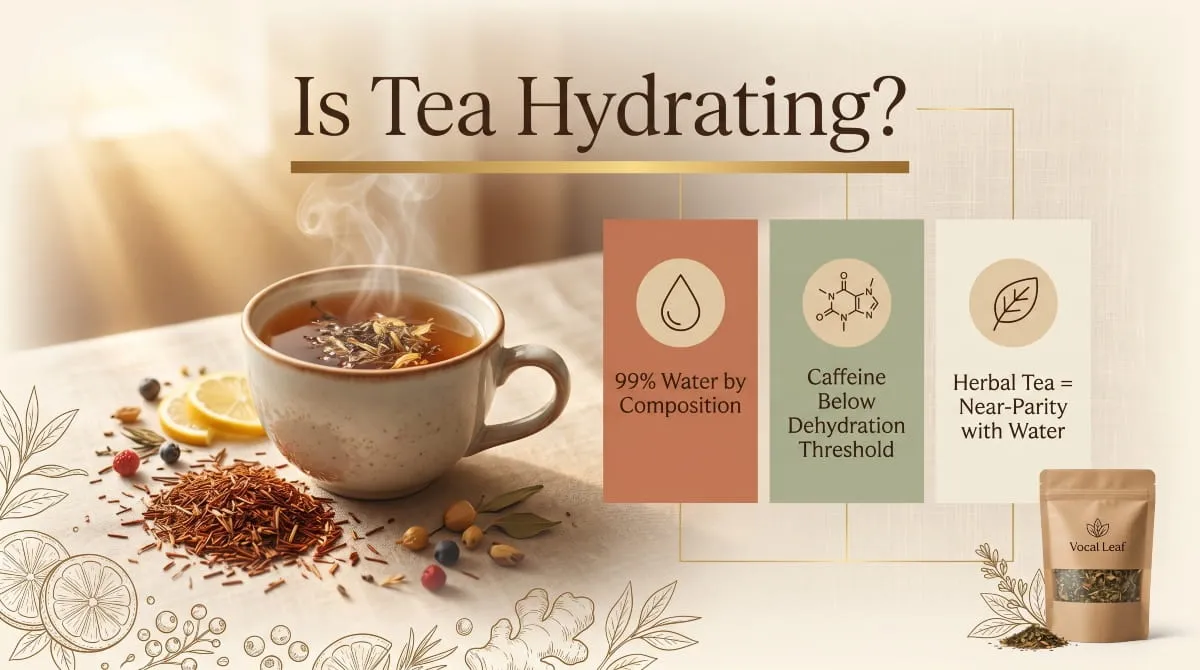
Somewhere between your second cup of the morning and the moment someone tells you to “just drink more water,” a reasonable question surfaces: Does tea actually count?
It’s a fair one. Tea is mostly water, brewed from water, drunk like water, warming you the way water never quite does. And yet the doubt lingers, usually traced back to some half-remembered warning about caffeine and dehydration. So before you swap your kettle for a water bottle, here’s what the science actually says.
Yes, tea is hydrating. For most people, in most situations, drinking tea contributes meaningfully to daily fluid intake, and the research backs that up. A landmark study published in the European Journal of Clinical Nutrition found that moderate tea consumption hydrates the body just as effectively as plain water. The caffeine content in a typical cup, usually between 30 and 50mg, simply isn’t high enough to trigger a net fluid loss. Your body absorbs far more liquid than it expels.
That said, not all teas behave the same way. Herbal teas, which are naturally caffeine-free, sit at the top of the hydration spectrum. Heavily caffeinated options are still hydrating, but the margin narrows as caffeine climbs. Sweet tea adds sugar to the equation, which introduces its own considerations. And the temperature of your brew, hot or iced, matters less than most people assume.
This guide untangles all of it. Whether you’re curious about green tea versus black tea, iced tea versus hot, decaf versus full-caffeine, or simply want to know which teas hydrate best for your voice, your workouts, or your daily routine, you’ll find a clear answer here, backed by evidence and free of the usual noise.
Does Tea Actually Hydrate You?
If you’ve ever been told that tea doesn’t really count toward your daily fluids, you were given incomplete information. The full picture is more nuanced and considerably more reassuring for anyone who reaches for the kettle before the tap.
The Short Answer: Yes, With One Important Caveat
Tea hydrates you. That’s not a wellness claim or a brand talking point; it’s the conclusion drawn from clinical research. The caveat is caffeine, and it’s smaller than most people think.
Caffeine is a mild diuretic, meaning it can prompt the kidneys to excrete more fluid. In high doses, that effect is real. But a standard cup of tea contains nowhere near enough caffeine to cause a net fluid loss. Most brewed teas deliver between 20 and 50mg of caffeine per cup, a threshold well below what researchers have identified as the point where diuresis becomes meaningful. Your body absorbs the liquid, uses it, and retains far more than it loses.
The one genuine caveat applies to very high caffeine intake, think multiple strong cups back to back over a short window. At that level, the diuretic effect becomes more measurable. For the vast majority of tea drinkers, though, it’s simply not a practical concern.
How Tea Counts Toward Your Daily Fluid Intake
Health authorities, including the European Food Safety Authority and the NHS, recognize tea as a valid contributor to daily fluid intake. The commonly cited hydration target of around 2 liters per day doesn’t mean 2 liters of water exclusively; it means 2 liters of fluid, and tea qualifies.
What matters most is the total water content of what you drink, and brewed tea is roughly 99% water. The remaining fraction, tea compounds, trace minerals, and, in caffeinated varieties, caffeine, doesn’t meaningfully reduce its hydrating effect at normal consumption levels. So yes, your morning cup counts. Your afternoon pot counts. The iced tea you drink through a long afternoon counts too.
Does Tea Count as Hydration the Same Way Water Does?
Functionally, yes, with one small distinction worth understanding. Pure water delivers hydration with zero variables. Tea delivers essentially the same hydration, but with compounds layered on top: caffeine in some varieties, polyphenols in most, and naturally occurring minerals depending on the herb or leaf.
For most people, those additions are either neutral or mildly beneficial. Polyphenols, for instance, carry antioxidant properties that plain water doesn’t. The caffeine in a moderate cup doesn’t negate hydration; it simply means caffeinated tea sits slightly below pure water on the efficiency scale in laboratory conditions. In real-world terms, that difference is negligible for anyone drinking tea within normal daily amounts.
Where tea diverges more noticeably from water is when sugar is added. A heavily sweetened iced tea or an artificially flavored variety changes the calculation. High sugar content can slow gastric absorption and, over time, work against good hydration habits. Unsweetened tea, by contrast, is functionally equivalent to water for hydration.
Is Drinking Tea the Same as Drinking Water for Hydration?
Close, but not identical, and the distinction is worth making clearly so you can make informed choices rather than anxious ones.
Water is the baseline. It hydrates with complete efficiency, no caveats, no variables. Unsweetened herbal tea is the closest alternative, with hydration near that of water. Caffeinated teas, green, black, and oolong, are still genuinely hydrating, just positioned a small step below that baseline due to caffeine’s mild diuretic influence. Sweetened or heavily processed tea drinks are where the gap widens, because added sugar and artificial ingredients shift the composition away from what makes tea hydrating in the first place.
The practical takeaway: if you’re drinking good-quality, unsweetened loose-leaf tea throughout the day, you are hydrating yourself. You don’t need to chase every cup with a glass of water as a corrective measure. Tea isn’t a substitute that requires an apology; for most people, it’s a legitimate, well-supported way to stay hydrated.
Tea vs. Water for Hydration: Is There Really a Difference?
The comparison feels almost unfair to water, a drink that’s been the unchallenged hydration standard for as long as humans have been thirsty. But tea has quietly built a compelling case for itself, and the gap between the two is narrower than most people expect.
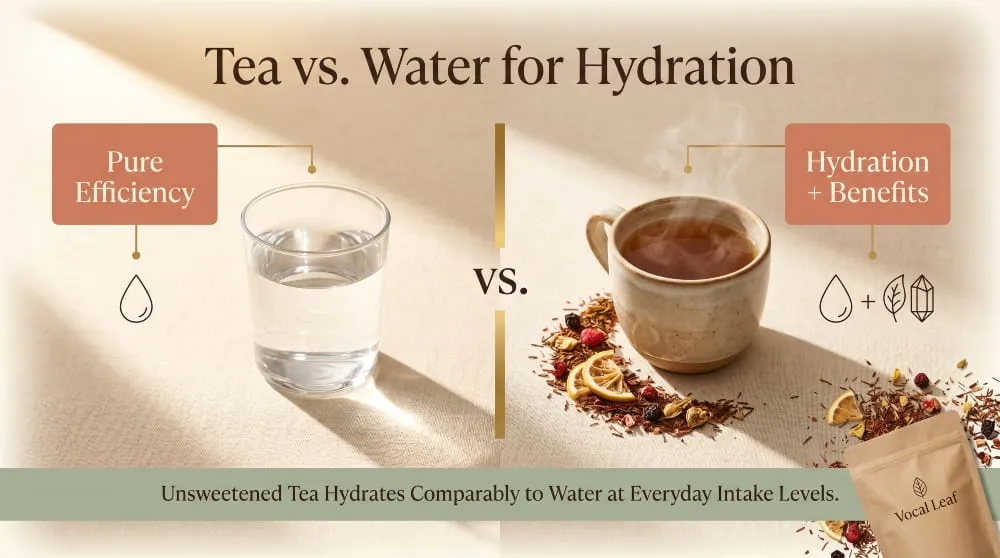
Is Tea as Hydrating as Water?
For practical, everyday purposes, yes. The study most frequently cited on this question comes from researchers at Loughborough University, who found no significant difference in hydration markers between participants who drank tea and those who drank water throughout the day. Blood osmolality, urine output, and fluid retention were comparable between the two groups.
The reason is simple: brewed tea is predominantly water. The tea compounds, minerals, and caffeine that give it character account for only a fraction of the total volume. When you drink a cup of tea, your body processes it as a fluid, because that’s almost entirely what it is.
The nuance comes with caffeine. In laboratory settings, caffeinated beverages show a marginally reduced hydration efficiency compared to plain water, but the keyword there is marginally. For someone drinking one to four cups of tea daily, the range most people fall into, that difference doesn’t translate into measurable dehydration or any practical shortfall in fluid intake.
Is Tea More Hydrating Than Water, or Less?
Honestly, it depends on the tea, and the comparison is less about hydration power and more about what else you’re adding to the equation.
Plain water is technically the most efficient hydrator because it delivers fluid with nothing to process. In that narrow sense, water has a slight edge over caffeinated tea. But the story shifts when you look at herbal teas. Caffeine-free herbal varieties contain no diuretic compounds whatsoever, which puts them essentially on par with water, and in some interpretations, arguably ahead of it, because certain herbs contribute electrolytes and trace minerals that support fluid retention at the cellular level.
So the honest answer is this: water is slightly more efficient in a controlled clinical sense. Herbal tea matches it closely. Caffeinated tea sits just behind. But the real-world difference between drinking three cups of quality tea and three cups of water is not something you will feel, measure, or notice in your daily life.
Can Tea Replace Water for Hydration?
For most healthy adults, tea can make up a significant portion of daily fluid intake without adversely affecting hydration. Health organizations in the UK and Europe have long acknowledged this, and the evidence supports it. People who drink tea as their primary beverage alongside meals tend to maintain normal hydration levels without supplementing heavily with plain water.
That said, replacing water entirely with tea carries some practical caveats. If your tea of choice is caffeinated, very high daily consumption could theoretically push caffeine intake into a range where diuretic effects become noticeable. If it’s sweetened, the added sugar works against efficient hydration over time. And during intense exercise or heat exposure, when fluid replacement needs are elevated, and the speed of absorption matters, water and electrolyte drinks remain the more targeted choice.
For everyday hydration at normal activity levels, though? A diet built around quality, unsweetened tea, particularly loose-leaf herbal varieties, supports healthy fluid intake. Reaching for the kettle instead of the tap isn’t a compromise; it’s a reasonable, well-supported choice.
Is Tea Better Than Water for Hydration in Any Situation?
There are specific circumstances where tea genuinely has the advantage, not because it hydrates more efficiently than water in a technical sense, but because it does more than water while hydrating you at nearly the same level.
Cold and flu recovery is one clear example. Hot tea keeps fluid intake consistent when plain cold water may feel unappealing, while also delivering warmth that eases throat discomfort and steam that opens airways. Staying hydrated when you’re unwell is more about maintaining fluid intake than optimizing for efficiency, and tea’s palatability makes that easier.
Vocal health is another. For singers, speakers, teachers, and performers, staying consistently hydrated throughout the day matters enormously for how the voice feels and functions. A warm cup of quality loose-leaf tea, particularly a caffeine-free herbal blend, hydrates the body while soothing the vocal tract in a way that a glass of cold water simply doesn’t. The warmth itself promotes blood flow and relaxes the muscles surrounding the larynx, making tea not just a hydration vehicle but a genuinely functional choice for anyone who uses their voice professionally.
So while water remains the hydration baseline, tea earns its place, especially when what you need from your drink goes beyond simple fluid replacement.
Does Caffeine Make Tea Dehydrating?
Of all the myths surrounding tea and hydration, this one has the longest legs. The idea that caffeine makes tea dehydrating has been repeated so many times, in wellness articles, by well-meaning doctors, in offhand comments, that it has taken on the weight of fact. It isn’t. The reality is more precise and considerably less alarming.
Is Tea Hydrating or Dehydrating? The Caffeine Question
Caffeine is a diuretic. That part is true. What gets left out of the conversation is the dose at which that diuretic effect actually becomes meaningful, and how far a typical cup of tea falls short of that threshold.
A diuretic increases urine output by signaling the kidneys to excrete more fluid. In pharmacological doses, caffeine does exactly that. But the operative Word is doses. The caffeine concentration required to produce a measurable diuretic effect in clinical settings is substantially higher than what you’d find in a standard brew. And here’s the part that changes everything: when caffeine is dissolved in a large volume of liquid, as it always is in tea, your body absorbs far more fluid than the caffeine prompts it to lose.
The net effect is positive. You are hydrated by drinking tea, not depleted. The diuretic property of caffeine doesn’t disappear, but it is comfortably outweighed by the fluid volume you’ve consumed alongside it. Calling caffeinated tea dehydrating is a bit like calling a salted meal dehydrating because salt makes you thirsty, technically connected to a real mechanism, but misleading as a practical conclusion.
How Much Caffeine Does It Take to Cause Dehydration?
Research puts the threshold at approximately 300mg of caffeine or more consumed in a short window, the point at which diuretic effects become clinically significant and fluid loss begins to outpace fluid intake from the beverage itself.
To put that in context: a standard cup of black tea contains roughly 40 to 70mg of caffeine. Green tea typically sits lower, at 20-35mg. To reach the dehydration threshold with tea alone, you would need to drink between five and ten strong cups in rapid succession. This scenario bears no resemblance to how people actually drink tea.
At normal consumption levels, the caffeine in tea simply doesn’t accumulate fast enough or in sufficient quantity to shift the fluid balance into negative territory. The body processes it, benefits from the fluid volume, and moves on. The dehydration threshold is real; reaching it through ordinary tea drinking is not.
Is Caffeinated Tea Still Hydrating?
Yes, unambiguously and consistently at everyday intake levels. This isn’t a qualified or conditional answer. Multiple peer-reviewed studies, including those published in the British Journal of Nutrition, have confirmed that moderate consumption of caffeinated tea improves fluid balance in healthy adults.
Where people go wrong is treating caffeine as a binary: either it dehydrates you, or it doesn’t. The reality is a spectrum governed entirely by dose. At low doses, present in a normal cup of tea, caffeine’s diuretic effect is minimal, and the fluid intake dominates. At very high doses, the balance tips. Most tea drinkers never get anywhere near that tipping point.
Caffeinated teas, black, green, and oolong, are still hydrating. They sit a fraction below pure water and caffeine-free herbal teas on the efficiency scale, but they sit firmly in hydrating territory. Choosing a caffeinated tea over no fluid at all is always the better outcome for hydration.
At What Point Does Tea Stop Hydrating You?
The honest answer is: at a level of consumption that very few people reach. The threshold at which caffeinated tea shifts from net-hydrating to net-dehydrating requires both a high caffeine concentration per cup and a high volume consumed in a short period. In practical terms, drinking four or five cups of strong black tea throughout the day keeps you well within the hydrating range. The problems begin when consumption becomes extreme, think ten or more strong cups in a few hours, which is less a tea habit and more an edge case.
There are a few legitimate situations where the calculus shifts slightly. During intense exercise or in high heat, your fluid replacement needs are elevated, and the rate of absorption matters more. In those contexts, plain water or electrolyte drinks are more targeted tools than caffeinated tea, not because tea becomes dehydrating, but because it’s simply less optimized for rapid rehydration under physiological stress. Similarly, very high caffeine sensitivity in certain individuals may lower their personal threshold somewhat, though this remains the exception rather than the rule.
For the overwhelming majority of people, drinking tea throughout the day, caffeinated or otherwise, keeps them hydrated. The fear that your morning cup is working against you lacks evidence. Drink it.
Is Herbal Tea Hydrating?
If the caffeine question makes regular tea a qualified yes, herbal tea removes the qualification entirely. There are no diuretic compounds to account for, no thresholds to stay below, no caveats to navigate. Herbal tea is hydrating, cleansing, consistent, and suitable for virtually everyone.
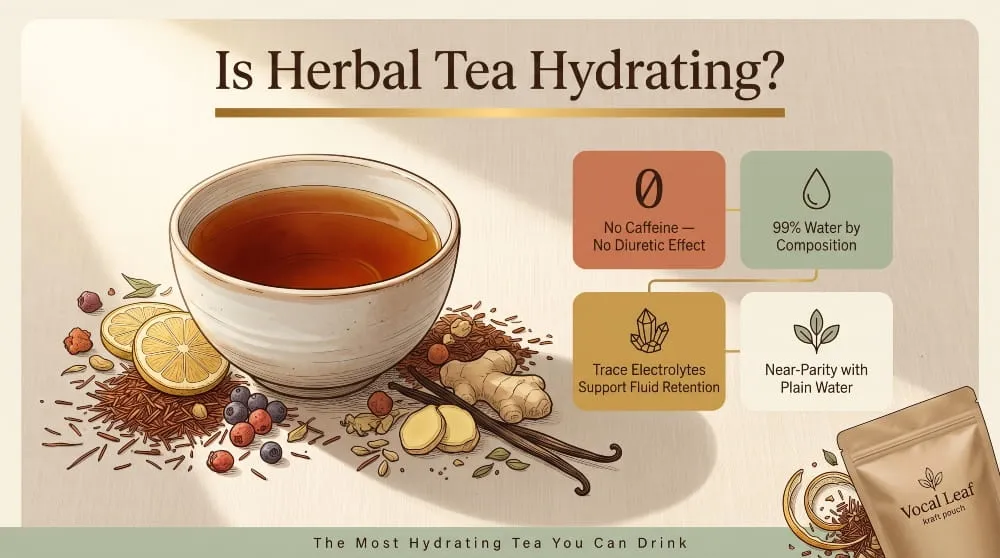
The term “herbal tea” covers a broad family of infusions made from dried botanicals: flowers, roots, berries, bark, and leaves that contain no Camellia sinensis, the plant that gives black, green, and oolong teas their caffeine. As a result, herbal teas behave differently in the body. They deliver fluid, plant compounds, and, in many cases, trace minerals without any of the mechanisms that complicate the hydration picture in caffeinated varieties.
Why Herbal Tea Is the Most Hydrating Tea You Can Drink
The answer comes down to what herbal tea doesn’t contain rather than what it does.
Every cup of brewed herbal tea is roughly 99% water. Strip away the caffeine that creates even a marginal diuretic response, and what you’re left with is a fluid that your body absorbs and retains with the same efficiency as plain water, sometimes with minor advantages layered on top. Certain herbs naturally contain minerals, such as potassium and magnesium, that play a role in cellular fluid balance. Others carry anti-inflammatory compounds that support the mucous membranes lining the throat, which matters more than most people realize for sustained comfort and vocal health.
The result is a category of drink that sits at the very top of the hydration spectrum among flavored beverages, above caffeinated tea, far above coffee, and in a different league from sugary drinks entirely. For anyone who finds plain water difficult to drink in volume, herbal tea is the most effective substitute that doesn’t compromise hydration in any measurable way.
Is Herbal Tea as Hydrating as Water?
For all practical purposes, yes. This is the conclusion that emerges consistently from nutritional research, and it’s why health authorities count herbal tea as a full and valid contribution to daily fluid intake, not a partial credit, not an approximation, but a genuine equivalent.
The slight technical distinction worth noting is that water delivers hydration with nothing alongside it. Herbal tea delivers hydration plus botanical compounds, polyphenols, antioxidants, and trace minerals that the body also needs to process. In laboratory conditions with precise measurement, this can produce marginally different absorption rates. In the context of your actual day, drinking three cups of herbal tea versus three cups of water produces outcomes your body cannot distinguish in any meaningful way.
Where herbal tea arguably has an edge over plain water, it complies. People drink more of what they enjoy. A warm, flavorful cup of herbal tea is considerably easier for many people to reach for consistently than a glass of water, and consistency is what actually drives good hydration over time. The best hydration strategy is the one you’ll follow, and for a significant portion of the population, herbal tea makes that far easier.
Is Herbal Tea More Hydrating Than Regular Tea?
In a direct comparison, yes, herbal tea has a hydration advantage over caffeinated varieties, and the reason is straightforward. Regular tea, whether black or green, contains caffeine, which has a mild diuretic effect. As established, that effect doesn’t make caffeinated tea dehydrating at normal intake levels, but it does place a small drag on net fluid retention that simply doesn’t exist with herbal tea.
Think of it as a spectrum. Plain water sits at the top. Herbal and caffeine-free teas match it almost exactly. Caffeinated teas, green, black, oolong, sit just below, still firmly in hydrating territory but with a fractional reduction in efficiency. The gap between herbal tea and regular tea is small enough that it shouldn’t change your tea habits dramatically, but if hydration is your primary goal and you’re choosing between the two, herbal tea is the cleaner choice.
There’s also a behavioral dimension worth considering. Because herbal teas are naturally caffeine-free, they can be consumed throughout the day and into the evening without affecting sleep quality or triggering a caffeine ceiling that might prompt you to stop drinking. That freedom to keep sipping throughout the day gives herbal tea a practical hydration advantage that goes beyond biochemistry.
The Best Hydrating Herbal Teas (And What Makes Them Work)
Not all herbal teas are identical in their hydrating profile, and a handful stand out for reasons that go beyond simply being caffeine-free.
Rooibos sits at the top of the list for reasons covered in more detail below. Still, the short version is this: naturally sweet, mineral-rich, and completely caffeine-free, it’s the closest thing to an ideal hydrating tea.
Lemon- and berry-based blends deliver natural vitamin C and mild fruit acids that support the immune response, and their compelling taste encourages consistent drinking throughout the day. A well-crafted lemon berry blend is something most people will reach for repeatedly, which is exactly the behavior that good hydration requires.
Ginger contributes warming compounds that stimulate circulation and promote warmth from within, making it particularly effective when you need hydration alongside soothing. It’s also one of the most researched botanicals for throat and digestive comfort.
Vanilla-forward blends offer a naturally sweet, smooth character that requires no added sugar, which matters because sugar is one of the few things that can genuinely compromise a tea’s hydrating efficiency. A high-quality vanilla herbal blend delivers palatability that keeps fluid intake consistent without the drawbacks of added sugar.
What unites all of these is the combination of zero caffeine, high water content, and enough sensory appeal to make drinking them feel like a pleasure rather than a prescription. That combination is what makes herbal tea the most reliable hydration tool in the tea category.
Is Rooibos Tea Hydrating?
Rooibos isn’t just hydrating; it’s one of the most hydrating teas you can drink, and its profile makes a compelling case for why it deserves more attention than it typically receives.
Native to the Cederberg region of South Africa, rooibos is made from the Aspalathus linearis plant. It contains no caffeine by nature, not decaffeinated, not low-caffeine, but entirely and inherently caffeine-free. That alone puts it on par with water in terms of hydration efficiency, with no diuretic effect whatsoever.
What sets rooibos apart further is its mineral content. It contains naturally occurring calcium, potassium, magnesium, and zinc, in trace amounts, but meaningful ones. Potassium and magnesium, in particular, play direct roles in electrolyte balance and cellular fluid retention, which means rooibos does something plain water doesn’t: it delivers modest cellular hydration support alongside the fluid itself.
Its flavor profile adds a practical advantage. Rooibos is naturally smooth and mildly sweet with a slight earthiness that makes it highly drinkable without any added sugar or honey. Because it requires no sweetening to be palatable, it reaches the body as a clean, efficient source of fluid, free of the complications that sugar introduces into the hydration equation.
For singers, speakers, teachers, and anyone who depends on their voice, rooibos carries an additional appeal. Its anti-inflammatory compounds, particularly aspalathin and nothofagin, which are unique to rooibos, have been shown to reduce oxidative stress and support tissue health. When consumed warm, it hydrates the body, soothes the throat, and delivers those compounds directly to the vocal tract. It is, in nearly every respect, the optimal hydrating tea.
Is Green Tea Hydrating?
Green tea occupies a particular place in the hydration conversation, partly because it’s the tea most people reach for when they’re thinking about health, and partly because its caffeine content makes the hydration question feel less settled than it actually is. The short answer is that green tea is hydrating. The longer answer explains why the caffeine in it is much less of a concern than most people assume, and where green tea sits relative to the other drinks in your daily rotation.

Does Green Tea Hydrate You or Dehydrate You?
It hydrates you. This isn’t a close call or a nuanced maybe; it’s a well-supported conclusion backed by clinical research and consistent with how the body responds to low-caffeine beverages consumed at normal volumes.
Green tea contains between 20 and 35mg of caffeine per cup, depending on steeping time and leaf grade. That’s meaningfully lower than black tea, substantially lower than coffee, and well below the threshold of around 300mg at which caffeine’s diuretic effect becomes clinically significant. When that modest amount of caffeine is dissolved in 200 to 250ml of hot water, the fluid intake overwhelmingly dominates the equation. Your kidneys process the liquid, retain the majority of it, and the net effect on your body’s fluid balance is positive.
The dehydration concern around green tea stems from a real mechanism: caffeine does have diuretic properties, but when applied incorrectly at a dose that doesn’t justify the conclusion. At the amounts present in a standard cup of green tea, the diuretic signal is too weak to outpace the hydration delivered by the water it’s brewed in. You are not dehydrating yourself by drinking green tea. You are hydrating yourself, with a small fraction of caffeine along for the ride.
Is Green Tea as Hydrating as Water?
Close enough that for most people, in most situations, the distinction is irrelevant. Research comparing hydration markers in participants who consumed moderate amounts of green tea versus plain water found no meaningful difference in outcomes; blood osmolality, urine output, and subjective hydration indicators remained comparable across both groups at normal intake levels.
The technical footnote is that green tea’s caffeine creates a marginally lower hydration efficiency than pure water in controlled laboratory conditions. But the gap is small enough that it disappears entirely in the context of a normal day. If you drink two or three cups of green tea alongside your regular meals and activities, your hydration status will be functionally identical to that of someone who drank the same volume in water.
Where green tea may have a subtle edge over plain water, though not a hydration edge specifically, is in what it delivers alongside fluid, green tea is among the most extensively researched sources of catechins, particularly EGCG, a polyphenol with well-documented antioxidant and anti-inflammatory properties. You’re not just hydrating when you drink green tea; you’re delivering compounds to the body that water simply doesn’t carry. That doesn’t make it more hydrating in the fluid-balance sense, but choosing to drink green tea instead of water is a reasonable and well-supported one.
Is Green Tea More Hydrating Than Black Tea?
Yes, marginally, and the reason is entirely caffeine content. Green tea’s lower caffeine level means a slightly weaker diuretic signal, which translates into slightly better net fluid retention compared to a cup of black tea brewed to a similar strength. In practical terms, that difference is minor. Both teas hydrate you. Both are confirmed to contribute positively to daily fluid intake at normal levels of consumption.
The more meaningful distinction between green and black tea for hydration purposes isn’t caffeine, it’s how people tend to drink them. Black tea is more commonly consumed with milk and sugar, both of which alter the drink’s composition and, in the case of sugar, can impede efficient absorption. Green tea is more typically drunk plain, which preserves its clean, hydrating profile. If you’re comparing an unsweetened green tea against an unsweetened black tea of equivalent volume, the green tea holds a small advantage. If you’re comparing a plain green tea against a heavily sweetened black tea, the gap widens considerably, not because of the caffeine, but because of what’s been added.
For daily hydration, both teas belong in the same category: genuinely hydrating, appropriate as part of a balanced fluid intake, and better choices than sugary drinks or excessive coffee.
Does Green Tea Hydrate Better Than Coffee?
Yes, and by a more comfortable margin than the green versus black tea comparison. The difference here is significant enough to be practically meaningful, not just a matter of laboratory precision.
A standard cup of coffee contains between 80 and 120mg of caffeine, depending on the brew method and roast. A cup of green tea contains 20 to 35mg. That’s roughly three to four times less caffeine for a comparable volume of liquid. Because caffeine’s diuretic effect scales with dose, coffee sits considerably closer to the threshold where fluid loss starts to offset fluid intake. At one or two cups, coffee is still net-hydrating for most people, but the margin is narrower, and it shrinks faster as consumption increases.
Green tea, by contrast, stays comfortably hydrating across a much wider range of intake. Its lower caffeine load means the fluid volume consistently wins the equation, even when you’re drinking several cups across a day. For anyone managing their caffeine intake carefully, whether for hydration reasons, sleep quality, or vocal health, green tea offers the flavor and gentle lift of a caffeinated drink without the hydration trade-off that coffee imposes at higher volumes.
The practical takeaway is simple: if coffee is your primary beverage and hydration is a concern, green tea is a direct upgrade. You keep the ritual, the warmth, and a degree of the caffeine effect, while giving your body a drink that hydrates rather than merely offsets its fluid loss.
Is Black Tea Hydrating?
Black tea is the most widely consumed tea in the world, and in most of the countries where it’s drunk, the UK, India, Ireland, Australia, it’s consumed daily, in volume, often as the primary hot beverage of the day. If black tea were genuinely dehydrating, we would have a global public health problem. We don’t. Because it isn’t.
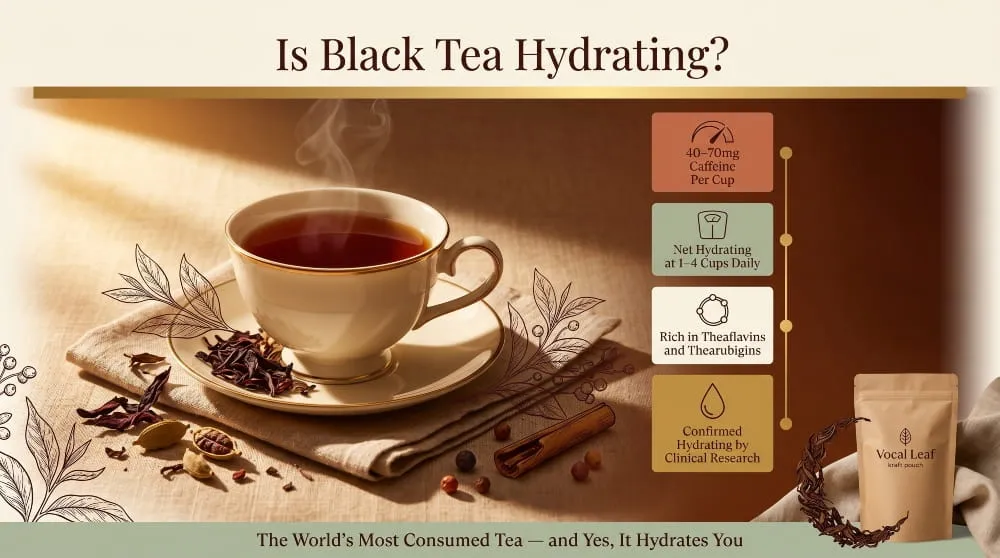
The caffeine content of black tea is higher than that of green or herbal varieties, which is where the concern originates. But higher caffeine relative to other teas is not the same as enough caffeine to cause dehydration, and the distinction matters enormously for anyone trying to understand whether their daily cup is working for them or against them.
Does Black Tea Dehydrate You?
No, not at the amounts that constitute normal tea drinking. This question has been studied directly, most notably at Loughborough University, where participants who drank black tea showed hydration markers comparable to those who consumed plain water throughout the day. The study was specifically designed to test the dehydration hypothesis regarding caffeinated tea, and the results were clear: moderate black tea consumption does not cause dehydration in healthy adults.
The concern is real, but it is overapplied. Caffeine does stimulate the kidneys to produce more urine; that’s established physiology. What’s equally established is that this effect requires a dose far in excess of what a cup or two of black tea delivers. A standard cup of black tea contains approximately 40-70mg of caffeine. The clinical threshold for measurable caffeine-induced diuresis sits at around 300mg or above. You would need to drink somewhere between five and eight strong cups of black tea in a short window to approach that level, a consumption pattern that is both uncommon and easy to avoid.
At everyday intake levels, the fluid volume in black tea dominates the caffeine’s diuretic signal. The body absorbs the liquid, processes the caffeine, and retains a net positive fluid balance. That is hydration. Claiming that black tea dehydrates at normal consumption levels is not supported by the evidence.
Is Unsweetened Black Tea Hydrating?
Unsweetened black tea is one of the more reliably hydrating caffeinated beverages. The absence of sugar is what makes it so, not because sugar suddenly makes tea dehydrating, but because sugar slows gastric emptying and alters the absorption dynamics in ways that compromise efficiency over time.
When you drink black tea without added sugar or milk, you’re consuming a liquid that is predominantly water, with a moderate caffeine load and a significant amount of polyphenols. The body processes it efficiently. The caffeine is metabolized, the polyphenols are absorbed and provide antioxidant benefit, and the fluid contributes directly to your daily hydration total. None of that changes with temperature; unsweetened iced black tea hydrates by the same mechanism as a hot cup, because the determining factors are composition, not temperature.
For anyone tracking their fluid intake seriously, athletes, performers, and people recovering from illness, unsweetened black tea is a straightforward and validated addition to daily hydration. It doesn’t require any qualification or compensatory water intake to offset it. It simply counts.
Is English Breakfast Tea Hydrating?
English Breakfast is a blend, typically combining leaves from Assam, Ceylon, and Kenya to produce a full-bodied, robust cup. Its caffeine content sits in the middle-to-upper range for black teas, generally between 50 and 75mg per cup depending on steeping time, which places it firmly within the hydrating zone at normal consumption levels.
The habits surrounding English Breakfast tea are worth addressing honestly, because they’re often where the hydration story gets complicated. Drunk plain, it hydrates effectively. Drunk with a splash of milk, it still hydrates. Milk contributes fluids, protein, and electrolytes, none of which harm hydration. Drunk with sugar, efficiency drops slightly as sugar slows absorption. Drunk with both milk and two sugars, as a significant portion of the population prefers it, it remains net-hydrating but is no longer the clean, efficient fluid that unsweetened tea provides.
The tea itself is hydrating. What you add to it shapes how hydrating it actually is in the cup you’re drinking. For anyone using their voice professionally, singers, teachers, speakers, the milk question carries a separate consideration beyond hydration: dairy can increase mucus production in some individuals, which affects vocal clarity regardless of fluid balance. But from a pure hydration standpoint, English Breakfast tea, in all its common variations, contributes positively to daily fluid intake.
Black Tea vs Water for Hydration
Water wins on efficiency, cleanliness, and simplicity, without argument. It hydrates with zero variables, no caffeine to metabolize, and no compounds to process alongside it. That is its advantage, and it’s a real one.
Black tea sits just behind it. Not dramatically behind, not in a way that would register as a meaningful shortfall in your daily life, but behind nonetheless. Caffeine introduces a mild drag on net fluid retention that water doesn’t. In clinical measurements, the gap is small. In practice, it’s even smaller.
Where the comparison becomes more interesting is when you account for what black tea brings to the exchange that water doesn’t. Black tea is one of the richest dietary sources of theaflavins and thearubigins, polyphenols formed during oxidation that give black tea its color and depth. These compounds carry antioxidant and anti-inflammatory properties that plain water cannot replicate. You are not choosing between hydration and health benefits when you choose black tea over water. You are choosing slightly less optimized hydration in exchange for a drink that delivers additional value alongside the fluid.
For most people, most of the time, that trade is worth making. Drink water when you need efficient rehydration, after exercise, first thing in the morning, or during illness. Drink black tea when you want the warmth, the flavor, the ritual, and the polyphenol benefit of a drink that also, meaningfully and measurably, keeps you hydrated.
Is Iced Tea Hydrating?
Temperature is one of the least relevant factors in the hydration conversation. Yet, iced tea attracts more skepticism than its hot counterpart, as if chilling a brewed tea fundamentally changes how the body processes it. It doesn’t. The hydrating effect of tea is determined by its composition, not how cold it is when you drink it. Whether you’re reaching for a glass over ice on a warm afternoon or sipping a hot cup in the morning, the fluid your body receives and retains is governed by the same variables: caffeine, sugar, and overall volume consumed.

That said, iced tea comes in a wider range of forms than hot tea typically does, from unsweetened loose leaf brewed cold to heavily sweetened bottled versions with artificial flavoring, and those variations do matter for hydration in ways worth understanding clearly.
Does Iced Tea Hydrate You as Well as Water?
Unsweetened iced tea hydrates you as well as water in practical terms, just as unsweetened hot tea does. The mechanism is identical: the liquid is absorbed by the body, the caffeine, if present, is metabolized at a level too low to cause measurable fluid loss, and the net effect on hydration is positive. Studies examining tea’s contribution to daily fluid intake make no meaningful distinction between hot and iced preparation. The body doesn’t care about temperature when processing fluid; it cares about composition.
Where iced tea begins to diverge from water is almost always a matter of what’s been added to it rather than anything inherent to the cold brew process itself. A glass of unsweetened iced black tea performs nearly identically to a hot cup of the same tea. A glass of unsweetened iced herbal tea matches water almost exactly. The preparation method doesn’t change the physics of hydration. The ingredients do.
Is Unsweetened Iced Tea Hydrating?
Unambiguously yes, and it’s worth saying this plainly, because unsweetened iced tea is often lumped together with sweetened bottled versions in conversations about hydration, which does it a genuine disservice.
Unsweetened iced tea, whether brewed hot and chilled or cold-steeped overnight, is essentially water infused with tea compounds. It contains no sugar to slow absorption, no additives to complicate the fluid balance, and, if it’s an herbal or caffeine-free variety, no caffeine either. Brewed from high-quality loose-leaf ingredients and drunk without sweetener, it is one of the cleanest and most effective hydrating drinks available. It counts fully toward daily fluid intake, requires no compensatory plain water to offset it, and delivers whatever botanical benefits the base tea carries alongside the hydration.
Cold steeping in particular produces a brew that tends to be lower in caffeine than hot brewing; the extraction of caffeine is less efficient at cold temperatures, which pushes unsweetened cold-brewed tea even closer to the hydration profile of herbal varieties. For anyone looking to maximize hydration from their tea habit, cold-brewing an herbal or lightly caffeinated blend and drinking it throughout the day is one of the most effective strategies available.
Is Sweet Tea Hydrating, or Does Sugar Work Against You?
Sweet tea occupies a middle ground worth honestly examining rather than dismissing outright. It is still hydrating; the fluid volume in a glass of sweet tea is substantial, and the body does absorb and use it. But the sugar it contains introduces factors that compromise hydration efficiency, with effects that accumulate over time.
Sugar draws water into the digestive tract by osmosis during absorption, slowing gastric emptying and delaying the rate at which fluid becomes available to the body’s tissues. At moderate sugar levels, a teaspoon or two, this effect is minor and unlikely to register in any practical way. At the sugar concentrations found in heavily sweetened sweet tea or commercially bottled iced tea, the effect becomes more meaningful. High sugar content means slower absorption, greater demand on the digestive system, and, in large quantities, a net pull on fluid from other tissues to manage the sugar load.
The distinction matters most at the extremes. A lightly sweetened iced tea, made at home with a small amount of honey or sugar, hydrates you well, and the sugar impact is negligible. A 500ml bottle of commercially sweetened iced tea containing 30g or more of sugar is a different proposition entirely. It will still contribute some fluid, but its efficiency as a hydration source is genuinely compromised. If hydration is the goal, the sweetness is working against you rather than with you, and unsweetened is always the better choice.
Iced Tea Hydration Percentage: What the Numbers Show
Brewed tea, hot or iced, is approximately 99-99.5% water by composition. That number alone tells most of the story. When you drink a 300ml glass of unsweetened iced tea, you are consuming roughly 297-298ml of water alongside a small amount of tea solids, trace minerals, and caffeine or botanical compounds, depending on the type.
The hydration percentage of iced tea relative to plain water is estimated at around 95-100% for unsweetened caffeinated varieties and effectively 100% for caffeine-free herbal iced teas. That margin narrows as sugar content rises. Lightly sweetened versions drop to roughly 85-90% hydration efficiency relative to water. Heavily sweetened commercial iced teas, particularly those with added sugar exceeding 25 to 30 grams per serving, can fall to 70% or below, at which point the drink is doing meaningful hydration work but at a significantly reduced efficiency compared to what the volume alone would suggest.
The takeaway from the numbers is consistent with everything else in this section: the tea itself is not the variable. Iced tea, as a preparation method, is as hydrating as the drink deserves to be, given what’s in it. Strip away the sugar, and you have a highly efficient hydrating drink. Add it back in the same quantity, and you’re trading hydration efficiency for sweetness. That trade-off is a personal choice, but it’s better made with clear information than on the assumption that all iced tea behaves the same.
Is Hot Tea Hydrating?
The question of whether hot tea hydrates you is, at its core, a question about temperature, and temperature, as established with iced tea, is not what determines how well a drink hydrates you. What your body absorbs, retains, and uses for fluid balance is governed by composition. The heat of the liquid as it enters your mouth changes the drinking experience considerably. It changes the hydration outcome very little.

And yet hot tea deserves its own examination, because the way people drink it, the contexts in which they reach for it, and what it does beyond simple fluid delivery make it a meaningfully different choice from cold tea in ways that matter, particularly for anyone managing vocal health, recovering from illness, or simply trying to stay hydrated through a cold day when a glass of water holds no appeal.
Does Drinking Hot Tea Hydrate You?
Yes, in the same way and by the same mechanism as any other form of tea. The body receives fluid, absorbs it through the gastrointestinal tract, and distributes it to tissues. Caffeine, if present, exerts its modest, well-documented non-dehydrating effect. Botanical compounds are absorbed alongside the fluid. The net result is positive hydration.
What changes with heat is the rate at which you drink. Hot tea is sipped slowly by necessity, which means fluid intake is distributed over a longer window rather than consumed quickly. This is actually a mild advantage for sustained hydration; slower, more consistent fluid intake tends to support better absorption and retention than rapid, large-volume intake. The body processes fluid more efficiently when it arrives at a manageable pace, and the temperature of hot tea naturally enforces that pace without any conscious effort.
There is also a psychological dimension that shouldn’t be dismissed. People who drink hot tea tend to drink it deliberately, as a ritual, a pause, a moment of attention. That intentionality means the cup usually gets finished. A glass of cold water left on a desk often doesn’t. From a hydration standpoint, the best drink is the one that actually gets consumed, and hot tea has a strong record on that front.
Hot Tea vs. Cold Water: Which Hydrates Better?
Cold water has a slight edge in one specific context: speed of rehydration after physical exertion. Cold liquids empty from the stomach faster than warm ones, which means they reach the small intestine, where the majority of fluid absorption occurs, more quickly. In the immediate aftermath of exercise or during heat stress, when rapid fluid replacement is the priority, cold water or cold electrolyte drinks are the more targeted tools.
Outside of that context, the comparison is far closer than most people expect. For everyday hydration, the kind that happens across the course of a normal day at a desk, in a classroom, in a studio, hot tea and cold water deliver comparable hydration outcomes. The fluid volume reaches the body either way. The slightly slower gastric emptying of a warm drink doesn’t create a meaningful shortfall when you’re not operating under physiological stress that demands rapid fluid replacement.
Where hot tea genuinely outperforms cold water is in conditions that call for more than fluid alone. When you’re unwell, a hot drink is easier to consume consistently than cold water, which many people find unpleasant when their throat is already irritated. When the temperature is cold, and the instinct is to minimize fluid intake, a warm cup provides comfort that helps maintain hydration. When vocal health is the concern, warm liquid does something cold water doesn’t: it relaxes the musculature surrounding the larynx, promotes circulation to the vocal folds, and maintains the warmth that keeps the throat pliable and comfortable. In those situations, hot tea doesn’t just match cold water for hydration. It exceeds it as an overall choice.
Is Hot Herbal Tea More Hydrating Than Iced Tea?
When comparing like-for-like, the same herbal blend, one served hot, and one served cold, the hydration outcome is essentially identical. The composition is the same, the caffeine content is zero in both cases, and the body absorbs the fluid from either preparation with comparable efficiency. On paper, the difference is negligible.
In practice, the comparison shifts depending on what type of iced tea you’re measuring against. Hot herbal tea brewed from quality botanicals and drunk plain is directly comparable in hydration to unsweetened herbal iced tea brewed the same way. But the iced tea category as a whole includes a much wider range of products, many of which are sweetened, artificially flavored, or processed in ways that compromise their hydrating efficiency. Hot herbal tea, almost by definition, tends to be made simply: botanicals, hot water, nothing added. That simplicity works in its favor.
For vocal health specifically, hot herbal tea holds a clear advantage over iced tea regardless of hydration equivalence. Cold drinks cause mild vasoconstriction in the throat. They can temporarily tighten the muscles involved in vocal production. This concern matters little for casual hydration but is significant for performers, teachers, and speakers who need their voices to function optimally throughout the day. Warm herbal tea keeps those tissues relaxed, the vocal tract comfortable, and hydration consistent in a way that a cold drink, however well-formulated, simply cannot replicate. The hydration itself may be equal. The functional outcome for the voice is not.
Is Decaf Tea Hydrating?
Decaf tea exists in a quiet corner of the hydration conversation, rarely the first thing people ask about, but consistently relevant for anyone who loves tea and wants to drink more of it without the caffeine. The question of whether decaf tea hydrates you is one of the more straightforward ones in this entire guide, and the answer is about as clean as it gets.

Yes. Decaf tea is hydrating, and hydrating well, sitting closer to plain water on the efficiency scale than any caffeinated tea variety. The decaffeination process removes the one compound that introduces even a marginal diuretic effect, leaving what remains essentially flavored water with a rich complement of polyphenols and botanical compounds. There is no meaningful caveat to attach to it, no threshold to stay below, and no compensatory plain water required to offset it.
Does Decaf Tea Hydrate as Well as Water?
For practical purposes, yes, and the reasoning is direct. Decaffeination reduces caffeine content to trace levels, typically 2-5mg per cup, depending on the method used. That’s a quantity so small it has no measurable diuretic effect whatsoever. The body processes decaf tea as it would any other warm fluid. It absorbs the liquid, retains the majority of it, and the net contribution to daily fluid balance is positive and essentially equivalent to drinking the same volume of plain water.
The technical footnote that applied to caffeinated teas, that a marginally lower hydration efficiency exists in laboratory conditions due to caffeine’s mild diuretic influence, disappears almost entirely with decaf. What remains is a brewed drink that is 99% water by composition, delivers the flavor and warmth of tea without the caffeine load, and counts fully toward daily fluid intake by any reasonable nutritional standard.
For people who want to keep drinking tea into the evening, during periods of caffeine sensitivity, or simply in greater volume than caffeinated options allow, decaf tea is not a compromise. It’s a straightforward solution that delivers genuine hydration without the variables that make caffeinated tea a slightly more complex calculation.
Is Decaf Green Tea or Decaf Black Tea More Hydrating?
The honest answer is that the difference is negligible, and the reasoning that would apply to their caffeinated counterparts no longer holds in the same way once caffeine is removed from the equation.
When comparing regular green tea and regular black tea for hydration, the distinction came down to caffeine content: green tea’s lower caffeine level gave it a marginal advantage. Remove the caffeine from both, and that distinction evaporates. Decaf green tea and decaf black tea both arrive at roughly the same caffeine floor, trace amounts below 5mg, which means neither exerts a meaningful diuretic effect. Both hydrate you with essentially the same efficiency.
Where a difference does remain is in the polyphenol profile, which has implications for health benefits but not for fluid balance directly. Decaf green tea retains a significant portion of its catechins, particularly EGCG, though the decaffeination process slightly reduces their concentration. Decaf black tea holds onto its theaflavins and thearubigins, the oxidation compounds that give black tea its character, in proportions that vary with the decaffeination method used. Neither of these differences affects how well the drink hydrates you. They affect what else the drink does for you, in addition to hydration.
If your primary goal is hydration, choose whichever you prefer to drink, because the one you’ll reach for consistently is the better hydration strategy, regardless of which sits marginally ahead on paper.
Is Caffeine-Free Tea the Same as Decaf Tea for Hydration?
This is a distinction worth making because the two terms are often used interchangeably, even though they describe meaningfully different things.
Decaf tea starts as a regular tea, typically black or green, and undergoes a process to remove most of its naturally occurring caffeine. The methods vary: carbon dioxide extraction, ethyl acetate processing, and the Swiss Water Process are the most common. Each removes caffeine to varying degrees and affects the remaining compounds differently, but all result in a tea that originally contained caffeine and has had most of it removed. Trace amounts remain.
Caffeine-free tea, by contrast, never contained caffeine to begin with. Herbal teas, including rooibos, ginger, lemon, berry blends, and vanilla-based infusions, are made from botanicals naturally free of caffeine. There is nothing to remove because there was nothing there in the first place. The result is a drink with a genuinely zero caffeine profile, not a trace-level one.
For hydration, this distinction translates into a small but real difference. Caffeine-free herbal teas sit at the very top of the hydration spectrum among teas, matching water almost exactly, with no residual caffeine whatsoever. Decaf teas sit just behind them, not because their trace caffeine causes meaningful dehydration, but because the floor isn’t quite as clean. In practice, both are excellent hydrating choices, and the gap between them is unlikely to register in any perceptible way during a normal day.
The more important implication of this distinction is behavioral. Because truly caffeine-free herbal teas contain no caffeine, they can be consumed at any time of day or night without concern for caffeine accumulation, sleep disruption, or daily intake limits. Decaf teas, while very low in caffeine, are not entirely without it, a consideration that matters for people with genuine caffeine sensitivity, those managing certain health conditions, or anyone drinking in very high volume. For most people, the difference is academic. For those who care, it’s worth knowing.
The Most Hydrating Teas, Ranked
Not all teas hydrate equally. The differences aren’t dramatic enough to make any tea a bad choice. Still, they’re real enough to matter if you’re choosing deliberately, whether for vocal health, athletic recovery, daily wellness, or simply trying to stay consistently hydrated without relying on plain water alone.
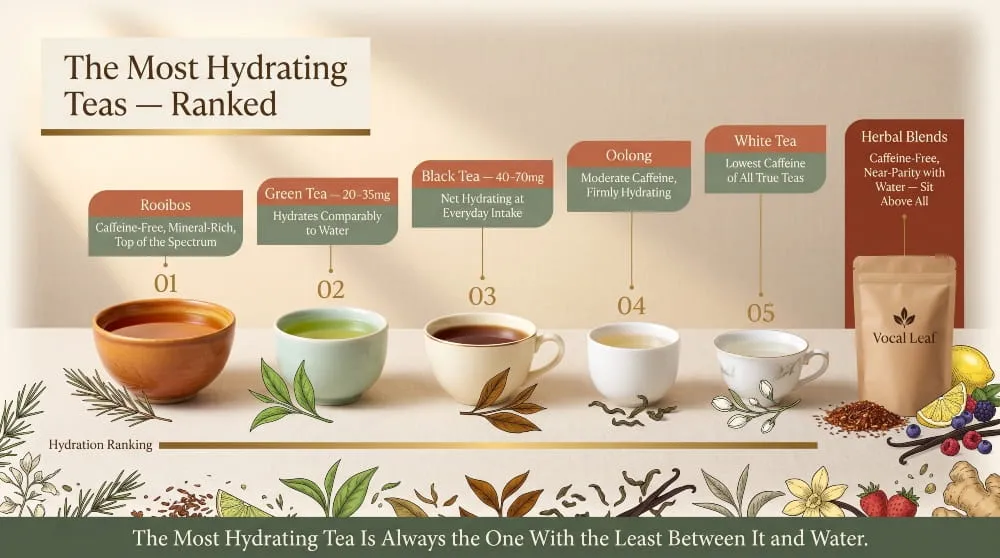
The ranking below is built on three variables: caffeine content, sugar content, and botanical composition. Caffeine introduces a mild diuretic effect that reduces net fluid retention. Sugar slows gastric absorption and compromises efficiency at higher concentrations. And certain botanical compounds, minerals, electrolytes, and anti-inflammatory agents actively support fluid balance rather than simply delivering water. Together, those three factors determine where a tea sits on the hydration spectrum.
What Is the Most Hydrating Tea You Can Drink?
The most hydrating teas share a common profile: naturally caffeine-free, botanically rich, and drinkable without a sweetener. That combination puts herbal and caffeine-free teas at the top of the ranking, with rooibos consistently standing out as the single strongest performer when all variables are considered together.
The full ranking, from most to least hydrating among common tea types, runs approximately as follows: rooibos and caffeine-free herbal blends at the top, followed by decaf varieties, then white tea, then green tea, then oolong, then black tea. Fruit teas and lemon ginger blends sit at the high end of herbal teas when unsweetened, but drop considerably when sugar is added. Chai, depending on preparation, occupies a middle position for reasons the section below addresses in detail.
Is Rooibos Tea the Most Hydrating?
By any reasonable measure, rooibos is the most hydrating tea available, and the case for that position goes beyond being caffeine-free.
Rooibos is naturally caffeine-free, which already places it near-parity with water on the hydration efficiency scale. But what distinguishes it further is its mineral content. Rooibos contains naturally occurring trace amounts of calcium, potassium, magnesium, and zinc, which contribute to electrolyte balance and support fluid retention at the cellular level. This is something plain water doesn’t offer and something most other teas don’t provide in any significant quantity.
Its flavor profile adds a practical advantage that compounds over time. Rooibos is naturally smooth and mildly sweet, drinkable without honey, sugar, or any other additions that would compromise its hydrating properties. That means it arrives in the body as a clean, unencumbered source of fluid, with minerals alongside it, and nothing working against its absorption. For singers, speakers, and performers who need reliable vocal hydration across long days, it delivers warmth, anti-inflammatory botanicals, and efficient hydration in a single cup. It is, across every metric that matters for hydration, the strongest performing tea in the category.
Is Ginger Tea Hydrating?
Ginger tea is hydrating, and it earns its place near the top of the ranking on the strength of one straightforward fact: when brewed from fresh or dried ginger root without added sugar, it contains no caffeine and no compounds that compromise fluid absorption. The body receives it as warm, botanical-rich fluid and processes it accordingly.
What ginger adds beyond hydration is what makes it genuinely interesting. Ginger’s active compounds, primarily gingerols and shogaols, have well-documented anti-inflammatory and circulatory effects. Consumed warm, ginger tea promotes blood flow, soothes the throat, and supports the digestive system in ways that make it a particularly functional hydrating choice when you’re unwell, vocally fatigued, or simply needing something that does more than deliver fluid. It hydrates you and works for you simultaneously, a combination that makes it worth reaching for deliberately rather than by default.
Is Chai Tea Hydrating?
Chai is hydrating, but its ranking depends almost entirely on how it’s prepared, making it one of the more variable entries on this list.
Traditional chai is a spiced black tea blend, which means it carries the caffeine load of black tea, typically 40 to 70mg per cup, and the corresponding mild diuretic consideration. That alone places it below herbal varieties in hydration efficiency. But the more significant variable in most chai preparations is what gets added: milk, sugar, and sweetened syrups are common, and each addition shifts the hydration profile in ways that matter at scale.
A chai brewed with quality spices, steeped in water, and drunk without sweetener is a solid, caffeinated, meaningfully hydrating choice at one or two cups per day. A heavily sweetened chai latte made with a large volume of flavored syrup is a different drink entirely, delivering hydration at considerably reduced efficiency. Rooibos chai, brewed from the same spice profile but on a caffeine-free rooibos base, is worth mentioning here as the version that captures everything appealing about chai while delivering the hydration profile of an herbal tea. It is the stronger choice for anyone prioritizing hydration within the chai category.
Is Oolong Tea Hydrating?
Oolong sits in the middle of the hydration ranking among caffeinated teas, above black tea, below green tea, and well within hydrating territory at normal daily consumption. Its caffeine content typically falls between 30 and 50mg per cup, depending on oxidation level and steeping time, placing it between green and black tea on the caffeine spectrum.
The hydration story for oolong mirrors the broader caffeinated tea story: the fluid volume dominates the caffeine’s diuretic signal at everyday intake levels, and the net effect on fluid balance is positive. Oolong also carries a distinctive polyphenol profile that reflects its partial oxidation, a blend of the catechins found in green tea and the theaflavins characteristic of black tea, which gives it both the hydrating efficiency of a moderate-caffeine drink and a compound profile with genuine antioxidant value.
For anyone who drinks oolong regularly, the hydration contribution is real and reliable. It won’t match rooibos or herbal teas, but it outperforms coffee comfortably and holds its own against other caffeinated teas as a daily hydration source.
Is White Tea Hydrating?
White tea is one of the better hydrating options among caffeinated teas, and the reason is simple: it contains the least caffeine of any true tea. White tea is the least processed variety of Camellia sinensis, made from young leaves and buds that are simply dried rather than rolled, oxidized, or fired. Minimal processing preserves a delicate flavor while keeping caffeine content low, typically between 15 and 30mg per cup.
That low caffeine level means white tea sits closer to the decaf end of the caffeinated spectrum for hydration purposes. The diuretic signal is minimal, the fluid volume absorbed is high, and the net hydration contribution is strong. White tea also retains a high concentration of catechins relative to more processed teas, since the compounds haven’t been altered by heat or oxidation, which adds antioxidant value alongside the hydration benefit.
For anyone who wants the gentle presence of caffeine without compromising hydration, white tea is one of the most effective choices in the caffeinated category. It sits comfortably at the top of that group, just below the caffeine-free tiers.
Is Fruit Tea Hydrating?
Fruit tea sits at opposite ends of the hydration spectrum, depending entirely on its form, which makes it one of the most important categories to understand before reaching for it as a hydration strategy.
Fruit tea brewed from dried fruit pieces, hibiscus, rosehip, or berry botanicals and consumed without added sugar is naturally caffeine-free and highly hydrating. The botanical compounds give it vivid color and flavor without introducing any variables that compromise fluid absorption. In this form, fruit tea belongs alongside herbal teas at the top of the ranking, a clean, efficient, enjoyable, hydrating drink that counts fully toward daily fluid intake.
The category shifts dramatically when a sweetener is introduced. Fruit teas are frequently the base for heavily sweetened ready-to-drink products, flavored iced teas, and fruit-flavored tea drinks that carry significant sugar loads. In those forms, the underlying tea may be hydrating, but the sugar content works against efficient absorption in the ways covered throughout this guide. The distinction between a fruit-based herbal infusion drunk plain and a fruit-flavored, sweetened tea drink is between one of the most hydrating things you can consume and a beverage that compromises its own hydration potential.
Is Lemon Ginger Tea Hydrating?
Lemon ginger tea is hydrating, caffeine-free, and, when made simply from lemon and ginger without added sugar, one of the cleanest hydrating options in the entire tea category. It combines the benefits of ginger’s anti-inflammatory and circulatory properties with the vitamin C and natural acidity of lemon, producing a drink that is both highly effective at delivering fluid and genuinely functional for throat health and immune support.
The lemon component deserves particular mention for its vocal hydration benefits. Lemon’s natural acidity stimulates saliva production, which contributes to oral and throat moisture in a way that plain water doesn’t replicate. For singers, teachers, podcasters, and speakers, the additional mucosal stimulation and fluid intake make lemon ginger tea a specifically targeted hydration choice rather than a generic one.
The caveat, as with fruit teas, is the use of a sweetener. Lemon ginger tea is often drunk with honey, a natural and reasonable addition that provides mild antimicrobial benefits for the throat. A small amount of honey has a negligible impact on hydration efficiency and is generally a sound choice. A large shift in the sugar dynamic is enough to matter. Used lightly, honey preserves the hydrating value of lemon ginger tea while adding a layer of throat-soothing benefit. Used heavily, it begins to work against the very hydration the tea is meant to deliver.
Hydrating Teas for Vocal Health, The Vocal Leaf Perspective
Most hydration advice treats the body as a single system with a single need: fluid. Drink enough, stay hydrated, carry on. For the average person managing a desk job and a moderate activity level, that framework is sufficient. For singers, speakers, teachers, podcasters, and performers, it misses something important, because vocal hydration operates on two levels simultaneously, and understanding both changes which teas you reach for and how you use them.
Why Vocal Hydration Is Different From General Hydration
The vocal folds are among the most delicate and mechanically demanding tissues in the human body. They vibrate hundreds of times per second during speech and singing, and they depend on a precise moisture balance to do so without strain, fatigue, or injury. That moisture comes from two sources: systemic hydration, the fluid circulating through your bloodstream and tissues as a result of what you drink, and surface hydration, the thin mucous layer that coats the vocal folds directly and keeps them pliable during vibration.
Systemic hydration takes time. A glass of water or a cup of tea drunk now reaches the vocal folds as tissue fluid roughly twenty to thirty minutes later, after absorption through the gastrointestinal tract and distribution through the circulatory system. This is why singers are told to hydrate well in advance of a performance, not five minutes before stepping on stage. It also means that consistent, all-day hydration, rather than large volumes consumed in short bursts, is the approach that actually supports vocal fold health.
Surface hydration is more immediate but also more fragile. It is maintained partly by systemic hydration, partly by the warmth and humidity of the air passing over the vocal tract, and partly by the direct contact of warm liquid with the mucosal lining of the throat. This is where hot tea earns its specific advantage over cold drinks: the warmth promotes blood flow to the surrounding tissues, maintains the mucosal layer through steam and direct contact, and keeps the muscles of the larynx relaxed in a way that cold water actively works against. Cold drinks cause mild vasoconstriction in the throat. Warm tea does the opposite, and for a performer mid-show or a teacher mid-lesson, that difference is felt immediately.
Vocal hydration also demands consistency in a way that general hydration doesn’t. A normally active person who forgets to drink for two hours and then catches up manages fine. A singer or speaker who lets hydration slip during a long performance day compounds fatigue in the vocal folds hour by hour, and no amount of catching up before curtain time fully corrects it. The goal is sustained, steady fluid intake of warm, clean, botanical-rich tea throughout the day, and that goal shapes every product and recommendation that follows.
Which Vocal Leaf Teas Are Best for Staying Hydrated
Vocal Leaf’s four teas were each developed with the vocal performer in mind, which means they were designed to support hydration without introducing anything that works against it, no excessive caffeine, no added sugars that compromise absorption, no ingredients known to increase mucus production or irritate the vocal tract.
Lemon Berry Dream is the most immediately vocal-specific blend in the range. The lemon component stimulates saliva production, contributing to oral and throat moisture in a way that plain hot water doesn’t replicate. The berry botanicals bring natural vitamin C and antioxidant compounds that support tissue health and immune resilience, both of which matter for performers who cannot afford to lose their voice to illness or inflammation. It is caffeine-free, meaning it can be consumed throughout the full performance day without caffeine accumulation, and naturally flavorful enough to drink without a sweetener, preserving its hydrating efficiency.
Organic Rooibos Chai brings together the hydration benchmark of the tea category, rooibos, with the warming, circulatory benefits of traditional chai spices. Ginger and cinnamon promote blood flow and reduce throat inflammation. Rooibos provides calcium, potassium, and magnesium, along with its caffeine-free fluid base. The result is a tea that hydrates at the highest level the category offers while actively supporting the tissues of the vocal tract. For performers who need warmth, comfort, and genuine throat support across long days, this is the blend that works hardest.
Vanilla Bliss addresses the part of vocal hydration that is easy to overlook: palatability under pressure. When you are rehearsing for hours, teaching back-to-back classes, or recording long podcast sessions, the tea you actually finish consistently matters more than the tea with the most impressive compound profile that sits half-drunk beside you. Vanilla Bliss is smooth, naturally sweet, and completely without caffeine, qualities that make it the easiest tea in the range to drink throughout the day without deliberate effort. Its mild, comforting character makes consistent hydration feel like a pleasure rather than a chore.
Organic Loose Leaf Black Tea is the considered choice for performers who need caffeine throughout the day, focused energy before a performance, and/or the morning cup that anchors a long teaching schedule. Organic black tea is genuinely hydrating at moderate intake, and its polyphenol content, theaflavins and thearubigins, contributes to anti-inflammatory benefits that support vocal tissue health over time. The practical guidance is to position it earlier in the day and transition to caffeine-free blends as the day progresses, so that total caffeine intake stays within the range where hydration remains consistently positive.
How to Use Loose Leaf Tea for All-Day Vocal Hydration
The strategy for vocal hydration is built on two principles: consistency and timing. Flood and drought patterns, large volumes consumed rarely, don’t serve the vocal folds. A steady, moderate intake of warm tea maintained across the waking day does.
Start before the voice is called upon. A cup of Lemon Berry Dream or Organic Rooibos Chai, thirty to forty-five minutes before a performance, a lesson, or a recording session, gives systemic hydration time to reach the vocal folds at the tissue level. This is the window most performers neglect, reaching for tea as they walk onto the stage rather than as they prepare for the day, and it’s the one that makes the most difference to how the voice feels under pressure.
Brew loose leaf rather than bags where possible. Loose leaf tea extracts more fully from the leaf, delivering a richer concentration of the botanical compounds that make each blend functional, not just flavorful. It also gives you control over steeping time and temperature, both of which affect caffeine extraction and the concentration of beneficial polyphenols. A quality loose-leaf blend, steeped correctly, gives you more of what you’re drinking for in every cup.
Keep a thermos with you throughout the day. The behavioral dimension of vocal hydration is as important as the biochemical one. A thermos filled with your tea of choice, warm, accessible, requiring no effort to access, removes the friction between intention and action. Performers who carry their tea through rehearsals, classes, and long recording days consistently report better vocal endurance and faster recovery from fatigue than those who rely solely on water, consumed reactively.
Transition to caffeine-free blends in the afternoon. If your day includes organic black tea in the morning, move to Vanilla Bliss or Rooibos Chai by midday. This keeps caffeine intake at a level where hydration remains uncompromised while ensuring the ritual of warm tea, and the sustained mucosal benefit it provides, continues through the hours when the voice is working hardest.
The voice rewards consistency. So does the habit of reaching for the right loose-leaf tea throughout the day, not as a performance-day intervention, but as the daily practice that makes performance possible.
How to Stay Hydrated With Tea: Practical Tips
Understanding the science of tea and hydration is useful. Knowing how to apply it across a real day is where it actually becomes valuable. The gap between knowing that tea hydrates you and building a tea habit that keeps you consistently hydrated is a practical one, and it’s closed not by drinking more, but by drinking smarter.
Can You Drink Tea Instead of Water for Hydration?
For most healthy adults at normal activity levels, yes, tea can form the foundation of daily fluid intake without compromising hydration status. Health authorities in the UK and Europe have confirmed this position for years, and the research supports it: people who rely heavily on tea as their primary beverage maintain normal hydration markers without needing to supplement substantially with plain water.
The practical answer carries a few sensible qualifications. Unsweetened tea, herbal, green, black, or any caffeine-free variety, substitutes for water most cleanly, because nothing in the cup works against the fluid it’s delivering. Sweetened teas, as covered elsewhere in this guide, reduce hydration efficiency at higher sugar concentrations, which means they function less well as a water substitute the sweeter they get. And in situations of acute physiological demand, intense exercise, illness with fever, extreme heat, plain water and electrolyte drinks remain the more targeted tools for rapid rehydration.
For the vast majority of daily life, though, choosing tea over water is a reasonable and well-supported decision. You are not shortchanging your body. You are hydrating it with flavor, warmth, and botanical compounds, along with the fluid.
How Much Tea Do You Need to Stay Hydrated?
The standard guidance on daily fluid intake, approximately 2 liters for women and 2.5 liters for men, according to European Food Safety Authority recommendations, refers to total fluid from all sources, not water specifically. Tea counts toward that total in full, and for someone who drinks three to four substantial cups of unsweetened tea across the day, a meaningful portion of that target is already met.
Practical math works like this: a standard mug holds roughly 250-300ml. Four mugs over a day add up to approximately 1 liter of fluid from tea alone. Alongside the water present in food, which accounts for roughly 20 to 30% of daily fluid intake for most people, and any other beverages consumed, a consistent four-cup tea habit brings most people comfortably within their daily hydration range.
The number shifts upward with physical demand. On days involving exercise, heat exposure, heavy vocal use, long teaching days, performances, or extended recording sessions, fluid needs rise, and the volume of tea required to keep pace with them increases. The body’s signals are reliable guides here: thirst is a meaningful prompt, and urine color remains the most practical at-a-glance hydration check available. Pale straw yellow indicates good hydration. Darker shades indicate the need for more fluid, regardless of how much tea you think you’ve had.
The Best Time of Day to Drink Tea for Maximum Hydration
Hydration is not a goal you achieve once and carry through the day. It’s a state you maintain by consistently replacing the fluid your body expends through normal functions such as breathing, circulation, and temperature regulation at a rate that keeps pace with demand. That means the timing and distribution of your tea intake matters as much as the total volume.
The morning window is where most people have the largest hydration deficit. You’ve gone seven or eight hours without fluid, breathing, sweating mildly through the night, and waking with tissue hydration already depleted. A cup of tea within the first thirty minutes of waking begins restoring that deficit and sets the tone for consistent intake through the day. For vocal performers and speakers, this first cup carries additional importance: the vocal folds have been at rest for hours, the mucosal layer has thinned overnight, and warm fluid, consumed before any significant vocal demands, begins restoring tissue moisture well before it’s needed.
Mid-morning and early afternoon are the highest-value windows for caffeinated tea, if that’s part of your routine. Caffeine’s alertness benefit peaks in the hours after consumption; hydration from the brew is delivered alongside it, and early consumption leaves sufficient time for any mild diuretic effects to resolve before the evening.
The afternoon and evening benefit most from a transition to caffeine-free blends. Not because caffeine suddenly becomes dehydrating after 3 pm, it doesn’t, but because caffeine consumed in the later hours of the day can disrupt sleep quality, and sleep disruption compromises overnight recovery, including vocal fold recovery. A warm herbal or rooibos blend in the afternoon and evening keeps the hydration consistent, the vocal tract comfortable, and the body’s recovery processes uninterrupted. It is the simplest habit shift that pays off across every dimension of vocal and overall health.
Does Adding Sugar Reduce Tea’s Hydrating Effect?
Yes, and the degree to which it does depends on how much sugar you add, not whether you add it at all.
A small amount of sugar, a teaspoon of honey, or a light sprinkle of cane sugar has a negligible effect on tea’s hydrating efficiency. The osmotic impact on gastric absorption is minimal at that level, the body handles it easily, and the tea performs essentially the same as an unsweetened cup. This is reassuring for anyone who finds plain tea difficult to drink and relies on a small amount of sweetener to keep their daily intake consistent. A lightly sweetened cup you’ll actually drink is a better hydration strategy than an unsweetened cup you’ll leave half-finished.
The story changes as sugar content rises. At higher concentrations, the kind present in heavily sweetened homemade iced teas or commercially bottled varieties, sugar begins to draw water into the digestive tract through osmosis, slowing gastric emptying and delaying the rate at which fluid reaches the body’s tissues. The tea is still providing some hydration, but less efficiently than the volume alone would suggest. At very high sugar loads, the body may actually require additional fluid to process the sugar, which works directly against the drink’s hydration purpose.
The practical guidance is simple: use sweetener sparingly if needed, and treat it as a palatability tool rather than a flavor goal. A small amount of honey in a lemon ginger blend or a light touch of sugar in a morning black tea doesn’t compromise your hydration. A heavily sweetened drink consumed in volume across the day does. Keep the tea as the hero of the cup, because it’s the tea, not the sugar, that keeps you hydrated.
Conclusion
The question that opened this guide-“Does tea actually count?“-has a clear answer. It counts. Across every variety examined here, from rooibos and herbal blends at the top of the hydration spectrum to caffeinated black tea and lightly sweetened iced tea further down, tea is a legitimate, well-researched, and consistently reliable source of daily hydration. The myth that caffeine makes tea dehydrating has been examined, measured, and found wanting. At the doses present in everyday tea drinking, the fluid always wins.
What this guide has shown is that not all teas are equal, but all of them, consumed sensibly and without excessive sweetener, contribute positively to your body’s fluid balance. The differences between them are real but modest, governed by caffeine content and sugar concentration rather than anything mysterious about the drink itself. Strip both of those variables away, and you are left with what tea has always been: hot water infused with plants, delivering fluid and botanical compounds in a form the body readily absorbs, and the mind willingly reaches for.
For most people, the practical takeaway is permission. Permission to count your morning cup. Permission to replace a glass of water with a brew you actually enjoy. Permission to build a hydration habit around something warm, flavorful, and genuinely functional rather than forcing down plain water out of obligation. Hydration works best when it’s consistent, and consistency is built on habits you’ll sustain, not ones that require discipline to maintain.
Frequently Asked Questions (FAQ’s)
Does tea count toward your daily water intake?
Yes, tea counts fully toward your daily fluid intake. Health authorities, including the NHS and the European Food Safety Authority, recognize tea as a valid contributor to the recommended 2 to 2.5 liters of daily fluid intake, alongside food and other beverages.
Is drinking tea a good way to stay hydrated?
Drinking tea is a reliable and well-researched way to stay hydrated. Studies confirm that moderate tea consumption produces hydration outcomes comparable to plain water, making it a legitimate daily fluid source for most healthy adults.
Does herbal tea hydrate you as well as water?
Yes, unsweetened herbal tea is naturally caffeine-free and hydrates the body at near-parity with plain water. Because it introduces no diuretic compounds, the body absorbs and retains the fluid with essentially the same efficiency as drinking water directly.
Is sweet tea hydrating or dehydrating?
Sweet tea is hydrating, but less efficiently so than unsweetened tea. The sugar it contains slows gastric absorption and, at high concentrations, can draw fluid from tissues, reducing its hydrating effectiveness the sweeter it gets.
Does green tea dehydrate you?
No, green tea does not dehydrate you at normal consumption levels. Its caffeine content, typically 20 to 35mg per cup, is well below the threshold required to cause net fluid loss, and the fluid volume absorbed comfortably outweighs any mild diuretic effect.
Is iced tea a good hydrator?
Unsweetened iced tea is an excellent hydrator; temperature doesn’t affect hydration efficiency, and a caffeine-free or lightly caffeinated iced tea performs comparably to the same tea served hot. Sweetened bottled iced teas are less efficient due to their sugar content.
Can tea keep you hydrated throughout the day?
Yes, three to four cups of unsweetened tea spread consistently throughout the day contribute meaningfully to daily fluid targets and support sustained hydration. Transitioning to caffeine-free herbal or rooibos blends in the afternoon allows tea drinking to continue without caffeine accumulation.
Is tea bad for hydration?
Tea is not bad for hydration. The persistent belief that tea dehydrates you is based on a misapplication of caffeine’s diuretic properties to doses far lower than those required to cause meaningful fluid loss. At everyday intake levels, tea reliably and consistently hydrates.
Is tea more hydrating than coffee?
Yes, tea is more hydrating than coffee for most people in most situations. A standard cup of tea contains roughly 20 to 70mg of caffeine, depending on variety, compared to 80 to 120mg in coffee. The lower caffeine load means tea’s diuretic effect is smaller and its net hydrating efficiency is consistently higher.
Do herbal teas count toward daily water intake?
Yes, herbal teas count fully toward daily water intake. Because they contain no caffeine, they pose no diuretic concerns and are recognized by nutritional authorities as equivalent to water for daily fluid targets.
What tea hydrates you the most?
Rooibos tea is the most hydrating tea available, naturally caffeine-free, rich in minerals including potassium and magnesium that support cellular fluid balance, and smooth enough to drink without added sugar. Caffeine-free herbal blends follow closely, with all varieties outperforming caffeinated teas on net hydration efficiency.
Is hot tea or cold tea better for hydration?
Neither is meaningfully better; hydration efficiency is determined by composition, not temperature. However, hot tea has a practical advantage for vocal health and recovery from illness, as warmth promotes blood flow to throat tissues and encourages slower, more consistent fluid intake throughout the day.
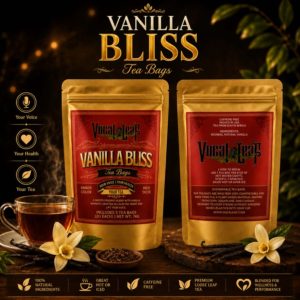

)
&description=&image=https://vocalleaf.com/wp-content/uploads/2026/05/Tea-Hydrating-1024x572.webp)