What Tea Helps With a Sore Throat, and How to Make It

A sore throat has a way of stopping everything. Swallowing feels sharp, talking becomes uncomfortable, and even drinking water can irritate the dryness. It is no surprise that one of the most searched questions during the cold season is: which tea helps with sore throat relief, and which types work better than others?
Warm tea has long been used as a simple home remedy, but not all teas deliver the same soothing effect. Some provide gentle hydration, others contain natural compounds that calm irritation, and certain herbal blends may help ease the scratchy feeling that makes swallowing uncomfortable. Temperature, ingredients, and preparation method can all influence how effective a cup of tea feels.
This guide breaks down what tea helps with sore throat discomfort, why it works, and how to make it properly for the best results. From ginger and chamomile to green tea with honey and lemon, you will discover which options are most supportive, how to prepare them correctly, and how to adjust your cup for maximum soothing comfort.
What Tea Does for a Sore Throat
Does Tea Help With a Sore Throat, or Just Feel Soothing?
When people ask what tea helps with sore throat relief, they are usually trying to distinguish between comfort and real support. Tea can do both. In many cases, the immediate benefit is soothing: warm fluid coats irritated tissues and temporarily reduces the raw, scratchy sensation. At the same time, tea can also support recovery in practical ways by keeping you hydrated, easing dryness, and delivering gentle plant compounds depending on the type you choose. That is why so many searches centre on whether tea helps with sore throat problems and whether tea actually helps a sore throat, not just make it feel better for a moment.
The key is choosing the right option. Some teas are simply comforting, while other teas that help with sore throat discomfort are better at calming irritation or supporting a congested, inflamed feeling. So if you are wondering which tea helps with sore throat pain the most, the answer depends on what is causing the irritation and how your throat reacts to heat, acidity, and stronger flavours.
Why Warm Liquids Can Ease Throat Discomfort
A sore throat often feels worse when the tissues are dry, inflamed, or irritated by coughing and mouth breathing. Warm liquids can help by adding moisture, encouraging saliva flow, and relaxing the tight feeling around the throat. That is a big part of why people reach for tea to help sore throat symptoms, especially when swallowing feels uncomfortable.
Warmth can also be mentally and physically calming, which matters when you are run down. Even if your throat is irritated from a cold, post-nasal drip, or overnight dryness, a gentle cup can reduce that “sandpaper” sensation and make speaking and swallowing feel less harsh. This is why many people feel that tea that helps with sore throat discomfort works best when sipped slowly and consistently rather than taken as one quick drink.
Hot vs Warm vs Cold Tea: What to Choose and When
Temperature can affect how effective tea is at relieving sore throat discomfort. Very hot tea may seem like it should work faster, but it can sometimes irritate already sensitive tissue. For most people, warm tea is the sweet spot because it soothes without causing extra redness. If you are asking whether tea helps a sore throat more when it is hotter, the better approach is usually “comfortably warm,” not “steaming hot.”
Cold tea can feel good in specific situations, especially if your throat feels swollen or you prefer a cooling sensation. However, some people find that cold drinks can tighten the throat or trigger more coughing, worsening symptoms. If you are choosing teas for sore throat relief, start with warm, then adjust to cooler or slightly hotter as your throat responds. The best temperature is one that reduces irritation and helps you sip steadily, because consistency matters more than extremes when you are using tea to help with sore throat discomfort.
The Best Teas for Sore Throat Relief

Ginger Tea for Sore Throat: When It Helps Most
If you are trying to figure out what tea helps with sore throat discomfort fast, ginger tea is one of the strongest choices when your throat feels inflamed, scratchy, and “raw,” especially alongside a cold. Many people ask if ginger tea helps with sore throat pain because it feels warming and settling, and ginger is widely discussed for its bioactive compounds and general usefulness and safety when used in typical food amounts.
Ginger tea tends to feel most helpful when you sip it slowly while it is comfortably warm, not scalding, and when you keep the flavour smooth rather than overly spicy, since an aggressive brew can irritate a sensitive throat. If you are on blood thinners, diabetes medication, or have reflux, it is smart to keep ginger intake moderate, as it can cause heartburn for some people and may interact with certain medicines.
Chamomile Tea for Sore Throat: Calming and Soothing Angle
When people ask whether chamomile tea helps with sore throat discomfort, they are often looking for something gentle. Chamomile is a classic “soft” tea that feels soothing, which can matter when soreness makes it hard to rest. It is commonly used in herbal regimens, and reputable health sources emphasize its general safety and potential interactions.
One caution: if you have ragweed-related allergies, chamomile may trigger symptoms in some people, so it is not always the best pick, even if it sounds mild.
If you are deciding which tea helps with sore throat irritation at night, chamomile can be a comfortable option because it is typically caffeine-free and easy on the palate, making it easier to sip consistently.
Peppermint and Mint Teas: Cooling Sensation, When to Avoid
People also ask: Does peppermint tea help with sore throat pain, and does mint tea help with sore throat irritation? Because mint can feel instantly cooling. That sensation can be pleasant when your throat feels hot, swollen, or irritated, and the aroma can feel refreshing when you are congested. Practical self-care guidance often recommends warm or cool drinks based on what feels soothing, helping you stay hydrated.
Mint is not perfect for everyone. If you deal with acid reflux, mint can sometimes make symptoms feel worse, and reflux can also aggravate throat irritation, which is the opposite of what you want when choosing a tea to help with sore throat discomfort.
For many people, mint works best as a mild brew, warm rather than very hot, and especially when your throat prefers a cooling feel without harshness.
Green Tea vs Black Tea: Which is Better for a Sore Throat
If you are comparing options, it is normal to ask, “Does green tea help with sore throat discomfort and “Does black tea help with sore throat pain. Both can feel soothing because the main baseline benefit is hydration, and a warm drink keeps the throat moist.
The practical difference often comes down to sensitivity and timing. Black tea is usually stronger and can be more drying for some people due to its caffeine content, while green tea tends to feel lighter. If your throat is very irritated, a milder cup may be easier to sip consistently, and consistency is what usually makes tea help sore throat discomfort feel most effective.
So if you are asking, can green tea help a sore throat more than black tea, the best answer is: choose the one you can comfortably drink in small, frequent sips, and consider a lower caffeine option if dryness or nighttime discomfort is an issue.
Chai Tea: Spices, Warmth, and Sensitivity Considerations
Chai is often searched because it is warming and comforting, so people ask, ” Does chai tea help with sore throat discomfort? It can, mainly because warm drinks can soothe and help keep the throat moist.
The catch is that chai commonly contains black tea plus spices that may feel “too much” when your throat is inflamed. If you love chai, make it lightly spiced, avoid making it overly hot, and keep it gentle on the stomach, since reflux irritation can make throat pain linger.
If you want chai-style comfort without the edge, a softer approach is to steep a mild tea and add just a hint of ginger or cinnamon rather than a heavy spice load, keeping the focus on comfort and steady hydration.
Add-ins That Can Make Tea More Effective

Honey in Tea for a Sore Throat: How It Supports Comfort
When someone asks whether honey in tea helps with sore throat discomfort, they are usually chasing two things at once: immediate relief and an easy-to-repeat remedy. Honey delivers on both because it coats irritated tissue, which can make swallowing feel less sharp, and it can make a warm drink feel smoother and more soothing.
If you are wondering whether honey and tea help a sore throat better than plain tea, the practical advantage is that honey often makes it easier to sip more comfortably, which supports hydration. It is also commonly used to calm cough-related irritation, which matters because coughing can keep a sore throat feeling raw.
One simple rule that improves results is to control temperature. Adding honey to boiling tea can be too harsh for an already sensitive throat, so letting the tea cool slightly before stirring in the honey tends to feel better.
Lemon in Tea for Sore Throat: Benefits and Irritation Edge Cases
People often ask if lemon tea helps with sore throat symptoms because lemon feels “clean,” bright, and comforting, especially when paired with warmth. Lemon can make a drink more appealing when you do not feel like eating, helping you keep sipping fluids.
There is one important edge case: acidity. If your throat is extremely raw or if you are prone to reflux, lemon may sting or make irritation feel sharper. In those cases, tea with lemon can turn into “tea with lemon hurts,” and the smarter move is to reduce the lemon to a few drops or skip it entirely until your throat calms down.
Lemon Ginger Tea: A Simple Blend, and When It’s Ideal
Does lemon and ginger tea help with sore throat discomfort? For many people, it can feel especially supportive when soreness comes with congestion or that heavy “sick” feeling, because ginger brings a warming bite while the lemon adds brightness. The key is keeping the blend gentle, so it soothes rather than irritates.
If your throat is sensitive, make the ginger mild rather than intense, because ginger can cause mouth and throat irritation in higher amounts for some people.
This is the version that often works best first thing in the morning or midday, when you want something warming but not overly heavy.
Tea With Honey and Lemon: Ratio Guidance and Taste Fixes
Does tea with honey and lemon help sore throat discomfort? It often does because it combines two of the most commonly used soothing ingredients: honey for coating and smoothness, and lemon for flavour and freshness.
A throat-friendly ratio is usually “honey forward, lemon light.” Start with about 1 teaspoon of honey in a mug, then add a small squeeze of lemon and adjust to taste. If it stings, the fix is simple: reduce the lemon, increase the dilution with warm water, and keep the tea comfortably warm rather than very hot.
This approach also answers two common questions at once: what to put in tea to help soothe a sore throat and how to make tea to help relieve a sore throat without making it too strong. Aim for smooth, sippable, repeatable, because the best soothing cup is the one you can keep drinking throughout the day.
How to Make Tea That Helps a Sore Throat

Step-by-step Method for Maximum Soothing
If you have ever wondered how tea helps a sore throat, and why it helps it feel less raw, the answer usually comes down to steady hydration plus a warm, comforting sip that keeps irritated tissue moist. Self-care guidance consistently emphasizes drinking plenty of fluids, and warm drinks are often included as soothing options for sore throats.
Start by choosing a tea you can drink slowly without it feeling harsh. Bring water to a boil, then let it sit briefly so the temperature drops to comfortably hot rather than scalding. That detail matters because “why does hot tea help a sore throat” is really about warmth and moisture, not burning heat, and overly hot drinks can feel irritating instead of soothing.
Steeping is where people accidentally make tea too aggressive. For herbal teas, steep until the flavour is present but not intense, and for green or black tea, keep the steep time moderate so it does not turn bitter. Then sip slowly instead of taking big gulps. Small sips every few minutes often feel better than finishing a mug quickly, because the throat stays coated and moist longer. The goal is a cup you will actually keep drinking, which aligns with the core sore throat advice: stay hydrated.
What to Put in Tea to Help a Sore Throat
If you are deciding what to put in tea to help soothe a sore throat, start with add-ins that smooth and soften the sip. Honey is the most reliable choice because it can coat the throat and make irritation feel more bearable, which also explains why tea and honey are such a common combination for a sore throat.
One safety note: honey should not be given to infants under 1 year old due to the risk of botulism.
Lemon can enhance the taste and make tea easier to drink when you feel unwell, but it is not ideal for everyone. If your throat is extremely raw or you are prone to reflux, lemon’s acidity can sting, so keep it light or skip it when it irritates.
What to skip is just as important. Avoid making your tea overly hot, overly concentrated, or heavily spiced when your throat feels sensitive, because harsh heat and strong flavours can worsen irritation rather than ease it. The best “recipe” is the one that feels gentle enough to sip often throughout the day.
Quick Recipe Templates: Ginger-honey, Chamomile-honey, Green Tea-lemon
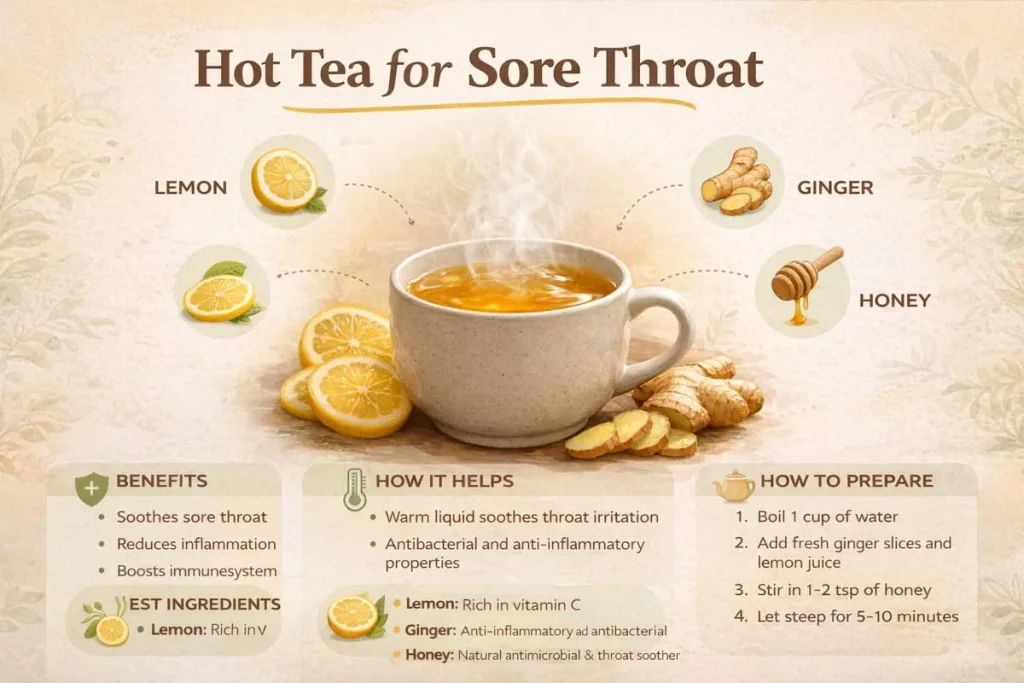
Ginger-honey template: steep ginger tea until it is warming but not intense, let it cool slightly, then stir in honey. This option is popular when you want a warming feel, and it stays throat-friendly when the ginger is kept mild.
Chamomile-honey template: brew chamomile for a smooth, gentle cup and add honey after it cools a little. This is a go-to at night because it is mild and easy to sip slowly when your throat feels tender.
Green tea-lemon template: steep green tea lightly to avoid bitterness, let it cool to a comfortably warm temperature, then add a small squeeze of lemon if it does not sting. If lemon irritates, switch to honey only, since comfort and consistency matter more than forcing an ingredient that makes symptoms feel worse.
Sore Throat Plus Cough or Congestion: Best Tea Choices

Tea for Sore Throat and Cough: Which Options Match This Combo
When your throat is sore and you are also coughing, the irritation usually feeds itself: coughing makes the throat raw, and a raw throat makes you cough more. That is why so many people search for ‘does tea help with a sore throat and cough’ and look for tea that specifically helps with a sore throat and cough. Tea can help here mainly because warm fluids keep the throat moist and feel soothing, and hydration is a core self-care step when you are dealing with a sore throat and cough.
For this combo, the most reliable “comfort” choices are gentle, warm teas you can sip slowly. Herbal options like chamomile are often chosen because they feel mild and are easy to drink even when your throat is tender. If your cough is dry and tickly, adding honey can make it feel smoother and more coated, which is why people keep asking what tea helps with a sore throat and cough and end up pairing it with honey.
Tea for Sore Throat and Congestion: What Tends to Feel Best
Congestion changes what “best” feels like. When you are blocked up, warmth and aroma often matter as much as taste, because steamy, soothing sips can feel comforting as you try to breathe through irritation. That is the intent behind searches like what tea helps with sore throat and congestion and tea that helps with sore throat and congestion. Warm drinks are commonly recommended as part of sore throat self-care because they can be soothing and support hydration.
For congestion, many people prefer ginger tea or mild mint tea because the sensation can feel clearing and refreshing, especially when you are sipping something comfortably warm. Ginger is also widely used as an herbal option, with reputable sources noting it is commonly consumed and generally well tolerated at typical doses, while acknowledging that strong ginger can cause discomfort for some people.
When Cold Tea Might Be Preferred (and When It Backfires)
Cold tea is a matter of personal preference, not a universal “better” choice. Some people find that cool drinks feel good when the throat feels hot or slightly swollen, so iced tea might feel calming in the moment. Others notice the opposite: cold drinks can trigger more coughing, make the throat feel tighter, or feel harsher on inflamed tissue. General sore throat self-care guidance leans toward choosing fluids that feel soothing and are easy to keep down, which is why warm is usually the default recommendation.
If you want to try cold tea, the best test is simple: take a few sips and pay attention to what happens over the next few minutes. If coughing increases or swallowing feels sharper, switch back to warm. If it feels soothing and you can drink more consistently, it can be a workable option, because the biggest win is steady hydration plus comfort you can repeat throughout the day.
Hot Tea for Sore Throat Relief: What It Really Does and How to Make It Work

Will Hot Tea Help a Sore Throat
When people search for hot tea help sore throat pain, they are usually hoping for fast, noticeable relief. Hot tea can help a sore throat mainly because warm fluids soothe irritation and support hydration, which are core parts of sore throat self-care. The comfort often comes from warmth plus moisture, not from the tea being “as hot as possible,” which is why the best results usually come from a comfortably hot drink rather than a scalding one.
That is the clearest answer to the question of whether drinking hot tea helps a sore throat and whether it helps with sore throat symptoms: it often helps when it is gentle enough to sip steadily and when you keep fluids flowing throughout the day, not just one mug at a time.
How Does Hot Tea Help a Sore Throat, and Why Does It Work
If you are wondering how hot tea helps a sore throat, the mechanism is simple and practical: warmth can feel soothing on irritated tissue, and drinking fluids helps prevent dryness that makes soreness feel sharper. That is also why hot tea helps a sore throat is such a common question, because people can feel the difference when their throat goes from dry and scratchy to warm and hydrated.
The temperature detail matters. Some NHS materials include advice to drink plenty of water and use warm or cool drinks for symptom relief, and other NHS leaflets explicitly warn to avoid hot drinks in certain contexts, which is a useful reminder that “hotter” is not always “better.” A safe, effective target is “comfortably hot,” meaning it feels soothing and never stings.
Does Hot Tea and Honey Help a Sore Throat?
Hot tea with honey is one of the most searched combinations because it often feels noticeably smoother than plain tea. If you are asking whether hot tea and honey help with sore throat discomfort, honey can coat the throat and make irritation more bearable, and there is clinical guidance noting that honey is commonly used for soothing and can help with cough, which often keeps the throat inflamed. That coating effect is the core reason why hot tea with honey helps a sore throat: it makes each sip gentler, helping you keep drinking fluids consistently.
One important safety note belongs in any responsible hot tea and honey section: honey should not be given to children under 12 months old due to the risk of botulism.
What Hot Tea Helps With a Sore Throat, and What to Watch for
If you are searching for what hot tea helps with a sore throat, the “best” choice is the one that stays gentle on irritated tissue. Hot ginger tea can feel warming, but strong ginger can cause mouth or throat irritation for some people, so keeping the brew mild is often smarter when soreness is intense. Hot green tea and hot black tea can also be soothing as warm fluids, but if caffeine makes you feel dry or jittery, you may do better with a gentler, caffeine-free option.
Hot lemon tea is the biggest “it depends” option. Lemon can make tea more appealing and easier to drink, but acidity can sting a raw throat, and irritation is a sign to reduce lemon or skip it until your throat calms down.
A final filter that prevents disappointment with “hot tea not helping” is this: aim for warm to comfortably hot, keep flavours mild, and sip slowly over time. That is how hot tea helps sore throats in the real world: it provides comfort you can repeat throughout the day.
Green Tea for Sore Throat Relief: Does It Actually Help

Does Green Tea Help a Sore Throat, or Just Feel Comforting
Green tea is one of the most searched options when people are looking for something gentle and familiar. Questions like ” Does green tea help sore throat discomfort, ” Will green tea help a sore throat, and ” Can green tea help with sore throat irritation all point to the same intent: is this a real remedy or just a warm drink?
In practical terms, green tea can help in two main ways. First, like any warm fluid, it supports hydration, which is consistently recommended for sore throat self-care. When your throat stays moist, irritation often feels less intense. Second, green tea is lighter than many other teas, which makes it easier to sip repeatedly without feeling harsh or heavy.
If you are wondering if drinking green tea helps a sore throat, the answer usually depends on how sensitive your throat is. A lightly brewed, comfortably warm cup is more likely to feel soothing than a strong, bitter brew. If it tastes sharp or drying, steep it for less time and let it cool slightly before sipping.
Green Tea With Honey or Lemon: Does It Work Better
Many people refine their search to determine whether green tea and honey help sore throat pain or whether green tea with honey helps a sore throat more effectively than plain tea. Honey can make the drink smoother and easier to tolerate, often resulting in a noticeable improvement in comfort. The coating effect can reduce the raw feeling that comes with frequent swallowing or coughing.
Lemon is more situational. While some ask if green tea with lemon helps sore throat symptoms, lemon can sting if the throat is very inflamed. If it feels sharp, reduce the amount or skip it entirely. Comfort should guide the choice, not habit.
If you are asking whether green tea can help cure a sore throat, it is important to think in realistic terms. Green tea may support comfort and hydration, but it is not a cure. Its value comes from making symptoms easier to manage while your body recovers.
Hot vs Cold Green Tea for a Sore Throat
Another common variation is whether cold green tea helps with a sore throat, or whether it helps more when it is hot. For most people, comfortably warm green tea feels better because warmth tends to soothe irritated tissue. Very hot tea can irritate, and very cold tea can sometimes trigger more coughing or tightness.
Cold green tea may feel refreshing if your throat feels swollen or overheated, but if symptoms worsen after a few sips, warm tea is usually the better option. The goal is steady, repeatable comfort, not extreme temperature.
Does Gargling Green Tea Help a Sore Throat
Some people also ask how green tea helps a sore throat when used for gargling, and why it does. Gargling with warm liquids can temporarily soothe and moisten irritated areas at the back of the throat. If you try this method, keep the tea mild and warm rather than hot, and avoid swallowing large amounts if the flavour is strong.
Choosing the Right Green Tea
Whether you are drinking Japanese green tea, standard green tea bags, or another variety, the most important factor is preparation. Brew it lightly, keep it comfortably warm, and sip slowly. If green tea helps sore throat discomfort without causing dryness or irritation, it can be a reliable part of your routine. If it feels bitter or makes your throat feel tighter, adjust the strength or switch to a gentler herbal option.
Green tea to help sore throat symptoms works best when it is mild, warm, and paired with steady hydration throughout the day.
Lemon Tea for Sore Throat: When It Helps, When It Irritates, and How to Make It Gentler

Does Lemon Tea Help a Sore Throat
When people ask whether lemon tea helps with sore throat discomfort, they are usually looking for a soothing drink that also feels “clean” and easy to sip when appetite is low. Lemon tea can help mainly because warm fluids support hydration and comfort, which is a core self-care recommendation for sore throats.
The important nuance is that lemon is acidic. If your throat is mildly irritated, a small amount of lemon in warm tea may feel refreshing and encourage you to drink more, which is helpful. If your throat is raw or burning, lemon can sting and make symptoms feel sharper, which is when the “lemon tea for sore throat” idea backfires.
Does Tea With Lemon and Honey Help With a Sore Throat
A lot of searches turn into ‘does honey lemon tea help with a sore throat’ or ‘does tea and lemon help with a sore throat’ because people want a cup that feels soothing, not harsh. Honey changes the experience because it can coat and smooth the throat, making the drink easier to tolerate and helping relieve coughing, which often worsens throat irritation.
That combination is why many people feel honey lemon tea helps sore throat symptoms more than lemon tea alone, especially when coughing is part of the picture. If lemon stings, the best fix is not forcing it; reduce it to a few drops and lean more on honey for smoothness so the drink stays easy to sip.
Does Lemon Ginger Tea Help With a Sore Throat
Questions like ” Does lemon ginger tea help with a sore throat and ” Will lemon and ginger tea help a sore throat usually show up when someone wants warmth plus a “clearing” feel. Ginger can feel comforting for many people, but it can also cause mouth or throat irritation if it is too strong, so the goal is a mild brew, not a spicy burn.
If you want the lemon ginger tea version to stay soothing, keep the ginger gentle, keep the tea comfortably warm, and add lemon lightly. When the throat is very raw, start with ginger and honey, then add lemon only if it does not sting.
How Does Honey Lemon Tea Help a Sore Throat, and How Can You Make It Work Better
If you are asking how honey lemon tea helps with sore throat comfort, the simple explanation is that warm fluid supports hydration and soothes. In contrast, honey makes the drink feel smoother and more coating, which can make swallowing easier and support cough comfort.
For a throat-friendly cup, aim for comfortably warm tea, not very hot. Stir in the honey after it cools a little, then add lemon slowly until it tastes pleasant without stinging. The best “recipe” is the one you can keep sipping throughout the day, because steady fluids are consistently recommended for sore-throat self-care.
Ginger Tea for a Sore Throat: Does It Actually Help

Will Ginger Tea Help a Sore Throat
If you are wondering whether ginger tea helps a sore throat, the answer depends on how it is prepared and how sensitive your throat feels. Ginger tea can feel warming and comforting, especially when soreness is linked to a cold or congestion. Like other warm fluids, it supports hydration, and staying hydrated is consistently recommended for easing sore throat discomfort.
When people ask, “Does ginger tea help a sore throat?” or “Can ginger tea help with sore throat irritation,” they are often looking for something stronger than plain tea. Ginger has naturally pungent compounds, and reputable health references note that it is widely consumed and generally well tolerated in typical food amounts. The key is moderation. A very strong brew can irritate an already raw throat, so mild and warm works better than intense and very hot.
Does Ginger Tea Help a Sore Throat More Than Plain Tea
Ginger tea helps relieve sore throat discomfort mainly by combining its distinctive flavour and aroma with warmth. For many people, that warming sensation feels soothing when the throat is scratchy or tight. However, the benefit often comes from the overall experience of sipping a warm, gentle drink rather than from ginger alone.
If you notice burning or increased irritation, reduce the amount of ginger or steep it for less time. Ginger can cause mouth or throat irritation at higher doses for some individuals, so keeping the flavour balanced is important when your throat is sensitive.
Ginger With Honey or Turmeric: Does It Work Better
Searches like “does ginger and honey tea help with sore throat” and “does honey ginger tea help with sore throat” show that many people prefer pairing ginger with honey. Honey can make the tea smoother and easier to sip, helping reduce the raw, scraping sensation when swallowing.
Some also look for whether ginger turmeric tea helps with a sore throat. Turmeric is commonly used in herbal preparations, but, like ginger, it can have a strong flavour that’s too much if your throat is inflamed. The safest approach is to keep any blend mild, comfortably warm, and easy to drink repeatedly.
How to Use Ginger Tea So It Stays Soothing
Suppose your goal is to use ginger tea to help sore throat discomfort; focus on preparation. Use fresh slices or a tea bag, steep briefly, let it cool slightly, then sip slowly rather than drinking it quickly. If it feels sharp, add a small amount of honey or dilute it with more warm water.
Ginger tea can help relieve sore throat symptoms when it is gentle, warm, and part of a steady hydration routine throughout the day. If it feels irritating, adjust the strength instead of abandoning tea entirely. Comfort and consistency are what make it effective.
Tea With Honey for Sore Throat Relief: Why This Classic Combo Works
Does Tea and Honey Help a Sore Throat?
When people search, ” Does tea and honey help a sore throat or ” Will tea with honey help a sore throat, they are usually looking for something simple that feels noticeably soothing. Warm fluids are commonly recommended for sore throat comfort because they support hydration and can ease irritation. Honey adds another layer by coating the throat, which can make swallowing feel less painful and may help calm a cough that keeps the throat inflamed.
That combination explains why so many variations appear, from ” Does honey tea help sore throat to ” Can tea with honey help with a sore throat. The warmth keeps tissues moist, and the honey helps the drink feel smoother and more protective.
How Does Tea With Honey Help a Sore Throat
If you are asking how tea with honey helps a sore throat, the mechanism is straightforward. Warm tea provides fluid and comfort, while honey forms a soothing layer over irritated tissue, helping reduce the dry, scraping sensation that makes every swallow uncomfortable.
This is also why many people feel that putting honey in tea helps sore throats is more than just a tradition. The smoother texture encourages slower, steadier sipping, and steady hydration is a key part of sore-throat self-care.
A safety note belongs here as well: honey should not be given to children under 12 months old due to the risk of botulism.
Which Tea With Honey Works Best
The base tea matters less than how gentle it feels. Whether you are asking, “Does black tea with honey help sore throat discomfort?” or “Does peppermint tea and honey help sore throat symptoms,” the best choice is the one that does not irritate your throat. Warm, mild black tea with honey can feel comforting if caffeine does not bother you. Peppermint tea with honey may feel cooling and soothing, especially if congestion is present, as long as mint does not trigger reflux for you.
Chamomile tea with honey is often chosen for nighttime because it is gentle and easy to sip slowly. That is why searches like ‘Does chamomile tea with honey help a sore throat?’ are common.
Even more specific combinations, such as honey-citrus-mint tea, lemon-honey-chamomile tea, or chai tea with honey, follow the same rule. Keep the brew mild, the temperature comfortably warm, and the honey balanced so the drink feels smooth rather than sharp. The real benefit comes from a soothing cup you can return to throughout the day, because consistency and comfort are what make tea with honey feel effective for sore throat relief.
Black Tea for a Sore Throat: Is It a Good Choice

Will Black Tea Help a Sore Throat
When people ask whether black tea helps a sore throat, they are usually comparing it to herbal options and wondering whether regular tea is enough. Black tea can help mainly because it is a warm fluid, and warm drinks are commonly recommended to soothe irritation and support hydration during a sore throat. Staying hydrated keeps the throat from becoming excessively dry, which can make pain feel worse.
So if you are thinking, “Does black tea help with sore throat discomfort?” the answer is often yes, in the same way that other warm drinks do. It can ease that scratchy feeling, especially when sipped slowly and kept comfortably warm rather than very hot.
Does Black Tea Help With a Sore Throat More Than Other Teas
Black tea does not contain a special “sore throat cure,” but it can still be effective because warmth and fluid intake are the core drivers of relief. If you are asking whether black tea helps a sore throat better than herbal tea, the difference usually comes down to tolerance and preference.
One factor to consider is caffeine. For some people, caffeine can feel slightly drying or disruptive to sleep, especially at night. If your throat feels dry or you are sensitive to caffeine, you may prefer decaffeinated black tea or a caffeine-free herbal option. If caffeine does not bother you, black tea can be a perfectly reasonable choice.
How to Use Black Tea So It Stays Soothing
If you want to use black tea to help sore throat symptoms, preparation makes the difference. Steep it lightly to avoid bitterness, let it cool to a comfortably warm temperature, and sip gradually rather than drinking it quickly. If plain black tea feels sharp, adding a small amount of honey can make it smoother and easier to tolerate.
In short, black tea can help a sore throat when it is mild, warm, and easy to drink consistently. The real benefit comes from steady hydration and comfort, not from intensity.
Herbal Tea for Sore Throat Relief: Which Ones Are Worth Trying
Does Herbal Tea Help With a Sore Throat
If you are wondering if herbal tea helps sore throat discomfort, the short answer is that it often can, especially because most herbal teas are caffeine-free and naturally mild. Warm fluids are commonly recommended for soothing throat irritation and supporting hydration, which makes herbal tea a practical option when your throat feels dry or scratchy.
When people search, ” Does herbal tea help a sore throat, they are usually looking for something gentler than black tea or coffee. Herbal blends tend to feel smoother and less drying, which makes them easier to sip throughout the day. Consistent, comfortable hydration is what usually makes the biggest difference in how your throat feels.
What Herbal Tea Helps With a Sore Throat the Most
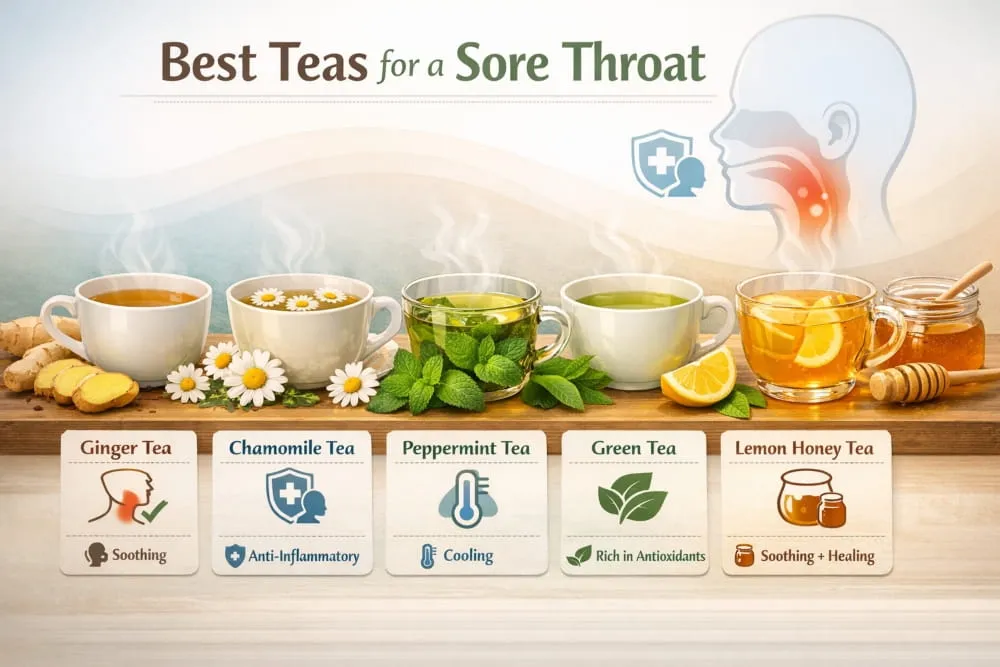
Questions like “Which herbal tea helps sore throats?” or “Which herbal tea helps sore throat symptoms?” usually point to a few popular options. Chamomile is often chosen because it feels soft and calming, making it suitable when your throat feels tender, especially at night. Peppermint is selected for its cooling sensation, which some people find soothing when irritation feels hot or swollen. Ginger herbal tea can feel warming and comforting, particularly when congestion is also present, as long as it is brewed mildly rather than strongly.
If your voice feels rough or “scraggly,” as some describe it, the best herbal tea for sore throat and strained-voice issues is usually gentle, warm, and easy to sip repeatedly. Avoid overly sharp, spicy, or highly acidic blends when your throat is sensitive, because intensity can increase irritation.
Choosing the Right Herbal Tea to Help Sore Throat Symptoms
When selecting an herbal tea to help sore throat discomfort, focus less on brand names and more on how the tea feels. A mild chamomile, light peppermint, or gently brewed ginger tea can all work if they are comfortably warm and not too strong. The most effective herbal teas that help with a sore throat are the ones you can drink steadily without discomfort.
In the end, herbal tea helps relieve a sore throat mainly through warmth, hydration, and comfort. Choose a blend that feels soothing to you, brew it lightly, keep it warm rather than hot, and sip consistently throughout the day for the best effect.
Does Tea Help With a Sore Throat, and Which Tea is Best
Does Tea Help a Sore Throat, or Does It Just Feel Soothing?
When someone types, “Does tea help with a sore throat?” or “Will tea help a sore throat?” they are usually trying to confirm whether tea is doing something real or only offering temporary comfort. Tea can genuinely help with sore throat symptoms in a practical way because sore throat self-care guidance consistently emphasizes drinking plenty of fluids, and warm or cool drinks can help relieve symptoms by keeping the throat moist and comfortable.
That is also the simplest explanation for why tea helps with sore throat discomfort: the more consistently you hydrate, the less dry, scratchy, and irritated the throat tends to feel, and warm drinks often feel soothing while you do it.
What Tea Helps With a Sore Throat, and What Kind of Tea Helps With a Sore Throat
People search for which teas help with a sore throat because “tea” is a broad category, and not every cup feels the same when your throat is raw. In most cases, the best tea to help a sore throat is the one you can drink easily, repeatedly, and comfortably without stinging, bitterness, or reflux triggers. Sore throat self-care advice focuses on fluids and comfort rather than a single magic tea, which is why the most effective approach is to choose a gentle tea you will actually keep sipping.
That logic answers which types of tea help a sore throat and which teas help with sore throat relief: mild herbal teas, lightly brewed green tea, or a softer black tea can all work if they feel soothing to you. The “best tea to help with a sore throat” is less about a specific label and more about a consistent, gentle drinking pattern that supports hydration and comfort.
Why Does Tea Help With a Sore Throat, and Does Tea Really Help a Sore Throat
If you are asking, does tea actually help with sore throat pain, or does tea really help a sore throat, the strongest evidence-based angle is self-care fundamentals: fluids, rest, and symptom-soothing. Tea fits because it is a drink you can take warm or cool, and both can be used for relief depending on what feels best.
Tea becomes even more “effective” when it helps you drink more overall. That is why many people notice tea helps with sore throat discomfort more than plain water, not because tea is medicine, but because it is easier to sip slowly and consistently when your throat is irritated.
Does Sugar in Tea Help a Sore Throat, and Does Tea With Sugar Help a Sore Throat
Some people look for does tea with sugar help sore throat comfort because the sweetness can make a drink easier to tolerate. The practical downside is that added sugar is still added sugar, and health guidance generally encourages limiting added sugars, especially for children. If you want the soothing effect of sweetness with fewer downsides, honey is commonly used for sore throat relief, but it must be avoided for babies under 12 months.
How to Make Tea That Helps a Sore Throat and Why Tea Sometimes Disappoints
If you are searching for how to make tea that helps sore throat symptoms, think gentle and repeatable. Keep the tea comfortably warm, brew it to a mild strength to avoid bitterness, and sip slowly so the throat stays moist. If tea is not helping, the usual reasons are temperature that is too hot, a brew that is too strong, or add-ins like lemon that sting when the throat is very raw. Fluids are still the foundation, so adjusting the cup for comfort is what turns “tea to help with a sore throat” from a one-time drink into real day-long relief.
When tea isn’t helping your sore throat

Common reasons relief is limited
If you are thinking, ” Why isn’t tea helping my sore throat, it usually comes down to a few fixable details rather than tea being “useless.” Temperature is the first one. Tea that is too hot can aggravate already sensitive tissue, so instead of soothing, it can leave your throat feeling more irritated. On the other hand, very cold tea can tighten the throat for some people or trigger more coughing, making tea not help sore throat discomfort feel like a dead end.
Acidity is another common culprit. Lemon and other strong citrus add-ins can sting when your throat is raw, and reflux can quietly worsen irritation, making it feel like nothing you drink is working. Dehydration also reduces the soothing payoff. If you are only having one cup and going hours without fluids, the relief fades fast because dryness returns. Timing matters as well. A sore throat often feels worse first thing in the morning or after talking and coughing, so a single cup at the wrong moment can feel like it “did nothing,” even when tea is helpful in smaller, repeated sips across the day.
Simple adjustments that change outcomes
When tea isn’t helping with sore throat symptoms, the fastest improvement usually comes from making the cup gentler and more consistent. Aim for comfortably warm tea, not steaming hot. Reduce steeping strength if bitterness or sharp flavours make your throat feel scratchy, because overly strong brews can feel harsh when you are already inflamed. If you are using lemon, scale back to a few drops or remove it entirely for a day, and see if the sting disappears.
Add-ins can change how the tea feels immediately. Honey often makes tea smoother and easier to sip slowly, which can make a big difference when your throat feels raw and swallowing is uncomfortable. Frequency is the quiet secret. Instead of relying on one big mug, take smaller cups or reheat a mild brew and sip it steadily, because the comfort comes from keeping the throat moist over time.
Practical try this next checklist for the next cup
If you are asking why tea isn’t helping my sore throat, make your next cup a simple test: brew it mild, let it cool to comfortably warm, then take small sips for ten minutes instead of drinking it quickly. Skip lemon if your throat feels raw or if you notice burning, and add a small amount of honey if you tolerate it to make the sip smoother. Pay attention to what happens after the cup, not just during the first two sips. If your throat feels better while drinking but worse again soon after, increase how often you sip fluids throughout the day. If tea is not helping with sore throat discomfort linked to coughing, choose a gentler tea and keep the temperature warm, because harsh heat, sharp acidity, and strong spices can all make irritation linger.
Conclusion
If you have been wondering what tea helps with sore throat relief, the real answer is simpler than it first appears. Tea works best not because of one magical ingredient, but because warm, soothing fluids support hydration, reduce dryness, and make irritation feel more manageable. When your throat stays moist and you sip consistently, discomfort often feels less intense.
Whether you choose ginger, chamomile, peppermint, green tea, black tea, or a gentle herbal blend, the key is preparation and comfort. Keep the temperature comfortably warm, avoid overly strong or acidic flavours if your throat feels raw, and add honey if you tolerate it for a smoother sip. The best tea to help a sore throat is the one you can drink regularly without irritation.
Tea does not replace medical care when symptoms are severe or persistent. Still, for everyday throat discomfort, it remains one of the simplest and most reliable ways to soothe, hydrate, and support recovery. When chosen carefully and sipped steadily, tea helps turn a painful, scratchy throat into something far more manageable.