
Best Tea for Vocal Cords | Herbs, Hydration and Recovery

If your voice feels tired, strained, or dry, the right tea for your vocal cords can make a real difference, not by healing damaged tissue, but by supporting the hydration and warmth your throat needs to recover comfortably. The best tea for vocal cords is warm (not hot), gentle on the throat, and easy to sip consistently throughout the day.
This guide covers what tea actually does for vocal cord health, which types work best, and what to avoid so you don’t strain your voice.
The short answer: warm, loose leaf tea designed for vocal health, caffeine-free where possible, and never scalding, is the safest and most effective choice for most people dealing with vocal cord strain or dryness.
Does Tea Help Your Vocal Cords?
Yes, tea helps your vocal cords primarily by supporting hydration and providing gentle warmth to a tired or irritated throat. It won’t repair vocal cord tissue or reverse damage, but when your voice feels strained, dry, or overworked, the right tea makes the recovery process significantly more comfortable.
The most important thing tea does is encourage you to drink more warm fluid. Vocal cords perform best when the surrounding tissue is well-hydrated, and sipping warm liquid throughout the day is one of the simplest ways to support that. Think of tea as a hydration tool with added comfort, not a cure.
What Tea Actually Does for Vocal Cord Health
When you drink warm tea for your vocal cords, three things happen that support vocal comfort:
Hydration is the primary benefit. Well-hydrated vocal cords vibrate more freely and feel less strained during use. Tea encourages steady fluid intake, especially when plain water feels unappealing.
Warmth and warm liquid help relax the muscles around the throat and reduce the tight, tense feeling that comes with vocal fatigue. This is why warm tea feels more soothing than cold water when your voice is tired.
Comfort, a good herbal tea can reduce the raw, scratchy sensation in the throat that makes speaking and singing feel difficult, making it easier to rest your voice without discomfort.
Why Warm Tea Is Better Than Hot Tea for Your Vocal Cords
Temperature matters as much as the type of tea you choose. Warm tea, comfortably warm to the touch, not steaming, is what actually helps. Very hot tea can irritate an already sensitive throat and make inflammation feel worse, not better.
A simple test, if the tea is too hot to sip comfortably, it is too hot for strained vocal cords. Let it cool for two to three minutes before drinking. This is especially important when your throat is already irritated, because heat adds stress to tissue that needs rest.
Best Tea for Vocal Cords What to Look For
The best tea for your vocal cords is not necessarily the strongest or most heavily marketed throat tea; it is the one you can sip consistently, that feels comfortable going down, and that does not leave your throat feeling drier afterward. A few simple criteria separate a genuinely good choice from one that sounds helpful but works against you.

What Makes a Tea Good for Vocal Cord Health
A tea that is good for vocal cord health shares most of these qualities:
Caffeine-free or low-caffeine options are mild diuretics. For vocal cords that depend on hydration to function well, a tea that pulls moisture away from the body is counterproductive. Naturally caffeine-free loose leaf tea, never chemically decaffeinated, is the cleanest option for vocal cord support.
Warm, not hot, as covered above, temperature is critical. A tea that is too hot to sip comfortably is too hot for a sensitive or strained throat.
Smooth and easy to drink. If a tea feels harsh, astringent, or leaves a dry coating in the throat, it is not the right choice for vocal cord care, regardless of its ingredients. The goal is comfort and hydration, and the best tea delivers both effortlessly.
Loose-leaf over bagged tea tends to be higher quality, less processed, and free from the dust and filler that can make lower-grade bagged teas feel harsh on a sensitive throat. A premium loose-leaf tea brewed at the right temperature gives you a cleaner flavor and a gentler experience.
Best Tea for Strained or Sore Vocal Cords
When your vocal cords feel strained, after a long day of speaking, teaching, performing, or recording, the priority shifts from maintenance to recovery. The best tea for strained vocal cords in this situation is warm, caffeine-free, and easy to sip in volume. You want something you can drink two to three cups of throughout the day without it feeling like a chore.
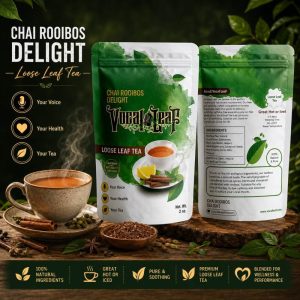
Vocal Leaf’s Organic Rooibos Chai Tea is a strong choice here. Rooibos is naturally caffeine-free, smooth, and warming, exactly the profile a strained voice needs. The gentle spice notes make it satisfying to sip repeatedly without becoming monotonous, which matters when consistent hydration is the goal.
Best Tea to Soothe Vocal Cords After Heavy Voice Use
Soothing vocal cords after heavy use is slightly different from recovery. Here, the goal is comfort in the moment, a tea that feels immediately calming on the throat and makes the post-performance or post-workday wind-down easier.
Vanilla Bliss works particularly well in this role. It is smooth, naturally sweet without added sugar, and caffeine-free, meaning you can drink it in the evening after vocal use without disrupting sleep, which is when vocal cord recovery actually happens.
Tea With Honey for Vocal Cords: Does It Add Anything?
Tea with honey for vocal cords is one of the most commonly recommended combinations, and it does have real value, but not for the reason most people think. Honey does not coat or protect the vocal cords directly, because nothing you swallow touches them (the epiglottis routes swallowed liquid away from them). What honey does is add a smooth, comforting feel to warm tea, making it easier to sip slowly, and it may reduce the raw sensation in the throat around the vocal cords.
If you enjoy honey in your tea, add it to a comfortably warm cup, not boiling. Heat destroys some of honey’s natural properties, so letting the tea cool slightly before stirring in honey yields the greatest benefit.
Best Herbs for Vocal Cords
The best herbs for vocal cords are the ones that hydrate rather than dry the throat and calm irritation without adding harshness, ginger, rooibos, and light citrus botanicals are the three that consistently do this well. None of them heal vocal cord tissue directly. What they do is make the surrounding throat more comfortable while your voice does the actual recovering, which is why the herb matters less than how gently and consistently you can drink it.
Ginger The Most Recommended Warming Herb for Vocal Cords
Ginger is the herb most voice professionals reach for instinctively, and the reason holds up: its naturally warming, anti inflammatory character eases the tight, raw feeling that builds up after heavy speaking or singing. Brewed too strongly or served too hot, it turns sharp and works against a sensitive throat instead of for it, a light steep, cooled to a comfortably warm sip, is where ginger actually helps. Vocal Leaf Organic Rooibos Chai is built around this exact profile, pairing ginger warmth with a naturally caffeine free rooibos base so the herb supports hydration instead of quietly working against it.
Rooibos A Naturally Caffeine-Free Base Built for Vocal Hydration
Rooibos stands out among vocal-health herbs because it never contained caffeine to begin with, it isn’t decaffeinated through a chemical process, it’s simply caffeine-free by nature. That distinction matters more than it sounds: even light green or black tea typically carries 20–45mg of caffeine per cup, enough of a mild diuretic effect to work against the steady hydration a strained voice depends on. Rooibos removes that trade-off entirely, which is why it’s the herbal base singers, teachers, and speakers can drink two or three cups of in a day without it fighting their recovery.
Citrus and Light Botanicals for Everyday Vocal Comfort
Not every herb needs to be a recovery tool, some are better suited to daily upkeep, and this is where lighter citrus forward botanicals earn their place. A blend built around lemon peel, orange peel, and gentle spice notes like cinnamon offers brightness without the astringency that heavier herbal blends can leave on a tired throat. Vocal Leaf Lemon Berry Dream uses exactly this kind of profile, naturally caffeine free, smooth, and light enough to sip consistently through a full day of voice use without ever feeling like a chore.
Best Herbal Tea for Vocal Cords
When it comes to vocal cord health, herbal tea is the most reliable starting point for most people. It is naturally caffeine-free, generally gentle on the throat, and easy to drink in the consistent volumes that actually make a difference to vocal hydration. If you are looking for the best herbal tea for vocal cords and are not sure where to begin, the answer is simpler than most guides make it sound: choose a warm, smooth herbal blend that you tolerate well and can sip throughout the day.

Why Herbal Tea Is the Safest Starting Point for Vocal Health
The advantage herbal tea has over caffeinated options is straightforward. Caffeine, even in moderate amounts, has a mild diuretic effect that works against the hydration your vocal cords depend on. Herbal tea gives you all the warmth and comfort of a hot drink without that trade-off.
There is an important distinction worth knowing: naturally caffeine-free herbal tea is not the same as decaffeinated tea. Decaffeinated teas go through a chemical process to strip caffeine from leaves that originally contained it, and traces of that process can remain. Naturally caffeine-free herbal loose leaf tea, like rooibos, never contained caffeine to begin with, making it the cleaner, gentler choice for anyone prioritising vocal health.
What Kind of Herbal Tea Will Soothe Vocal Cords
The herbal teas that soothe vocal cords best share a few common qualities: they are smooth rather than astringent, warming rather than sharp, and easy to drink repeatedly without irritating a sensitive throat. The specific ingredients matter less than how the tea feels going down. If it leaves your throat feeling drier or tighter after drinking, it is not the right choice, regardless of how it is marketed.
Vocal Leaf Lemon Berry Dream Tea is built around exactly this profile. Light, naturally caffeine-free, and smooth with a gentle brightness from the lemon notes, it is easy to sip consistently without the throat fatigue that heavier or more astringent teas can cause. For anyone asking what kind of herbal tea will soothe vocal cords without complicating a vocal care routine, this is the answer.
Soothing Herbal Tea for Vocal Cords, What to Sip and When
Timing and consistency matter more than most people realise. A single cup of herbal tea will not meaningfully change how your vocal cords feel. Two to three cups spread across the day, morning, midday, and evening, create the sustained hydration that actually supports vocal comfort.
A simple routine that works well for vocal cord health:
Morning, start with a warm cup before your voice is under any load. Organic Loose Leaf Black Tea is a good morning choice if you want a gentle caffeine option: it contains L-theanine, which moderates the stimulant effect of caffeine and supports calm, focused energy without the jittery dehydration that coffee can cause. For a fully caffeine-free morning, Lemon Berry Dream works equally well.
Midday, when your voice has been in use for several hours, a warm cup of herbal tea helps maintain hydration through the second half of the day. Rooibos Chai is a strong midday choice, warming, satisfying, and caffeine-free, so it does not build on any morning caffeine load.
Evening, after vocal use, the body needs rest and hydration to recover. Vanilla Bliss is the natural evening choice: smooth, naturally sweet, caffeine-free, and gentle enough to drink close to bedtime without disrupting sleep.
Ginger Tea for Vocal Cords
Ginger tea is one of the most consistently recommended teas for vocal cord health, and for good reason. Its warming, naturally soothing properties make it a strong choice when the throat feels irritated, tight, or fatigued after heavy voice use. If you have been asking whether ginger tea is good for vocal cords, the answer for most people is yes, with a few practical notes on how to get the most from it.
Is Ginger Tea Good for Vocal Cords?
Ginger tea is good for the vocal cords because of its naturally warming and anti-inflammatory properties. When your throat feels raw or tight after extended speaking, teaching, or performing, a warm cup of ginger tea supports comfort and hydration simultaneously, two of the most important factors in vocal cord recovery.
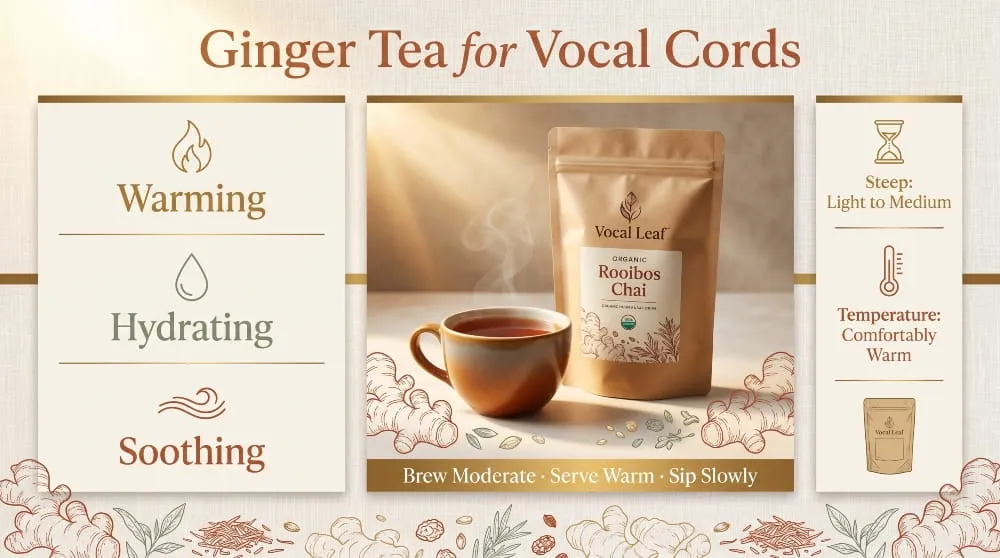
The key is temperature and strength. Ginger brewed too strongly can feel sharp and intense on an already sensitive throat, and served too hot, it can add irritation rather than relieve it. The right approach is a moderately brewed cup served warm, comfortably warm to sip, not steaming, which gives you the full soothing benefit without the harshness.
Vocal Leaf’s Organic Rooibos Chai is built around this principle. It combines the warming, naturally soothing character of ginger with rooibos, a naturally caffeine-free base that supports hydration rather than working against it. The result is a tea that delivers the vocal comfort ginger is known for, without the dryness risk of caffeinated alternatives.
Does Ginger Tea Help Vocal Cord Pain?
When people ask whether ginger tea helps vocal cord pain, it is worth being precise about what is actually happening. Ginger tea does not reach the vocal cords directly; nothing you swallow does, because the epiglottis routes liquids away from the airway. What ginger tea does is reduce the inflammation and irritation in the surrounding throat tissue, which is where much of the discomfort from vocal strain actually originates.
For vocal cord pain caused by overuse, the tight, aching sensation after a long day of voice-intensive work, warm ginger tea supports recovery by keeping the throat hydrated and comfortable while the vocal cords rest. It is a comfort and support tool, not a repair mechanism, but used consistently, it makes the recovery period noticeably more manageable.
If vocal cord pain is severe, persistent, or accompanied by other symptoms, that is a medical situation and warrants professional assessment rather than a tea remedy.
How to Brew Ginger Tea for Best Results
Getting the most from ginger tea for vocal cord health comes down to three things:
Strength, brew moderately. A light to medium strength is ideal for a sensitive throat. If you find ginger tea too intense, reduce the steeping time or use less ginger. The goal is warmth and comfort, not the strongest possible brew.
Temperature: Let it cool to comfortably warm before drinking. Two to three minutes off the boil is usually enough. If it is too hot to sip easily, it is too hot for strained vocal cords.
Consistency, one cup when your throat feels bad is less effective than two to three cups spread across the day as part of a regular vocal care routine. Sustained hydration is what actually moves the needle on vocal comfort.
Is Green Tea Good for Vocal Cords?
Green tea is a reasonable option for vocal cord health in moderate amounts, but it comes with a trade-off that makes it a less ideal choice than naturally caffeine-free herbal tea when your voice is under strain. Understanding that trade-off helps you decide when green tea works for you and when a gentler alternative is the better call.

Green Tea and Vocal Cord Health: The Honest Answer
Green tea contains antioxidants that support overall throat health, and when drunk warm at a light strength, it is smooth enough to sip without irritating a sensitive throat. For someone with a healthy voice looking for a light daily tea option, green tea is a perfectly acceptable choice.
The complication arises when your vocal cords are already strained or fatigued. In that situation, caffeine becomes a meaningful variable. Green tea contains less caffeine than coffee or black tea. However, it still contains enough to have a mild diuretic effect in larger amounts, and when vocal cord health depends on consistent hydration, anything that nudges the body toward fluid loss is working against your recovery.
The answer to whether green tea is good for your vocal cords depends on context. For general daily use when your voice is healthy, it is fine. For active vocal cord recovery or days when your voice is under heavy load, a naturally caffeine-free option is the more reliable choice.
Caffeine and Vocal Cords: Does Green Tea Dry Out Your Throat?
This is the practical question most people are really asking when they search whether green tea is good for vocal cords, and it deserves a direct answer.
Green tea, at 1 to 2 cups a day, is unlikely to cause significant dehydration for most people. The caffeine content is low enough that the hydration from the liquid itself largely offsets any diuretic effect. The problem comes with volume and timing. Drinking several cups of green tea across a day of heavy voice use, teaching, presenting, performing, and recording, adds a cumulative caffeine load that can contribute to the dryness and throat fatigue that vocal cord strain already causes.
If you enjoy green tea and want to keep it in your vocal care routine, the practical approach is straightforward: limit it to one cup in the morning, brew it lightly, and supplement with naturally caffeine-free loose leaf tea for the rest of the day. Vocal Leaf’s Organic Loose Leaf Black Tea is worth considering as a more vocal-health-conscious caffeinated option, it contains L-theanine, which moderates the stimulant effect of caffeine and supports calm, focused energy without the sharp dehydration spike that unmodified caffeine can cause. For those who want the ritual of a morning tea with caffeine, it is a meaningfully better choice for vocal health than drinking green tea in volume.
For full vocal cord recovery days, the cleanest move is to step away from caffeine entirely and lean into naturally caffeine-free options like Lemon Berry Dream or Vanilla Bliss, both smooth, hydrating, and built specifically for vocal health.
Hot Tea for Vocal Cords, Temperature Matters
When people search for the best hot tea for vocal cords, the assumption embedded in the question is that hotter means more soothing. It does not. Temperature is one of the most overlooked variables in vocal cord care, and getting it right makes a bigger difference to how your throat feels than the specific type of tea you choose. The goal is warm, consistently, comfortably warm, not hot.
Is Hot Tea Good for Vocal Cords?
Hot tea is good for vocal cords when it is warm enough to feel soothing but cool enough to sip without discomfort. That range, comfortably warm, not steaming, is where tea does its best work for vocal health. It relaxes the muscles around the throat, supports hydration, and creates a gentle warmth that helps a tired or strained voice feel more comfortable.
Very hot tea is a different matter. When tea is hot enough to require cautious sipping, it is hot enough to irritate already sensitive tissue. The throat lining and the tissue surrounding the vocal cords respond to heat the same way they respond to other irritants, with inflammation. For someone whose voice is already under strain, that is the opposite of what recovery requires.
The practical rule is simple: if the tea is too hot to sip freely and comfortably, let it cool before drinking. Two to three minutes off the boil is usually sufficient. This is not about being overly cautious; it is about making sure the temperature of your tea is actively helping rather than quietly working against you.
Does Hot Tea Help Vocal Cords or Irritate Them?
The answer depends entirely on temperature. Warm tea helps vocal cords by supporting hydration and reducing the tense, dry discomfort that comes with vocal fatigue. Hot tea, the kind that arrives steaming and requires blowing before sipping, can irritate the throat lining, add to inflammation, and make a sensitive voice feel worse after drinking rather than better.
There is also a steam consideration worth noting. Breathing steam from a very hot cup of tea does deliver some moisture to the upper airway, and some people find this helpful for throat comfort. But that benefit does not require scalding liquid; a comfortably warm cup produces enough gentle steam to provide that effect without the risk of irritation from drinking something too hot.
The Right Temperature Range for Vocal Cord Comfort
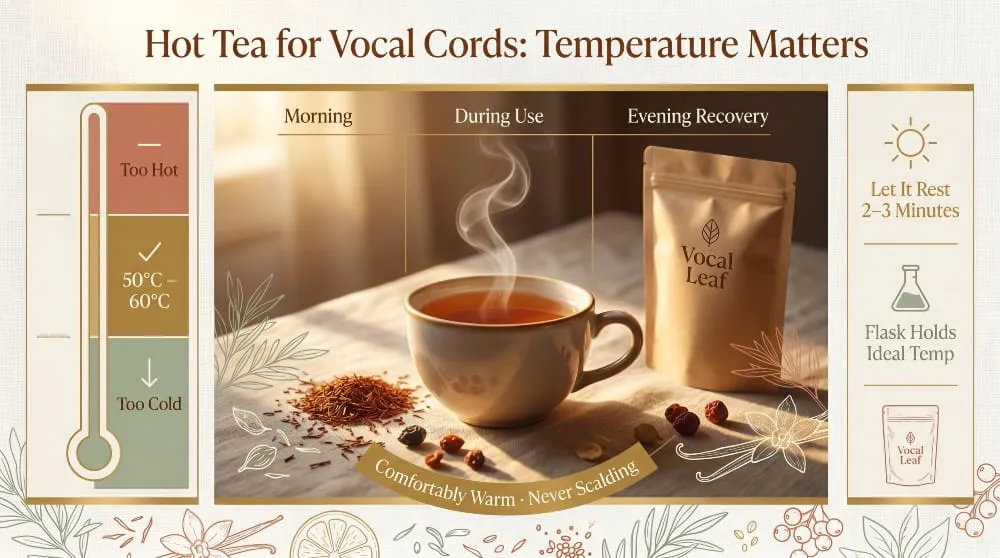
A useful benchmark: the ideal temperature for tea that supports vocal cord health is between 50°C and 60°C, warm enough to feel genuinely soothing, cool enough to sip without caution. Most teas brewed at the boiling point reach this range within two to three minutes of resting.
Timing this into a vocal care routine is straightforward. Brew your tea, set it aside while you prepare for the day or wind down after voice use, then return to it when it has reached that comfortably warm point. The tea is more enjoyable to drink at this temperature, it is kinder to a sensitive throat, and the hydration benefit is the same regardless of whether you drink it at 95°C or 55°C.
Morning: brew Organic Loose Leaf Black Tea or Lemon Berry Dream, let it rest for 2 to 3 minutes, then sip slowly while the voice warms up for the day.
During voice use, keep a flask of warm Organic Rooibos Chai to hand. Vacuum flasks hold tea at exactly the right temperature range for several hours, making consistent vocal hydration easy without repeated brewing.
Evening recovery: Vanilla Bliss, brewed warm and allowed to cool to a comfortable sipping temperature, is an ideal end-of-day vocal care ritual. Caffeine-free, smooth, and gentle enough to drink close to bedtime.
How to Keep Vocal Cords Hydrated (Beyond Tea)
Tea is one of the most effective tools for vocal cord hydration, but it works best as part of a broader approach. The voice professionals who maintain the most consistent vocal health do not rely on tea alone; they build hydration and recovery habits around it that keep the vocal cords in good condition before strain sets in, rather than responding to it after the fact.
What Vocal Cord Hydration Actually Means
Vocal cord hydration operates on two levels that are worth understanding separately.
Systemic hydration is the water content of your entire body. Your vocal cords are surrounded by mucous membranes that depend on whole-body fluid levels to stay moist. When you are dehydrated, from not drinking enough fluid, from caffeine, from alcohol, from a dry environment, or simply from a long, demanding day, those membranes dry out, and the vocal cords begin to feel tight, scratchy, and effortful to use. No amount of sipping tea immediately before a performance fixes systemic dehydration; it has to be maintained consistently across the whole day.
Surface hydration is the moisture directly on and around the vocal cord tissue. This is what steam addresses. Surface hydration responds faster than systemic hydration, which is why a few minutes of steam can make the voice feel noticeably better in the short term, even when overall fluid intake has been low.
Both matter. A complete vocal hydration strategy addresses them together.
Water Intake: The Foundation Everything Else Builds On
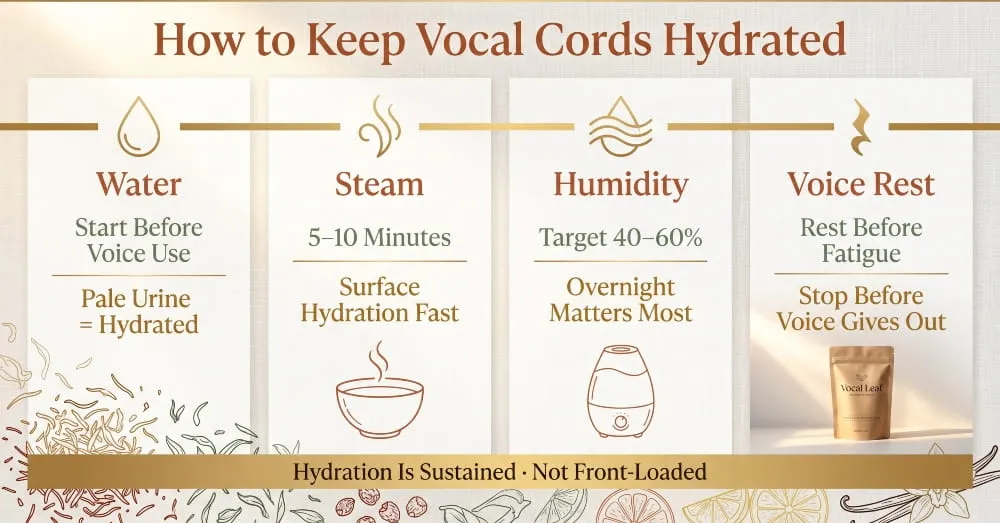
Warm loose-leaf tea contributes to your daily fluid intake, but it does not replace water. The general guidance for vocal health is to drink enough fluid that your urine stays pale, a simple and reliable indicator of adequate systemic hydration. For most adults in most climates, this means around two litres of fluid per day, with more on days of heavy voice use, physical exertion, or hot weather.
The practical approach for voice-intensive days is to start hydrating before your voice is under load. Drinking water consistently from the moment you wake up, alongside or between your morning tea, means your vocal cords arrive at their first period of heavy use already well-hydrated, rather than playing catch-up. By the time your throat feels dry or tight, systemic dehydration is already several hours old.
Steam, Fast Surface Hydration for a Strained Voice
Steam inhalation is one of the most effective short-term tools for vocal cord comfort, particularly when the voice feels dry, tight, or hoarse after extended use. Unlike drinking, steam delivers moisture directly to the laryngeal tissue, bypassing the digestive route entirely and providing rapid surface hydration that can make the voice feel noticeably more comfortable within minutes.
A simple steam routine for vocal cord recovery:
- Boil water and allow it to cool for two to three minutes so it is steaming but not aggressively hot
- Lean over the bowl at a comfortable distance, close enough to feel the warmth without discomfort
- Drape a towel over your head to concentrate the steam
- Breathe slowly and naturally for five to ten minutes
A personal steam inhaler achieves the same effect more efficiently and is worth the investment for anyone who uses their voice professionally. Used once or twice a day during periods of vocal strain, steam inhalation is one of the fastest ways to restore surface hydration and reduce the tight, scratchy feeling that comes with a worked voice.
Room Humidity, The Silent Variable Most People Miss
Dry air is one of the most common and underestimated causes of vocal cord discomfort, particularly in air-conditioned offices, heated indoor spaces in winter, and long-haul flights. When the air around you is dry, moisture evaporates from the mucous membranes faster than normal, meaning you need to drink significantly more fluid just to maintain the same level of vocal cord hydration you would have in a more humid environment.
A room humidifier running in the spaces where you use your voice most, your home office, bedroom, or recording space, can make a meaningful difference to how your voice feels throughout the day and overnight. Sleeping in dry air is particularly damaging to vocal cord recovery because the body repairs most tissues during sleep, and dry air continuously compromises that process for 7 to 8 hours.
A target indoor humidity range of 40–60% is most commonly recommended for vocal health. Below 30%, which is common in centrally heated homes in winter, vocal cord discomfort during the day and a rough, dry voice in the morning are predictable outcomes.
Voice Rest, What It Actually Means and Why It Matters
Hydration supports recovery, but recovery requires rest. Vocal cord tissue is muscle and membrane; it responds to overuse the same way any other muscle does, with fatigue, inflammation, and reduced performance. Tea, steam, and water all support the recovery process, but none of them substitute for giving the vocal cords actual downtime.
Voice rest does not necessarily mean complete silence. Relative voice rest, reducing the volume and duration of voice use, avoiding shouting, whispering, and throat clearing, and cutting out unnecessary talking during recovery periods, is often sufficient for everyday vocal strain. Complete voice rest (no speaking at all) is a more significant intervention typically recommended for acute vocal cord injury or under medical guidance.
The most important voice-rest habit for most heavy voice users is simply stopping before the voice gives out, rather than pushing through until it does. Vocal cord strain compounds, a voice that is moderately fatigued at the end of Monday is more vulnerable on Tuesday, and so on through the week. Building short periods of vocal rest into voice-intensive days, taking a quiet lunch, and avoiding unnecessary calls in the evening are more sustainable vocal health strategies than attempting to recover from complete vocal fatigue at the weekend.
Signs of Strained Vocal Cords: What to Watch For
Recognising vocal cord strain early allows you to respond before minor fatigue becomes a more significant problem. The most common signs are:
Hoarseness or a rough, gravelly quality to the voice is the most recognisable indicator that the vocal cords are under strain or inflamed. If your voice sounds noticeably different from normal, your vocal cords are telling you something.
Vocal fatigue: the voice tires more quickly than usual, loses power or clarity after relatively short periods of use, or simply feels effortful to produce. This is the earliest and most reliable warning sign.
Reduced range, singers and speakers notice this most acutely. Higher notes feel strained or unavailable, or the voice breaks unexpectedly. Reduced range is a sign of swelling or tension in the vocal cord tissue.
Throat clearing and persistent tickle, the urge to clear the throat frequently, is a sign of irritation. Throat clearing itself is worth avoiding when possible, because the sudden forceful expulsion of air from the cords during a throat clear creates a small but real impact between the vocal cord surfaces that adds to irritation rather than relieving it.
Dryness that does not resolve with drinking, if your throat still feels dry and scratchy despite adequate fluid intake, the problem may be environmental (dry air) or related to mouth breathing rather than systemic dehydration.
If these signs persist beyond a few days of rest and hydration or are accompanied by pain, difficulty swallowing, or significant voice changes, a medical assessment is the appropriate next step.
How to Heal Vocal Cords Quickly: The Complete Short-Term Strategy
When the voice is acutely strained, and you need to recover as efficiently as possible, the approach combines everything above:
Day of strain:
- Stop voice use as soon as possible
- Begin steam inhalation, one session in the afternoon, one in the evening
- Switch to exclusively naturally caffeine-free herbal tea, no caffeine, no alcohol
- Increase water intake above your normal daily baseline
- Check and address room humidity if possible
Recovery day:
- Continue relative voice rest, minimal, low-effort speaking only
- Two to three cups of warm herbal tea spaced across the day
- Morning steam session before any voice use
- Avoid environments with dry air, smoke, or heavy dust
- Sleep in a humidified room if possible
Return to voice use:
- Ease back gradually rather than returning to full load immediately.
- Maintain the tea and hydration routine established during recovery as an ongoing daily habit rather than an emergency measure.
The single most common mistake in vocal cord recovery is returning to full voice use too quickly, even though the voice feels better after a day of rest. Feeling better and being fully recovered are not the same thing; vocal cord tissue that is still inflamed can strain significantly faster on the first day back than it would under normal conditions.
The Best Tea Routine for Vocal Cord Health
Knowing which tea is good for vocal cords is only half the equation. How consistently you drink it, how much you drink, and when you drink it across the day determine whether tea actually makes a meaningful difference to how your voice feels. A single cup when your throat hurts is a comfort measure. A consistent daily routine built around vocal hydration is a genuine vocal care strategy.

How Much Tea to Drink for Vocal Cord Health
Two to three cups of warm tea spread across the day is the practical target for most people focused on vocal cord health. This is not a precise medical prescription; it is the volume that supports consistent throat hydration without requiring you to reorganise your day around tea drinking.
The distribution matters as much as the total. Three cups drunk back-to-back in the morning do less for vocal cord hydration than three cups spaced across morning, midday, and evening, because hydration is a sustained state rather than something you can front-load. The goal is to keep the throat tissue consistently moist throughout the day, particularly during and after periods of heavy voice use.
On days of intensive voice use, long teaching days, extended recording sessions, presentations, or back-to-back calls, consider adding a fourth cup in the early afternoon. This is the window where vocal fatigue typically begins to accumulate, and an extra cup of warm herbal tea at this point can meaningfully extend vocal comfort into the evening.
Best Time to Drink Tea for Vocal Cord Recovery
Timing tea around voice use rather than around habit makes the biggest practical difference to vocal cord recovery. Three windows matter most:
Before voice use, a warm cup in the morning before your voice is under load prepares the throat tissue for the day ahead. Vocal Leaf’s Organic Loose Leaf Black Tea works well here for those who want gentle caffeine to start the day; the L-theanine it naturally contains moderates the caffeine effect, supporting focused energy without the dehydrating spike that unmodified caffeine causes. For a fully caffeine-free morning, Lemon Berry Dream is the cleaner choice, light, smooth, and easy on a throat that has not yet warmed up.
During voice use, keeping warm tea accessible during periods of heavy voice use is one of the most practical things you can do for vocal cord health. A vacuum flask of Organic Rooibos Chai holds temperature in the ideal sipping range for several hours, making it easy to hydrate consistently without interrupting your day to brew fresh tea. The naturally caffeine-free rooibos base means you can drink it steadily throughout the day without accumulating a caffeine load that works against vocal hydration.
After voice use, the recovery window is when consistent hydration does its most important work. Vocal cords that have been under load for hours need rest and moisture to recover properly. The evening tea ritual supports both. Vanilla Bliss is the natural choice for this window, smooth, naturally sweet, caffeine-free, and gentle enough to drink close to bedtime so that hydration and recovery continue through the night rather than stopping when your last cup of tea does.
What to Avoid Alongside Your Tea for Vocal Cord Health
A vocal care tea routine works best when it is not undermined by other habits running alongside it. A few things are worth avoiding when vocal cord health is the priority:
Alcohol, alcohol is a significant dehydrant and inflames the throat lining. Even moderate alcohol consumption on a day of heavy voice use can undo the hydration benefit of several cups of tea. On days when your voice is under strain, avoid alcohol entirely.
Very hot drinks of any kind, this applies beyond tea. Coffee, hot chocolate, or any drink consumed at scalding temperatures adds heat irritation to a sensitive throat. If something is too hot to sip freely, let it cool.
Excess caffeine, one to two cups of a caffeinated drink per day, is manageable for most people even during vocal recovery. Beyond that, the cumulative diuretic effect begins to reduce throat hydration meaningfully. If your voice is under serious strain, switching entirely to naturally caffeine-free loose-leaf tea for the day is the cleanest approach.
Cold drinks immediately before or during voice use can cause the muscles around the larynx to temporarily tighten, increasing the effort required to produce sound and raising the risk of vocal strain. Room-temperature or warm drinks are always the better choice in the hours before voice use.
Vocal Leaf Teas for Vocal Cord Health
Vocal Leaf is the only tea brand built exclusively around vocal health. Every blend is formulated to meet the specific hydration, comfort, and recovery needs of people who depend on their voices, including speakers, teachers, performers, and anyone whose day puts serious demand on their vocal cords. All four blends are available as premium loose-leaf tea, sourced and crafted to the standard that vocal health actually requires.

Lemon Berry Dream, Light, Caffeine-Free, and Built for Daily Vocal Hydration
Lemon Berry Dream is Vocal Leaf’s lightest and most versatile blend, naturally caffeine-free, smooth, and easy to drink consistently throughout the day. The gentle brightness of the lemon notes makes it satisfying without being assertive, so it works equally well as a morning starter or a midday hydration cup when your voice has been in use for several hours.
For vocal cord health, its defining quality is drinkability. The best tea for your vocal cords is ultimately the one you will actually sip consistently, and Lemon Berry Dream removes every barrier to that, no caffeine load to manage, no strong flavour that becomes tiring after the second cup, no astringency that leaves the throat feeling drier than before. Just clean, smooth, naturally caffeine-free hydration designed specifically for vocal health.
Best for: daily vocal hydration, caffeine-free mornings, midday vocal recovery, and anyone who wants a light and easy everyday vocal health tea.
Organic Rooibos Chai, Warming, Caffeine-Free, and Built for Recovery
Organic Rooibos Chai is Vocal Leaf’s warming recovery blend, naturally caffeine-free rooibos with the gentle, soothing depth that makes it the strongest choice when your voice has been under serious strain. Rooibos is naturally caffeine-free, never chemically decaffeinated, and its smooth, full-bodied character means it satisfies like a comfort drink should, without the dehydration risk of caffeinated alternatives.
The warming spice profile, built around the naturally soothing character of ginger, makes it the vocal health equivalent of the ginger tea remedy singers and speakers have instinctively reached for for generations, delivered in a form genuinely designed for vocal health rather than general wellness. It is the tea you reach for after a long day of voice use, when warmth and hydration matter most.
Best for: strained or fatigued vocal cords, post-performance recovery, heavy-voice-use days, and anyone who wants the soothing warmth of ginger in a caffeine-free blend purpose-built for vocal health.
Vanilla Bliss, Smooth, Gentle, and Built for Evening Vocal Recovery
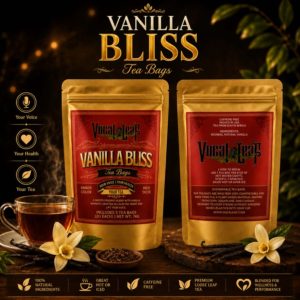
Vanilla Bliss is Vocal Leaf’s evening recovery blend, smooth, naturally sweet without added sugar, and caffeine-free in the way that matters for genuine vocal rest. When the voice has been working hard all day, the recovery that actually moves the needle happens overnight, and that means the last thing you drink before sleep is as important as the first thing you drink in the morning.
Vanilla Bliss is designed for that window. Gentle enough to drink close to bedtime, satisfying enough to make the evening wind-down ritual something worth looking forward to, and smooth enough that even a throat that has been under significant strain during the day finds it easy and comfortable to sip. There is no caffeine to disrupt sleep, no strong flavour that demands attention, and no astringency that adds any friction to a throat that has already done its work for the day.
Best for: evening vocal recovery, post-performance wind-down, anyone who wants a naturally sweet caffeine-free tea that supports overnight vocal rest.
Organic Loose Leaf Black Tea, Clean Caffeine With L-Theanine for Voice-Conscious Energy
Organic Loose Leaf Black Tea is Vocal Leaf’s caffeinated option, and the reason it belongs in a vocal health range is L-theanine. L-theanine is an amino acid that occurs naturally in tea and moderates the stimulant effect of caffeine, smoothing out the sharp energy spike and subsequent crash that unmodified caffeine produces. The result is clean, focused energy that does not deliver the dehydrating jolt that coffee or lower-quality caffeinated teas can.
For people who depend on their voice professionally and cannot simply eliminate caffeine from their day, this matters. A morning cup of Vocal Leaf Black Tea gives you the alertness and focus to perform at your best without the throat-drying caffeine hit that works against vocal cord health. It is the one caffeinated option in the range precisely because it earns its place; the L-theanine profile makes it a genuinely voice-conscious choice, unlike most caffeinated teas.
Best for: mornings before voice-intensive days, anyone who needs gentle caffeine without compromising vocal hydration, a cleaner caffeinated alternative to coffee or standard black tea.
The Right Tea Makes Vocal Cord Recovery Easier
Tea will not repair vocal cord damage or replace rest, but the right tea, drunk consistently, at the right temperature, throughout the day, makes a genuine difference to how your voice feels during and after heavy use. The principles that matter are simple, warm, not hot, naturally caffeine-free where possible, smooth enough to drink in volume; and purpose-built for vocal health rather than general wellness.
Vocal Leaf four blends are designed around exactly these principles: Lemon Berry Dream for light daily hydration, Organic Rooibos Chai for warming recovery after strain, Vanilla Bliss for a smooth evening wind-down, and Organic Loose Leaf Black Tea for mornings when clean, voice-conscious caffeine is part of the day.
Start with the blend that fits your routine, build the consistency, and let the hydration do its work.
Explore the full Vocal Leaf teas range and find the blend that suits your voice.
Frequently Asked Questions (FAQs)
What is the best tea for vocal cords?
The best tea for vocal cords is warm, naturally caffeine-free, and smooth enough to drink consistently throughout the day. Vocal Leaf’s Lemon Berry Dream and Organic Rooibos Chai are the strongest everyday choices, both naturally caffeine-free, purpose-built for vocal health, and easy to sip at consistent volumes that actually support vocal cord hydration.
Does tea help vocal cords?
Yes. Tea helps vocal cords primarily by supporting hydration and providing gentle warmth to a tired or irritated throat. The main benefit is encouraging consistent fluid intake; well-hydrated vocal cords vibrate more freely and recover from strain more comfortably. Tea is a support and comfort tool, not a repair mechanism, but used consistently as part of a daily vocal care routine, it makes a meaningful difference to how your voice feels.
Is tea good for your vocal cords?
Tea is good for your vocal cords when it is warm, naturally caffeine-free, and gentle on the throat. The right tea supports the sustained hydration that vocal cord health depends on. Tea works against vocal cord health when it is too hot, too high in caffeine, or leaves the throat feeling drier after drinking. The full breakdown of when tea helps and when it does not is covered in the Does Tea Help Your Vocal Cords section above.
What tea helps the vocal cords the most?
The tea that helps vocal cords the most is the one you will drink consistently throughout the day at a comfortably warm temperature. In practical terms, a naturally caffeine-free loose leaf tea designed specifically for vocal health, like Vocal Leaf’s range, gives you the most consistent benefit because it removes the caffeine variable that works against vocal hydration while delivering the warmth and comfort your throat needs during recovery.
Is ginger tea good for vocal cord pain?
Ginger tea is a strong choice for vocal cord discomfort caused by overuse or strain. Its naturally warming and anti-inflammatory properties support comfort and hydration in the throat tissue surrounding the vocal cords. It does not reach the vocal cords directly, nothing swallowed does, but it reduces the irritation and tension in the surrounding tissue where much of the discomfort from vocal strain originates. Vocal Leaf’s Organic Rooibos Chai is built around this warming, ginger-forward profile in a naturally caffeine-free base. If vocal cord pain is severe or persistent, consult a medical professional.
Is hot tea good or bad for the vocal cords?
Hot tea is good for vocal cords when it is warm, comfortably warm to sip, not steaming. Very hot tea can irritate an already sensitive throat and worsen inflammation rather than relieve it. The practical rule: if the tea is too hot to sip freely and comfortably, let it cool for two to three minutes before drinking. The full temperature guidance is in the Hot Tea for Vocal Cords section above.
Is green tea good for the vocal cords?
Green tea is a reasonable option for vocal cord health in moderation; one to two cups a day, brewed lightly, is unlikely to cause problems for most people. The limitation is caffeine. Green tea contains enough caffeine to have a mild diuretic effect at higher volumes, which works against the sustained hydration that vocal cord health depends on. For days of heavy voice use or active vocal cord recovery, naturally caffeine-free herbal loose leaf tea is the more reliable choice.
Can tea cause damage to vocal cords?
Tea itself does not cause damage to the vocal cords. The risk comes from temperature; very hot liquids consumed regularly are associated with throat irritation, not from tea as a category. Warm tea consumed at a comfortable sipping temperature carries no meaningful risk of vocal cord damage. Drink it warm, not hot, and choose naturally caffeine-free options when your voice is under strain.
Does tea smooth the vocal cords?
Tea does not physically smooth or coat the vocal cords; nothing swallowed reaches them directly. What warm tea does is reduce dryness and irritation in the surrounding throat tissue, which makes the voice feel more comfortable and easier to use. The sensation of a “smoother” voice after drinking warm tea comes from improved hydration and reduced throat tension rather than any direct effect on the vocal cords themselves.
What kind of herbal tea will soothe vocal cords?
The herbal tea that will soothe vocal cords best is one that is smooth rather than astringent, warming rather than sharp, and easy to drink repeatedly without irritating a sensitive throat. Vocal Leaf’s Lemon Berry Dream and Vanilla Bliss are both built around this profile, naturally caffeine-free, gentle, and specifically formulated for the hydration and comfort needs of vocal health.
Is chicory tea good for the vocal cords?
Chicory tea is generally neutral for vocal cord health and not harmful to most people when consumed warm. Still, it lacks specific vocal health benefits that make it a purposeful choice over a tea designed for vocal health. Its strong, assertive flavour can feel harsh on a sensitive or already irritated throat. For active vocal cord recovery, a smoother, naturally caffeine-free option is the better call.
Does tea with honey help vocal cords?
Tea with honey supports vocal comfort by adding a smooth, soothing feel that makes warm tea easier and more pleasant to sip slowly. Honey does not coat or protect the vocal cords directly, nothing swallowed does, but it reduces the raw sensation in the surrounding throat tissue and encourages the slow, consistent sipping that supports vocal hydration. Add honey to comfortably warm tea rather than boiling tea for the best result. The full details are in the Best Tea for Vocal Cords, What to Look For section above.
Which tea is best for vocal cords, caffeinated or caffeine-free?
For vocal cord health, naturally caffeine-free tea is the stronger choice in most situations. Caffeine has a mild diuretic effect that can work against the sustained throat hydration vocal cords depend on, particularly during days of heavy voice use. Vocal Leaf’s Organic Loose Leaf Black Tea is the exception; its L-theanine content moderates the stimulant effect of caffeine, making it a genuinely voice-conscious caffeinated option for mornings when some caffeine is part of the day. For recovery days and heavy voice use, the full naturally caffeine-free range is the cleaner choice.
Top Selling Products





Best Tea for Singers | What Actually Helps Your Voice
If you sing, whether you perform professionally, teach voice lessons, or spend your weekends in rehearsal, you’ve probably wondered whether tea actually does anything useful…

Best Tea for Laryngitis | Soothe Your Voice Naturally
The best tea for laryngitis is a warm, caffeine free loose leaf blend that hydrates the throat and eases the strain on inflamed vocal cords.…

What Is Chai Tea? The Ultimate Guide to Ingredients, Benefits, Types & How It’s Made
If you’ve ever wondered what chai tea is, you’re not alone. It’s one of the most searched beverage questions online, yet the answer is often…

Best Tea for Your Voice | Does It Make You Sound Deeper
What it can do is change how your voice feels and sounds in the moment, which is where most of the confusion starts. If you…

The Best Tea for Performers & Speakers, And Why Your Voice Deserves Better
You spend hours rehearsing the words. You perfect the tone, the breath, the timing. But then you reach for whatever is nearby, a cup of…
Best Tea for Stress Relief | Calming Loose Leaf Blends
Stress is something everybody carries. It shows up in tight shoulders, restless nights, and a mind that won’t quiet down after a long day. And…

Best Tea for Dry Throat | The Teas That Help and the Ones That Hurt
The best teas for a dry throat are caffeine-free herbal blends, teas with no tannins to strip moisture from the throat lining and no caffeine…

Best Teas for Acid Reflux, Heartburn and GERD
Acid reflux doesn’t just cause heartburn. If you have searched for tea good for acidity, you are asking the same question, acidity and acid reflux…

Best Morning Tea for Energy and Focus Without Coffee Crash
The best tea to drink in the morning is black tea if you want steady, coffee level energy without the crash, rooibos chai if you…

Best Tea for Cough | The Complete Guide to Soothing Relief
The best tea for cough relief is a warm, hydrating blend that soothes irritated throat tissue while easing the reflex that triggers coughing in the…

Best Teas for a Cold That Actually Work
Best teas for a cold combines warmth, hydration and gentle steam to ease congestion, calm a scratchy throat and help your body rest while it…

Best Teas for Inflammation | Guide to Nature’s Most Powerful Anti-Inflammatory Herbs
The best tea for inflammation depends on where and how inflammation is affecting you. For systemic and gut inflammation, rooibos and black tea offer daily…