
Best Tea for Phlegm in Throat | What Actually Clears It (and What Doesn’t)

There is nothing more distracting than that persistent, sticky feeling at the back of your throat, the kind that makes you constantly clear your throat mid-conversation, mid-song, or mid-sentence. If you’re a singer, teacher, speaker, or podcaster, you already know how quickly excess phlegm can derail your performance and your day.
The good news? The right cup of tea can make a real difference. The right kind of tea, brewed the right way, works with your body to loosen, thin, and clear phlegm naturally, without harsh sprays or chemical shortcuts.
But not all teas are created equal when it comes to throat phlegm. Some genuinely help. Some do very little. And a few can quietly make the problem worse if you’re not careful.
In this guide, you’ll find out exactly which teas are best for phlegm in the throat, what makes them work at a biological level, and how to use them for real, lasting relief, especially if your voice is your livelihood.
What Is Throat Phlegm, And Why Won’t It Go Away?
Most people use “mucus” and “phlegm” interchangeably, but there’s actually a meaningful difference, and understanding it helps explain why throat phlegm can feel so stubborn and hard to shift.
The Difference Between Mucus and Phlegm
Mucus is always present in your body. It lines your nose, throat, and airways continuously, acting as a protective barrier that traps dust, allergens, and bacteria before they can cause damage. Under normal conditions, you don’t notice it at all.
Phlegm is different. It’s a thicker, denser form of mucus produced specifically in the respiratory tract, your throat, lungs, and bronchial tubes, usually in response to irritation or infection. When something irritates your airways, your body ramps up production, and the result is that heavy, coating sensation at the back of your throat that just won’t seem to go away, no matter how many times you clear it.
What Causes Excess Phlegm Buildup in the Throat
Phlegm doesn’t appear without reason. The most common triggers include viral infections such as colds and flu, seasonal allergies, dry air, acid reflux, and environmental irritants such as dust, smoke, or pollution. Even dehydration can play a role when your body isn’t getting enough fluids; mucus thickens and becomes much harder to clear naturally.

Diet can also be a silent contributor. Certain foods and drinks cause mucus production to spike or thicken existing phlegm, which is why what you consume throughout the day matters just as much as any remedy you reach for.
Why Singers, Teachers, and Speakers Struggle With Phlegm Most
If your voice is central to your work, throat phlegm hits differently. Singers, teachers, public speakers, and podcasters rely on clear, unobstructed vocal folds to produce clean, controlled sound. Even a thin layer of excess mucus sitting on or near the vocal cords creates audible interference, the crack, the rumble, the constant urge to clear your throat that throws off your delivery.
The problem is compounded by the fact that heavy voice use can irritate the throat lining, triggering a response that increases mucus production. It becomes a frustrating cycle: the more you use your voice, the more phlegm builds up, and the more you have to fight through it just to sound like yourself.
That’s exactly why finding a reliable, throat-safe way to manage phlegm isn’t a luxury for voice professionals; it’s a daily necessity.
Does Tea Actually Help With Phlegm? Here’s What’s Really Happening
Before reaching for a cup every time your throat feels congested, it helps to understand why tea works, because the mechanism is more specific than most people realize. Tea isn’t a universal fix. When it works, it works for clear physiological reasons. And when it doesn’t, there are equally clear reasons for that too.

How Warm Liquids Loosen Throat Phlegm
The temperature of what you drink matters more than most people give it credit for. Warm liquids increase blood circulation to the throat lining, which helps relax the muscles surrounding the airway and encourages the body to thin out accumulated mucus. Think of thick phlegm the way you’d think of cold honey; it moves slowly and clings to everything. Warmth changes its consistency, making it far easier for your body to move and expel naturally.
There’s also a direct soothing effect on the throat tissue itself. When phlegm buildup is accompanied by inflammation or irritation, which it usually is, warm liquid provides immediate comfort while simultaneously addressing the underlying congestion.
The Steam + Hydration Effect Explained.
A cup of tea delivers two therapeutic actions at once. The first is internal hydration. Staying well-hydrated is one of the most effective ways to thin mucus secretions throughout your entire respiratory tract, and tea contributes meaningfully to your daily fluid intake. Thinner mucus moves more freely and clears far more easily than the thick, sticky variety that builds up when you’re under-hydrated.
The second action is steam inhalation. As you hold a hot cup close and breathe naturally while drinking, the warm vapor you inhale works directly on your nasal passages and upper airway, loosening congestion from the outside in, while the liquid works from the inside out. Together, these two effects make a well-brewed loose leaf tea genuinely useful for throat phlegm in a way that cold drinks simply cannot replicate.
Why Does Tea Sometimes Make Throat Phlegm Worse?
This is a question worth taking seriously, because it does happen, and it tends to catch people off guard when they’ve turned to tea specifically for relief.
The most common culprit is adding dairy. Milk, cream, or certain creamers can thicken mucus and increase phlegm production in some people, which directly cancels out the clearing effect you’re looking for. If your tea routine includes any dairy, that small habit could be the reason your phlegm never fully clears.
Temperature shock is another overlooked factor. Drinking tea that’s too hot can actually irritate the throat lining, triggering a protective mucus response rather than reducing one. The sweet spot is warm to comfortably hot, not scalding.
Finally, high-tannin teas consumed in excess can have a drying effect on the throat, paradoxically prompting the body to produce more mucus to compensate: moderation and balance matter. The goal is consistent, steady hydration and warmth, not flooding your system with back-to-back cups of overly strong brew.
The takeaway is simple: tea works best for throat phlegm when it’s warm, dairy-free, and brewed with intention. Get those basics right, and you’ll notice the difference quickly.
Best Teas for Phlegm in the Throat That Actually Work
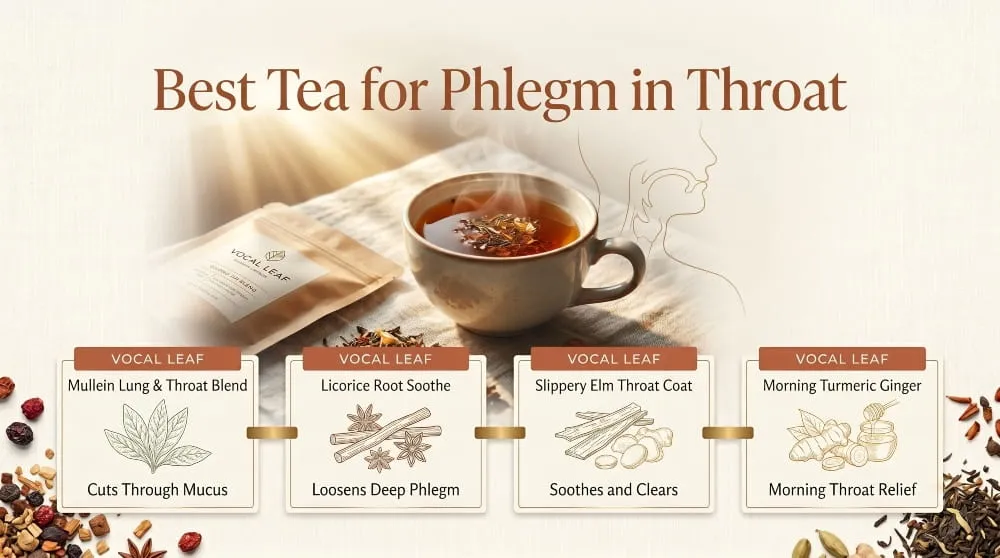
Not every tea earns a place in a serious throat care routine. The teas worth reaching for when phlegm is the problem share a few key qualities: they’re warm-brewed, naturally hydrating, free of additives that thicken mucus, and formulated with ingredients that actively support your vocal tract rather than just sit in it. These four Vocal Leaf blends check every box.
Vocal Leaf Lemon Berry Dream, Citrus and Berry Clarity for Congested Throats
Lemon Berry Dream is the go-to choice when phlegm feels thick, coating, and impossible to shift. The bright citrus profile does more than taste refreshing; the natural acidity works to cut through mucus buildup, while the berry elements bring a soothing quality that calms the irritated throat tissue that often accompanies excess phlegm. It’s a clean, vibrant brew that feels like it’s doing something the moment it hits the back of your throat.
For singers and speakers who need their voice to feel clear and unobstructed before a performance or a long day of talking, this is the blend to start with. Brew it warm, drink it slowly, and let the steam work alongside the liquid.
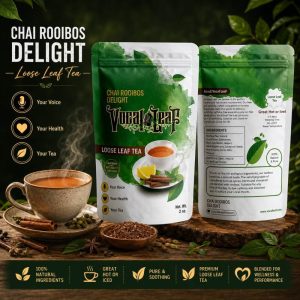
Vocal Leaf Organic Rooibos Chai, Deep Warmth That Loosens Throat Phlegm
When phlegm sits deep and heavy, you need warmth that penetrates, and Organic Rooibos Chai delivers exactly that. The warming spice blend creates a sustained heat that encourages mucus to thin and move naturally, making it one of the most effective options for loosening stubborn throat phlegm rather than just masking the sensation.
Rooibos, as a base, is particularly well-suited for voice users because it’s naturally caffeine-free, meaning you can brew it throughout the day without the dehydrating effect that comes with excessive caffeine consumption, dehydration being one of the primary drivers of thick, persistent phlegm in the first place. Rich, aromatic, and genuinely functional, this blend works hard in every cup.
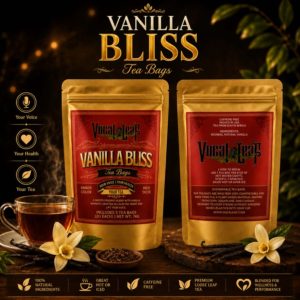
Vocal Leaf Vanilla Bliss, Smooth Relief for Phlegm and Throat Soreness Together
Phlegm rarely arrives alone. More often than not, it comes paired with a raw, irritated, or inflamed throat, especially for voice professionals who push through congestion rather than resting. Vanilla Bliss is the blend built for exactly that combination.
Its smooth, rounded profile makes it exceptionally gentle on an already aggravated throat lining. At the same time, its anti-inflammatory properties work beneath the surface to address the underlying irritation that keeps mucus production elevated. There’s no sharpness, no astringency, just a calm, coating warmth that supports both phlegm relief and tissue recovery simultaneously. It’s particularly effective in the evening, when your throat needs to recover from a full day of use.
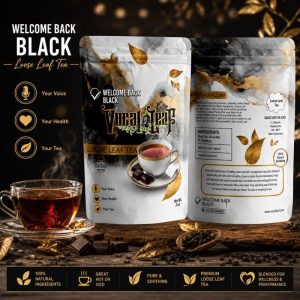
Vocal Leaf Organic Black Tea, Bold, Purposeful Support for Throat Clearing
Organic Loose Leaf Black Tea takes a different approach, one grounded in the natural compounds found in a well-crafted, full-bodied black tea. The depth and warmth of a properly brewed black tea support circulation in the throat, encourage mucus thinning through sustained heat and hydration, and provide the kind of robust, grounding cup that works particularly well in the morning, when phlegm tends to be at its thickest after hours of inactivity overnight.
The key with black tea is preparation. Brew it clean, no dairy, no heavy additives, and keep the temperature in the warm-to-hot range rather than boiling. Done right, it’s one of the most satisfying and effective teas for phlegm in the throat you can start your morning with.
Tea for Sore Throat and Phlegm, Addressing Both at Once
Phlegm and throat pain are frequent companions. Whether it’s the early stages of a cold, the aftermath of a long performance, or the result of prolonged vocal strain, the two symptoms tend to show up together, and when they do, you need a tea that can handle both without compromising on either.

The challenge is that sore throat and phlegm, while related, have slightly different needs. Phlegm relief requires warmth and thinning action. Throat pain relief requires soothing, coating, and anti-inflammatory support. The good news is that the right loose-leaf blend addresses both mechanisms in a single cup.
When Phlegm Comes With Throat Pain
The combination of phlegm and throat soreness usually signals one of two things: active irritation or active recovery. In the irritation phase, whether from infection, allergies, or vocal overuse, the throat lining is inflamed, mucus production is elevated, and every swallow reminds you that something is wrong. In the recovery phase, the inflammation begins to subside, but phlegm can linger long after the pain fades, sitting stubbornly in the throat even when you feel mostly better.
Understanding which phase you’re in helps you choose how to use your tea. During active irritation, frequency matters; warm, steady sipping throughout the day keeps the throat hydrated and the mucus moving. During recovery, consistency is what carries you across the finish line.
Best Vocal Leaf Teas for Combined Sore Throat and Mucus Symptoms
When both symptoms are present, two blends stand out as the strongest all-round choices.
Vanilla Bliss is the first choice for combined sore throat and phlegm because its smooth, anti-inflammatory profile works on both fronts simultaneously. It soothes the inflamed tissue responsible for throat pain, while its warmth thins the mucus that causes congestion. It’s gentle enough to drink when your throat is at its most raw and sensitive, making it the ideal blend for the acute phase of symptoms.
Lemon Berry Dream is the stronger choice once the worst of the soreness has passed, and phlegm is the dominant remaining symptom. The citrus-forward profile cuts through lingering mucus with more assertiveness, helping you clear your throat and recover your full vocal clarity faster. It also delivers a brightness that feels energizing during the draining later stages of recovery.
For those who need maximum warmth alongside both-symptom relief, Organic Rooibos Chai rounds out the approach. Its deep, spiced warmth supports the body’s natural recovery process while continuing to loosen phlegm throughout the day.
How to Brew for Maximum Throat Relief
Brewing for symptom relief is slightly different from brewing for everyday enjoyment. A few small adjustments make a meaningful difference in how effective your cup actually is.
Water temperature should be warm to comfortably hot, around 90°C or just below a rolling boil. Boiling water can strip some of the more delicate beneficial compounds from loose-leaf blends and can also shock an already sensitive throat. Let the kettle settle for thirty seconds before you pour.
Steep slightly longer than you normally would; an extra minute or two allows a fuller extraction of the blend’s soothing properties. Then drink slowly and deliberately, letting the warmth coat your throat with each sip rather than rushing through the cup. Hold the mug close and breathe in the steam between sips; this simple habit adds a meaningful layer of relief that most people overlook.
Aim for three to four cups spread across the day rather than consecutive cups in a short window. Consistent, steady warmth and hydration throughout the day outperforms any single heroic dose.
Tea That Clears Phlegm in the Throat vs. Tea That Makes It Worse
Choosing tea for throat phlegm isn’t just about picking the right blend; it’s equally about avoiding the habits and choices that quietly work against you. Many people drink tea consistently and still wonder why their phlegm never fully clears. More often than not, the answer isn’t the tea itself. It’s everything surrounding how it’s prepared, what’s added to it, and what it’s brewed from.

What to Avoid When Phlegm Is Your Main Complaint
The single most counterproductive habit is adding dairy. Milk, cream, or any dairy-based addition to your tea has a well-documented tendency to thicken mucus secretions in many people, making phlegm heavier and harder to clear rather than easier. If you’ve been drinking tea regularly without noticing much improvement in your throat congestion, this is the first thing to eliminate, and the change is most likely to produce immediate results.
Beyond dairy, heavily sweetened teas are worth reconsidering. Excess sugar can create an internal environment that promotes inflammation and elevates mucus production, the opposite of what you need when your throat is already congested. A small amount of raw honey is a far better choice if you need sweetness, as it contributes soothing properties rather than working against them.
Caffeinated options consumed in large quantities can also contribute to the problem indirectly. Caffeine is a mild diuretic, and even moderate dehydration can make existing phlegm thicker and stickier. This doesn’t mean avoiding caffeine entirely; it means balancing each caffeinated cup with adequate water intake throughout the day.
Temperature, Steeping, and Preparation Tips That Matter
How you brew matters just as much as what you brew. Water that’s too hot, at a full, aggressive boil, can irritate an already sensitive throat and degrade the more delicate beneficial compounds in your loose-leaf blend before they ever reach your cup. The ideal temperature sits just below boiling, around 90°C, where extraction is thorough without being harsh.
Steeping time is equally important. Under-steeped tea yields a thin, watery cup with minimal therapeutic value. Over-steeped tea, particularly with black tea blends, can produce excessive astringency that dries the throat rather than soothing it. Follow the recommended steep time for each blend and adjust it slightly upward by a minute or so when brewing specifically for throat relief rather than pure flavour.
Drink your tea while it’s still genuinely warm. A cup that has cooled to room temperature loses most of its phlegm-loosening benefit because the warmth is doing as much work as the liquid itself. Small, steady sips while the tea is warm, rather than drinking it quickly or letting it sit, is the most effective approach.
Loose Leaf vs. Bagged Tea: Does It Make a Difference for Phlegm?
For everyday drinking, the difference between loose leaf and bagged tea is a matter of preference. For throat phlegm specifically, it becomes a more meaningful distinction.
Bagged teas are typically made from smaller, more broken tea particles, often referred to as fannings or dust, which have a larger surface area relative to their mass. This leads to faster extraction but also faster degradation of the more complex beneficial compounds in the leaf. The result is a cup that tends to be sharper, more astringent, and less nuanced in its effect on throat tissue.
Loose-leaf tea uses whole or minimally broken leaves, which brew more slowly and produce a fuller, more complex cup. The compounds that support mucus thinning, throat soothing, and hydration are better preserved and more fully expressed. For someone dealing with persistent throat phlegm, especially a voice professional who needs real, reliable results, that difference is worth paying attention to.
Vocal Leaf blends are crafted as loose leaf specifically for this reason. The quality of what goes into your cup directly shapes what comes out of your throat.
How to Use Tea to Loosen Throat Phlegm, Step-by-Step
Knowing which tea to drink is only half the equation. How you use it determines whether you get genuine, consistent relief or just a warm cup that does very little. The good news is that optimizing your tea routine for throat phlegm doesn’t require dramatic changes; a few deliberate adjustments to temperature, timing, and frequency make a significant difference in how quickly and completely your throat clears.
Optimal Water Temperature for Phlegm Relief
Temperature is the variable most people never think to question, and it’s one of the most consequential. The common instinct is to brew as hot as possible, the hotter the better for a sore, congested throat. In practice, the opposite extreme causes problems.
Water at a full rolling boil sits at 100°C and is genuinely too aggressive for both the tea and your throat. It degrades delicate, beneficial compounds in the leaf before they fully dissolve into your cup, and it can further inflame already-irritated throat tissue from excess mucus and congestion. The result is a cup that’s harsh where it should be soothing.
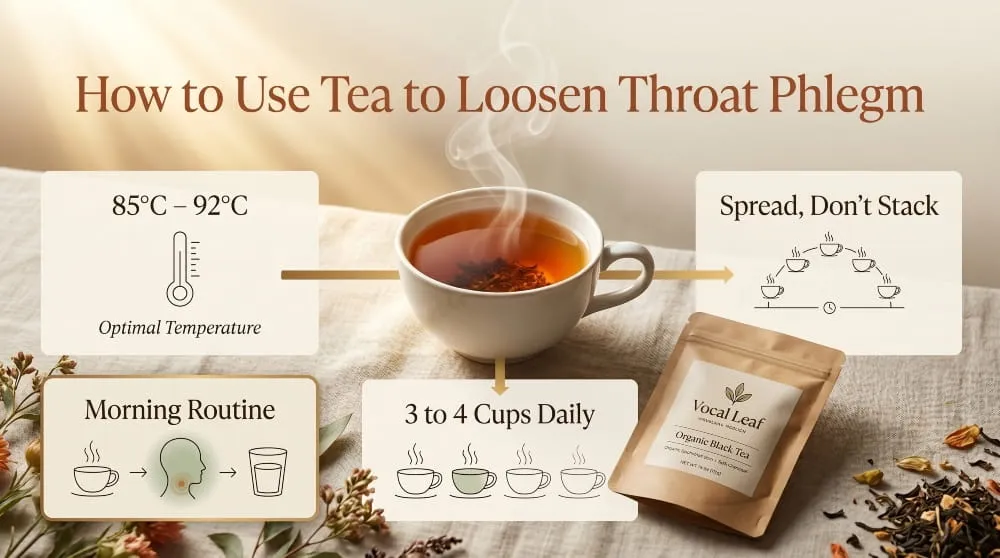
The optimal range for throat phlegm relief is 85°C to 92°C, hot enough to fully extract the blend’s beneficial properties and deliver meaningful therapeutic warmth to the throat, but gentle enough not to cause additional irritation. In practical terms, this means bringing your kettle to a boil and then letting it rest for 45 to 60 seconds before pouring. That small pause makes a noticeable difference in both flavour and effect.
How Many Cups Per Day?
For general maintenance, keeping throat phlegm at bay on a normal day, two to three cups spread across the day is the right target for most people. Morning, midday, and early evening cover the full arc of the day, keeping your throat consistently hydrated and warm enough to manage mucus naturally.
When phlegm is actively heavy, during illness, high-pollen periods, or after extended vocal use, increasing to three to four cups is appropriate and beneficial. The keyword is spread. Consecutive cups consumed in a short window provide a brief flood of warmth and hydration followed by a long dry period, which is less effective than steady, evenly spaced intake throughout the day.
There’s no meaningful benefit to exceeding four to five cups daily for most people, and with caffeinated blends, excessive intake introduces the dehydration risk that works directly against phlegm relief. If you’re reaching for more than five cups, plain warm water between servings is a smarter supplement than additional tea.
Morning Routine for Phlegm-Prone Voices
For singers, speakers, podcasters, and teachers, morning is when throat phlegm is typically at its worst. After hours of sleep with reduced swallowing, reduced movement, and potentially dry indoor air, mucus thickens and settles overnight, leaving the voice feeling foggy, heavy, and unreliable first thing in the morning.
A deliberate morning tea routine addresses this directly and sets the vocal tract up for a full day of use.
Start before you speak. Before any vocal warm-up, rehearsal, recording, or teaching, drink your first cup slowly over ten to fifteen minutes while the tea is still genuinely warm. This is not a rushed, pre-commute habit; it’s a functional vocal-preparation step. Vocal Leaf Organic Black Tea works particularly well here, its bold warmth cutting through overnight phlegm buildup with purpose and clarity.
While drinking, lean into the steam. Hold the cup at chest height and breathe naturally. The warm vapor reaches your nasal passages and upper airways simultaneously, adding a secondary layer of loosening that accelerates the clearing process before your voice is even used.
Follow your first cup with a glass of room-temperature water before moving on with your day. The combination of warm tea and room-temperature water immediately after is one of the most effective morning habits a voice professional can build, and one of the simplest.
Tea for Phlegm in Throat and Lungs: Is It the Same?
It’s a reasonable question, and the answer matters more than most people realize. Throat phlegm and lung phlegm feel related because they’re both mucus, both uncomfortable, and both seem to respond to warm drinks. But they originate in different parts of the respiratory system, behave differently in the body, and respond to tea in meaningfully different ways.

Upper Respiratory vs. Lower Respiratory Phlegm
Upper respiratory phlegm, the kind that sits in your throat, coats your vocal cords, and triggers that constant urge to clear, originates in the throat, nasal passages, and upper airway. It’s directly influenced by what you eat, drink, breathe, and how well hydrated you are. This is the phlegm that tea addresses most effectively, because warm liquid and steam make direct, immediate contact with the tissue producing it.
Lower respiratory phlegm originates deeper, in the bronchial tubes, airways, and lungs themselves. It’s associated with chest congestion, productive coughs, and the heavy, tight feeling that comes with more serious respiratory conditions. It sits further from the reach of what you drink and inhale, which changes the equation considerably when it comes to what tea can realistically accomplish.
The two types can coexist; a chest cold, for example, often produces both simultaneously, but they shouldn’t be treated as identical problems with identical solutions.
What Tea Can and Can’t Do for Lung Congestion
Tea is genuinely effective for throat phlegm because it works directly on the problem. Warm liquid hydrates the throat lining, steam reaches the upper airway, and the right blend supports the body’s natural mucus-thinning process right where the congestion is occurring.
For lung congestion, tea plays a supporting role rather than a primary one. The systemic hydration provided by consistent tea drinking throughout the day does help thin mucus throughout the entire respiratory tract, including the lungs, which can make a productive cough more effective and chest congestion somewhat easier to manage. The steam from a hot cup also offers mild relief by opening the airways slightly, easing the sensation of tightness that often accompanies phlegm in the lower respiratory tract.
What tea cannot do is treat an infection, clear a significant bronchial blockage, or replace targeted medical intervention when the lungs are genuinely compromised. It supports the body. It doesn’t substitute for treatment.
When to See a Doctor vs. When Tea Is Enough
For the vast majority of throat phlegm situations, such as seasonal congestion, post-nasal drip, vocal strain, mild illness, or dry air irritation, warm loose-leaf tea is a safe, effective, and entirely sufficient first response. If your symptoms are confined to the throat and upper airway, improving over time, and not accompanied by fever or significant systemic symptoms, a consistent tea routine combined with adequate hydration is likely all you need.
The calculation changes when symptoms move deeper or become more severe. If phlegm is accompanied by persistent chest tightness, a productive cough that lasts more than two to three weeks, shortness of breath, blood in the mucus, or a fever that won’t resolve, these are signals from your body that something beyond throat congestion is happening, and that a medical professional needs to be part of the picture.
Tea is a powerful daily tool for vocal health and the management of throat phlegm. Knowing the boundaries of what it can do allows you to use it with confidence and to recognize the moments when it’s time to seek more than a cup can offer.
Conclusion
Throat phlegm is frustrating, but it’s manageable, and the right tea routine makes a genuine difference when it’s built on the right knowledge. Now you know which teas actually work, why they work, how to brew them for maximum effect, and where the limits of tea’s role genuinely lie.
Whether you’re a singer protecting your voice before a performance, a teacher pushing through a long day, or simply someone tired of that persistent coating at the back of your throat, consistency is what delivers results. Warm, loose leaf, dairy-free, and spread throughout the day.
Vocal Leaf blends are crafted specifically for voices that can’t afford to be compromised. Start with the blend that matches your symptoms, build the habit, and let your throat remind you what clear actually feels like.
Frequently Asked Questions (FAQ’s)
What Tea Is Good for Phlegm in the Throat?
The best teas for phlegm in the throat are warm, dairy-free, and brewed from high-quality loose leaf blends. Vocal Leaf’s Lemon Berry Dream and Organic Rooibos Chai are particularly effective; the citrus profile cuts through mucus while the warming spice blend loosens and thins stubborn throat phlegm naturally.
Does Herbal Tea Help Clear Phlegm From the Throat?
Yes, herbal tea helps clear phlegm from the throat primarily through warmth, hydration, and steam. Warm liquid thins thick mucus, making it easier for the body to move and expel it, while the steam from a hot cup simultaneously loosens congestion in the upper airways.
Why Does Tea Sometimes Increase Throat Phlegm?
Tea can increase throat phlegm when dairy is added, when it’s brewed too hot and irritates the throat lining, or when highly caffeinated blends are consumed in excess, which can cause mild dehydration. Drinking warm, dairy-free tea, in moderation, eliminates all three triggers.
What is the Best Tea for Phlegm and a sore throat together?
Vocal Leaf Vanilla Bliss is the strongest choice for combined phlegm and sore throat symptoms. Its smooth, anti-inflammatory profile soothes irritated throat tissue, while its warmth helps thin and clear mucus. For lingering phlegm after soreness fades, Lemon Berry Dream delivers sharper, mucus-cutting clarity.
Can Loose Leaf Tea Help With Throat Phlegm Better Than Bagged Tea?
Yes, loose leaf tea preserves more of the whole leaf’s beneficial compounds than bagged tea, which is typically made from smaller broken particles that brew faster but with less therapeutic depth. For consistent throat-phlegm relief, loose leaf delivers a fuller, more effective cup with every brew.











)
&description=&image=https://vocalleaf.com/wp-content/uploads/2026/04/Best-Tea-for-Phlegm-in-Throat-1024x572.webp)