
Best Tea for Throat Health | How to Choose the Right Cup

Your throat does more work than you probably give it credit for. Every Word you speak, every breath you take, every meal you swallow depends on tissue that is surprisingly sensitive, and surprisingly responsive to what you put in a cup.
Tea has been one of the most trusted remedies for throat discomfort across cultures for thousands of years, and the reasons go well beyond tradition. Warm liquid soothes irritated tissue on contact. Steam hydrates the airways from the inside out. And depending on what’s in your cup, the botanicals themselves, their antioxidants, anti-inflammatory compounds, and natural mucilage, get to work the moment you take that first sip.
But not all tea is equally good for your throat. The right cup depends on what you’re dealing with: general dryness and irritation after a long day of talking, the tickle that won’t quit, congestion sitting heavy in your chest and throat, or simply a desire to support your vocal health as a daily habit. Each of those situations calls for something slightly different, and choosing well makes a meaningful difference in how quickly and completely your throat recovers.
This guide covers everything you need to know about tea for throat health, what it actually does inside your body, which types work best for specific concerns, what to add to your cup for better results, and the questions most people have about safety, temperature, and daily use. Whether you’re a singer protecting your voice before a performance, a teacher who’s been talking all day, or someone who simply reaches for a warm cup when their throat feels off, you’ll find clear, practical answers here.
Why Tea Is One of the Best Things You Can Drink for Your Throat
There is a reason the instinct to reach for tea when your throat feels off is nearly universal. It is not just comfort, though comfort matters. The physical and biochemical effects of a well-made cup of tea on throat tissue are real, measurable, and act through several mechanisms simultaneously. Understanding why tea is so consistently good for your throat helps you use it more deliberately and choose the right cup for what your throat actually needs.
How Warm Liquid Soothes and Protects Throat Tissue
The moment warm tea passes through your throat, something immediate happens. The heat relaxes the muscles surrounding the larynx, easing the tightness caused by strain, dryness, or irritation. The liquid itself coats the mucosal lining, that thin, delicate layer of tissue responsible for keeping your throat lubricated and protected, providing a temporary but meaningful barrier between inflamed tissue and further aggravation.
This is why sipping tea slowly and consistently tends to outperform drinking it in one go. The goal is sustained contact, not a single flush. Every sip refreshes that coating, keeps the tissue moist, and creates an environment where recovery can actually happen rather than being repeatedly interrupted by dryness, friction, or the rawness that comes from talking, coughing, or simply breathing dry air for hours.
Temperature matters here more than most people realise. Tea that is too hot, above roughly 65°C, can do the opposite of what you intend, further irritating tissue that is already sensitive. The sweet spot is warm enough to feel deeply soothing but cool enough to sip comfortably without pausing. That range is where tea does its best work on throat tissue.

The Anti-Inflammatory and Antioxidant Role of Tea Compounds
Beyond the physical warmth, the compounds dissolved in your cup are doing something the hot water alone cannot. Tea, particularly high-quality loose-leaf tea, delivers a concentrated dose of polyphenols, flavonoids, and antioxidants directly to the tissues that need them most.
These compounds work on the inflammatory response itself. When your throat is irritated or under strain, the tissue swells, blood vessels dilate, and the immune system sends signals that produce that familiar raw, achy sensation. Antioxidants disrupt the oxidative stress that drives this cycle. Anti-inflammatory compounds, present in varying concentrations depending on the tea, help reduce tissue swelling directly rather than simply masking discomfort.
Black tea, for example, is rich in theaflavins and catechins that have documented antimicrobial and anti-inflammatory properties. Rooibos contains aspalathin and nothofagin, two antioxidants found almost nowhere else in the plant kingdom. The specific profile varies by variety, but the principle holds across good-quality teas: you are not just drinking warm water. You are delivering plant intelligence to tissue that is actively asking for support.
This is also why loose leaf tea tends to outperform bagged tea for throat health. Whole and broken-whole leaf tea retains more of its essential oils and polyphenol content, releasing a fuller spectrum of compounds into the cup compared to the fine-particle dust common in standard tea bags.
Hydration, Steam, and the Full-System Effect of a Good Cup
Throat tissue does not exist in isolation. It is part of a connected system, airways, vocal cords, mucous membranes, and the immune response that underlies all of them, and that system depends on hydration to function. Dehydration is one of the most common and most overlooked causes of chronic throat irritation, and it is one of the easiest to address.
Tea solves this problem in two directions at once. Drinking it contributes directly to fluid intake, keeping the mucous membranes hydrated and the vocal folds supple. And breathing the steam from a freshly poured cup delivers moisture to the upper airways in a more immediate way, the warmth opens the nasal passages, the steam hydrates the throat lining from above, and the act of sipping slowly forces a rhythm of calm, deliberate breathing that is itself beneficial when your throat is under stress.
For singers, speakers, teachers, and anyone who uses their voice professionally, this dual hydration effect is not a minor detail. It is the mechanism that separates a genuinely restorative tea habit from simply drinking something warm. A good cup of tea, brewed well, sipped at the right temperature, from high-quality leaves, creates the conditions your throat needs to recover, maintain, and perform.
What Makes a Tea Good for Your Throat, And What Doesn’t
Not every tea earns its place when your throat needs genuine support. Some cups do real work, soothing irritated tissue, reducing inflammation, and keeping the airways hydrated. Others are pleasant enough but largely passive. And a few, depending on how they are made and what they contain, can quietly make things worse. Knowing what separates a throat-supporting tea from a throat-irritating one helps you choose with confidence every time.

Caffeine-Free vs. Caffeinated Tea for Throat Health
Caffeine is a diuretic. Consumed in significant quantities, it pulls fluid from the body, the opposite of what throat tissue needs when it is irritated, strained, or recovering. This does not mean caffeinated tea has no place in a throat health routine, but it does mean the choice deserves some thought.
For acute irritation, dryness, or vocal strain, caffeine-free tea is the stronger option. Without the dehydrating effect, every cup contributes purely to hydration, keeping the mucosal lining moist and the vocal folds supple. Caffeine-free teas also tend to be gentler on already-sensitive tissue; there is no stimulant effect pushing the body toward alertness when rest and recovery are what the throat actually needs.
Caffeinated tea is not without value. Black tea, for instance, carries a meaningful antioxidant load alongside its caffeine, and for someone who is not acutely unwell but wants daily throat support, a well-brewed cup in the morning is far from harmful. The key is balance, pairing caffeinated tea with adequate water intake and leaning toward caffeine-free options in the evening or whenever the throat is noticeably strained.
One important distinction worth knowing: naturally caffeine-free teas, those that never contained caffeine to begin with, like rooibos, are fundamentally different from teas that have been chemically decaffeinated. The chemical decaffeination process can strip beneficial compounds along with the caffeine, leaving residual solvents in the Leaf. If caffeine-free tea is what you want for your throat, naturally caffeine-free is the cleaner choice.
Loose Leaf vs. Tea Bags: Does It Matter?
For everyday drinking, the difference between loose Leaf and bagged tea is easy to overlook. For throat health specifically, it matters more than most people expect.
Standard tea bags are typically filled with fannings and dust, the fine particles left over after whole and broken-whole leaves have been sorted and packaged separately. These particles brew quickly, producing a darker, more astringent cup. Still, the rapid oxidation and smaller surface area mean a significant portion of the delicate polyphenols, essential oils, and volatile compounds have already degraded by the time the bag reaches your cup.
Loose leaf tea preserves the structural integrity of the Leaf. More of the essential oils remain intact. The polyphenol content, the anti-inflammatory and antioxidant compounds that make tea genuinely good for your throat, is fuller and more bioavailable. The cup you get from a quality loose-leaf blend is closer to what the plant actually contains than a processed approximation.
For casual hydration, the gap is less consequential. But if the goal is throat support, real, compound-driven soothing rather than just warm liquid, loose Leaf is worth the small additional effort.
Organic, Additive-Free Tea and Why It Matters for Sensitive Throats
Throat tissue is among the most sensitive in the body. It is constantly exposed, always in contact with whatever passes through, and when it is already irritated or inflamed, its tolerance for synthetic compounds, residual pesticides, artificial flavourings, and chemical processing agents drops considerably.
Conventional tea is one of the most heavily sprayed crops in the world. Unlike many fruits and vegetables, tea leaves are rarely washed before processing; whatever is applied in the field has a direct path to your cup. For a healthy person drinking tea occasionally, this may not be a significant concern. For someone drinking multiple cups a day specifically to support an already-compromised throat, the cumulative exposure is worth taking seriously.
Organic, additive-free tea eliminates that variable. No synthetic pesticide residue. No artificial flavouring compounds that can trigger additional irritation. No chemical processing agents from the decaffeination process. What you steep into your cup is the plant and nothing else, which is exactly what sensitive throat tissue needs.
Artificial flavourings deserve specific mention here. They are common in commercial tea blends and can be a hidden source of throat irritation, particularly for singers and professional voice users whose mucous membranes are more reactive than average. If your throat consistently feels worse after tea rather than better, artificial additives in the blend are often the overlooked reason.
Teas That Can Irritate Your Throat (And Why)
Tea has such a strong association with throat comfort that it can be surprising to learn some teas reliably cause irritation rather than relieve it. The reasons are worth understanding clearly.
Tannins are the most common culprit. These naturally occurring astringent compounds are present in all true teas to varying degrees and are responsible for the dry, slightly puckering sensation in a strong brew. In moderate amounts, tannins are harmless and even beneficial. But in a heavily steeped, highly concentrated cup, especially one drunk on an empty stomach, tannins can strip moisture from the mucosal lining, leaving the throat feeling drier and more irritated than before. Over-steeping is the most frequent cause of this, and it is entirely avoidable: follow recommended steep times and use water that is hot but not aggressively boiling.
Extremely hot tea is another underappreciated irritant. Water at a full rolling boil degrades delicate compounds in the Leaf and can damage already-inflamed throat tissue on contact. Research has linked habitual consumption of very hot beverages to increased throat irritation over time. The fix is simple: let your cup cool for a minute or two before sipping.
Teas with artificial additives, heavily scented blends, and anything with citric acid or synthetic flavour compounds can also provoke a reaction in sensitive throats, as noted above. And while high-caffeine teas are not inherently irritating, the dehydration they can cause over the course of a day creates the conditions in which irritation is much more likely to develop.
The common thread in all of these is preparation and quality. Good tea, brewed correctly and sipped at the right temperature, is rarely the problem. It is usually how the tea is made, what has been added to it, or how strong it has been left to become that turns something inherently soothing into something that works against you.
The Best Types of Tea for Throat Health and Comfort
Throat discomfort is not one thing. The rawness of a strained voice feels different from the persistent tickle that triggers a cough, which feels different again from the heavy, congested pressure that makes every swallow an effort. The best tea for your throat depends on what your throat is actually dealing with, and matching the cup to the condition is where the real difference gets made.

Best Tea for General Throat Soothing and Daily Comfort
For daily throat comfort, the kind of support a singer, teacher, or regular tea drinker wants as a consistent habit rather than a crisis response, the goal is gentle, sustained soothing without any compounds that deplete or overstimulate.
This is where naturally caffeine-free, botanically rich loose leaf blends earn their place. A tea made from smooth, low-tannin leaves with a clean, rounded flavour profile keeps the mucosal lining hydrated, and the throat tissue calm throughout the day. Warm, not hot. Sipped steadily, not gulped. The cumulative effect of drinking the right tea daily is meaningfully different from reaching for it only when something hurts.
Vocal Leaf Lemon Berry Dream Tea was formulated with exactly this kind of daily vocal comfort in mind. Its bright citrus character delivers a gentle cleansing quality that feels naturally soothing on the throat. At the same time, the smooth berry base makes it easy to sip consistently, cup after cup, day after day, without any heaviness or astringency. Naturally caffeine-free, it supports the throat without the dehydrating effect of regular caffeinated tea.
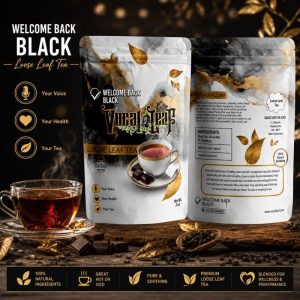
For those who prefer a caffeinated option in the morning without sacrificing throat support, Organic Loose Leaf Black Tea delivers a clean, antioxidant-rich brew. Brewed at the right temperature and not over-steeped, it provides the polyphenol depth of a quality black tea alongside the smooth energy of L-theanine, calm focus without the edge that aggravates a sensitive throat.
Best Tea for Throat Irritation, Tickle, and Dryness
The tickle is its own particular frustration, not painful enough to call it a sore throat, but persistent enough to interrupt speech, trigger a cough at the worst moment, and make a long meeting or performance feel genuinely difficult. It usually signals nerve hypersensitivity in the throat lining rather than significant tissue damage, which means the solution is less about reducing inflammation and more about calming the tissue and restoring moisture.
For throat irritation and dryness, the priority is coating and hydration. A tea that produces a smooth, slightly viscous brew, one that physically stays on the throat lining for a moment rather than passing straight through, addresses the tickle more effectively than something thin and astringent. Warm temperature, slow sipping, and consistent hydration throughout the day matter as much as the tea itself.
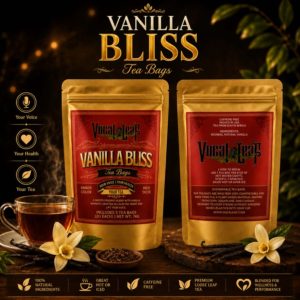
Vanilla Bliss is a strong choice here. Its smooth, naturally rounded botanical profile makes it one of the most comforting teas for a dry throat , irritated, or persistently ticklish. There is no astringency, no sharpness, and no compounds likely to provoke further sensitivity. It is the kind of tea you can sip slowly through an afternoon without thinking about it, which, when the goal is sustained hydration and calm, is exactly the right quality.
Adding a spoonful of raw honey to any cup amplifies this effect considerably. Honey is a natural demulcent; it forms its own soothing layer on irritated throat tissue, extends the coating action of the tea, and brings its own mild antimicrobial properties to the cup.
Best Tea for Throat Congestion and Swelling
When congestion is the dominant symptom, that thick, heavy feeling where the throat and airways feel blocked, swollen, or under pressure, the most useful teas are those with genuine anti-inflammatory properties and enough warmth to help thin and loosen what has built up.
The steam from a freshly poured cup does meaningful work here before you even take a sip. Leaning into it for a moment, breathing slowly, lets the moisture reach the upper airways and begin softening the congestion from above. The tea itself, once sipped, continues that work internally, reducing swelling in the mucosal tissue, keeping the airways hydrated, and creating the conditions in which the body can clear what needs to be cleared.
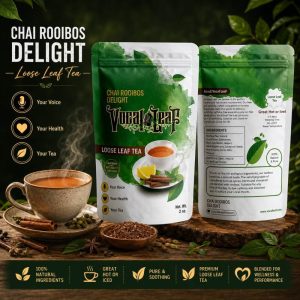
Organic Rooibos Chai is particularly well-suited to congested throats. Rooibos carries a notable anti-inflammatory compound profile, and the warming spice character of the chai blend adds a depth of heat that feels genuinely therapeutic when the throat is heavy and congested. It is caffeine-free, rich rather than astringent, and smooth enough to drink in volume, which matters when consistent hydration is part of what moves congestion along.
Lemon in the cup is a useful addition when congestion is present. The citric acidity helps cut through mucus and supports the body’s natural clearing process, and paired with the warmth of the tea and a spoonful of honey, it creates one of the more effective at-home remedies for a congested throat.
Best Tea for Clearing Your Throat
Chronic throat clearing, that involuntary, repetitive urge to clear that never quite satisfies, is one of the more disruptive throat issues for voice professionals and everyday speakers alike. It is usually a sign of post-nasal drip, mild acid irritation, or excessive mucus sitting at the back of the throat, and the instinct to keep clearing it actually worsens the problem over time by further irritating the vocal folds with each attempt.
Tea helps by addressing the underlying moisture and irritation rather than the clearing reflex itself. Staying consistently hydrated is the most important factor; dry throat tissue produces thicker mucus that is harder to move and more likely to trigger the clearing reflex. A warm cup of tea, sipped regularly throughout the day, keeps the mucus thin enough that the throat can manage it without constant conscious effort.
The right tea for this purpose hydrates without adding to congestion. Dairy-free, additive-free, naturally caffeine-free tea consumed at a moderate temperature is ideal. Lemon Berry Dream works particularly well here; its citrus brightness has a mild clarifying quality that feels clean on the throat, and its smooth profile makes it easy to sip steadily across the day without any heaviness that could compound the issue.
Best Tea for Throat and Lung Health
The throat and lungs share an airway, and what affects one typically affects the other. Teas that support the respiratory system broadly, reducing inflammation, keeping the airways moist, and delivering antioxidants that protect against oxidative stress, serve both simultaneously.
The most useful teas for combined throat and lung support are those with a rich polyphenol profile and anti-inflammatory properties, ideally consumed warm and without dairy. Dairy can thicken mucus and increase congestion in the throat and airways, which is counterproductive when the goal is open, clear, well-functioning respiratory tissue.
Organic Loose Leaf Black Tea brings a high concentration of theaflavins and catechins, antioxidants with documented respiratory-supporting properties, alongside L-theanine, which contributes a calm, focused state that is itself helpful when the body is under stress. For non-caffeinated options, Organic Rooibos Chai offers a complementary antioxidant profile from aspalathin and the warming compounds in its spice blend, making it a strong evening choice when the respiratory system needs support without caffeine’s stimulation.
The ritual matters here as much as the compounds. Sitting quietly with a warm cup, breathing the steam, and sipping slowly is not incidental to the therapeutic effect; it is part of it.
Best Tea for Singers and Vocal Performers
Singers, professional speakers, voice-over artists, and anyone whose livelihood depends on their voice share a specific set of priorities that go beyond general throat comfort. The vocal folds are extraordinarily sensitive tissue. They depend on precise hydration, respond poorly to inflammation and irritation, and can be compromised by substances, caffeine, alcohol, artificial compounds, and highly acidic beverages that a non-performer might tolerate without noticeable effect.
The best tea for vocal performance is one that does no harm first and actively supports second. Naturally caffeine-free, organic, additive-free, low-tannin, and sipped at the right temperature, warm, never scalding. Honey is the single most valuable addition for a performer’s cup, both for its demulcent coating action on the vocal folds and its mild antimicrobial properties.
Timing matters as much as the tea itself. Drinking a well-chosen cup in the hour before performance, not immediately before, as flooding the stomach with liquid has its own complications for breath support, allows the hydration and soothing compounds to reach the mucosal tissue and do their work. A warm cup between sets or during intervals maintains that state.
Vocal Leaf was built around this specific user. Every product in the range is organic, naturally caffeine-free where appropriate, and formulated without the artificial compounds that voice professionals need to avoid. Vanilla Bliss is a particular favourite before performance, its smooth, warming, dairy-free profile soothes the vocal folds without any sharpness or stimulation. Lemon Berry Dream works well for vocal maintenance through a long day of rehearsal or back-to-back sessions, its citrus brightness keeping the throat feeling clear and the airways hydrated without any heaviness that weighs on the voice.
What to Add to Your Throat Tea for Better Results
The tea in your cup is the foundation. What you add to it can meaningfully change how effective that cup actually is for your throat, amplifying the soothing effect, supporting recovery, and turning a good cup into a genuinely therapeutic one. There are only a few additions worth making, but the right ones are worth understanding properly.

Why Honey Is the Most Effective Add-In for Throat Comfort
Of everything you can stir into a cup of throat tea, honey earns its reputation more than anything else on the list. It is not just a sweetener. It is a demulcent, a substance that forms a protective, viscous coating over irritated mucosal tissue on contact. That coating is physical and immediate. The moment honey-laced tea passes through your throat, the tissue gets a layer of protection that stays in place after the liquid itself has moved on.
Raw honey also carries well-documented antimicrobial properties. Its low moisture content, natural hydrogen peroxide activity, and high concentration of plant-derived compounds create an environment that is genuinely hostile to certain bacteria. For a throat dealing with mild infection or the kind of irritation that follows prolonged voice use, these properties add a meaningful second layer to the soothing effect of the tea itself.
The practical advice here is simple but worth stating clearly: use raw honey, not processed. Processed honey is typically heated during production, which degrades the enzymes and antimicrobial compounds responsible for most of its therapeutic value. Raw honey, stirred into a warm, not boiling, cup, preserves those compounds intact. Stirring it into scalding tea defeats the purpose.
One generous teaspoon per cup is the right starting amount. For a throat under significant strain, two teaspoons is reasonable. Beyond that, the sweetness tends to dominate the cup without providing a commensurate benefit to the throat.
Temperature: The Exact Range That Soothes Without Damaging
Temperature is the variable most people never question, and it is one of the most consequential decisions in a throat tea routine. The instinct when the throat hurts is to go as hot as possible, more heat, more soothing. In practice, the extremes work against you in both directions.
Water at a full rolling boil (100°C) is genuinely too hot for both the tea and your throat. At that temperature, delicate polyphenols and essential oils begin to degrade before fully dissolving into the cup, resulting in a harsher, more astringent brew with fewer of the beneficial compounds intact. More importantly for throat health, repeatedly drinking tea at near-boiling temperature has been associated with increased tissue irritation over time. Scalding liquid on already-inflamed tissue is not soothing; it is an additional insult to the same tissue you are trying to protect.
Cold tea presents a different problem. While cold liquid is not inherently harmful to throat tissue, it can cause the muscles around the larynx to tighten, potentially worsening the sensation of irritation and reducing blood flow to tissue that needs good circulation to recover.
The optimal range is between 55°C and 65°C, warm enough to feel deeply comforting, cool enough to sip without hesitation. At this temperature, the tea’s compounds are fully extracted and intact, the warmth relaxes the surrounding musculature, and the liquid coats the throat lining without causing further irritation. In practical terms, this means letting a freshly poured cup sit for 2 to 3 minutes before drinking, or filling the cup with water that has been allowed to cool briefly after boiling, just off the boil, not at the boil.
The test is simple: if you need to blow on it before every sip, it is too hot. If it has cooled to the point where the warmth feels neutral rather than soothing, it has gone too far. Aim for the temperature that makes you want to keep sipping; that intuitive comfort is, in this case, a reliable guide.
Is Hot Tea Safe for Your Throat?
Tea has such a strong association with throat comfort that questions about its safety can feel counterintuitive. But they are worth addressing directly because some reflect genuine concerns backed by research. In contrast, others stem from misunderstandings that lead people to either avoid tea unnecessarily or use it in ways that harm them. Here is a clear, honest answer to the most common questions.

Can Hot Tea Burn Your Throat, And What to Do If It Does
Yes, it is possible to burn your throat with tea, and it happens more often than people realise, usually not from deliberate carelessness but from pouring a fresh cup and drinking it before it has had a chance to cool. The tissue lining the throat and oesophagus is sensitive and not built to tolerate repeated exposure to very high temperatures.
A mild thermal burn from hot tea typically produces a raw, scalded sensation that is noticeable immediately and tends to worsen slightly over the following hour as the tissue responds to the damage. It is usually self-limiting; the mucosal lining of the throat regenerates relatively quickly, and for most people, a minor burn resolves on its own within a day or two.
If you have burned your throat with hot tea, the immediate priority is cooling. Room-temperature water, sipped slowly and steadily, helps lower tissue temperature and begins the hydration process that the damaged lining needs to heal. Avoid anything acidic, spicy, or alcoholic while the throat is recovering, as these can worsen irritation. A spoonful of raw honey, on its own or stirred into lukewarm tea, can provide meaningful relief. Its demulcent properties coat the damaged tissue and create a protective layer as healing progresses.
What you should not do is reach for very hot tea right away to soothe a burned throat. The instinct to comfort with warmth is understandable, but adding more heat to already-damaged tissue slows recovery rather than supporting it. Let the cup cool to a genuinely comfortable temperature, warm, not hot, before returning to your tea routine.
Does Drinking Hot Tea Cause Throat Cancer? What the Research Says
This question circulates widely enough to warrant a careful, evidence-based answer rather than a dismissive one. The concern is real, but the specific detail that matters most is almost always left out of the headline.
The International Agency for Research on Cancer classifies beverages consumed at above 65°C as probably carcinogenic to the oesophagus. This classification applies to the liquid’s temperature, not to the tea itself. The same finding applies to hot water, hot coffee, hot soup, or any other very hot beverage habitually consumed at that temperature over many years. Tea, as a beverage, is not carcinogenic. Scalding-hot liquid consumed repeatedly over decades is the identified risk factor.
The practical takeaway is the same one that appears throughout this guide: let your tea cool to a comfortably warm temperature before drinking. Below 65°C, the research does not support a cancer risk from tea consumption, and at that temperature range, tea delivers its anti-inflammatory and antioxidant benefits intact. This is not a reason to fear tea. It is a reason to drink it at the right temperature, which is also, independently, the temperature at which it does the most good for your throat.
Why Does Tea Sometimes Make My Throat Feel Worse?
If tea consistently leaves your throat feeling more irritated rather than less, there is almost always a specific, identifiable reason, and it is rarely the tea itself in any fundamental sense.
Over-steeping is the most common cause. Leaving tea to brew for longer than recommended releases tannins in concentrations that can strip moisture from the mucosal lining, leaving the throat drier and more irritated than before you drank anything. The fix is straightforward: follow the recommended steep time for your tea, and if you prefer a stronger flavour, use more Leaf rather than increasing the steep time.
Artificial flavourings and additives in commercial tea blends are another frequent culprit, particularly for singers and professional voice users whose mucous membranes tend to be more reactive. If switching to a clean, additive-free loose-leaf tea resolves the irritation, the blend, rather than the tea, was the problem all along.
Temperature, as discussed, matters considerably. Drinking tea too hot adds a thermal irritant to tissue that may already be sensitive. Caffeine consumed in excess across the day can create a low-grade dehydration that manifests as throat dryness and irritation, even when you feel like you are drinking enough. And for a small number of people, a genuine sensitivity to specific compounds in certain teas, tannins, and specific plant acids, means that not all teas agree with their throat equally. Paying attention to which teas produce the response and which do not usually reveals the pattern quickly.
Can Black Tea Irritate Your Throat?
Black tea can irritate the throat in specific circumstances. Still, in normal use, it is not an irritant; it is one of the more throat-supportive teas available, with a rich polyphenol profile and documented anti-inflammatory properties.
The circumstances in which black tea becomes an irritant are consistent and predictable. Over-steeped black tea is high in tannins and significantly more astringent than a correctly brewed cup, and that astringency can dry and irritate sensitive throat tissue. Black tea consumed in large quantities throughout the day can contribute to caffeine-driven dehydration if fluid intake is inadequate to compensate. And black tea with milk, a common preparation, introduces dairy, which can thicken mucus and worsen congestion and throat irritation, particularly for singers and voice users.
Brewed correctly, the right temperature, the right steep time, without dairy, alongside adequate water intake, black tea is genuinely good for the throat. The concern is not the tea. It is the preparation.
Is It Safe to Drink Throat Tea Every Day?
For the overwhelming majority of people, yes, drinking a good-quality, organic, additive-free throat tea every day is not only safe but actively beneficial. The throat, like any tissue under regular use, responds well to consistent hydration and the steady presence of anti-inflammatory and antioxidant compounds. A daily tea habit is one of the simplest, most sustainable things a singer, speaker, or vocal health-conscious person can do.
A few sensible parameters make a daily routine work better. Varying your teas rather than drinking the same very strong brew in large quantities every day gives any single compound, tannins included, less opportunity to accumulate to levels that could irritate. Keeping caffeine-free teas naturally as the backbone of the habit, with caffeinated options as a complement rather than the foundation, maintains hydration as the primary effect. And choosing organic, additive-free loose-leaf tea means your daily exposure is to plant compounds your body recognises and benefits from, not to residual pesticides or artificial additives that accumulate with repeated use.
The throat is not fragile. It is designed for daily use. Treat it well, stay hydrated, and give it the right cup at the right temperature, and a daily tea habit becomes one of the more effortless investments in vocal health you can make.
Vocal Leaf Teas for Throat Health: Our Recommendations
Every tea in the Vocal Leaf range is organic, additive-free, and formulated without the artificial compounds that sensitive throats, and especially professional voices, need to avoid. What follows is an honest account of what each blend does for throat health, who it suits best, and when to reach for it.
Lemon Berry Dream, Bright Citrus Comfort, Naturally Caffeine Free
Lemon Berry Dream is the most versatile tea in the range for daily throat support. Its bright citrus character brings a natural clarifying quality that feels immediately clean on the throat, the kind of cup that cuts through heaviness, refreshes the airways, and leaves you wanting the next sip. The smooth berry base rounds out the brightness without adding any astringency, making it easy to drink consistently across the day without palate fatigue.
Naturally caffeine-free, it contributes purely to hydration every time you pour a cup, no diuretic effect, no stimulant edge, just clean, plant-forward soothing from morning through evening. The lemon character makes it a strong choice when throat congestion or post-nasal drip is present, its mild acidity helping to thin and clear mucus, while the brew’s warmth works on the tissue below.
For singers and voice professionals, Lemon Berry Dream earns its place as a reliable daily companion, during rehearsal, between sets, or simply as a steady hydration habit through a long day of voice use. Add a spoonful of raw honey, and the cup becomes genuinely therapeutic, the honey’s demulcent coating amplifying everything the tea is already doing.
Organic Loose Leaf Black Tea, Antioxidant Strength With Clean L-Theanine Energy
Organic Loose Leaf Black Tea is the right choice when you want the deeper compound profile of a full-bodied tea alongside real, sustained energy, without the jittery edge that makes high-caffeine beverages a bad idea for anyone who needs a steady, controlled voice.
The difference here is L-theanine, an amino acid naturally found in tea leaves that works alongside caffeine to produce a calm, focused alertness rather than a spike-and-crash effect. For a performer about to go on stage, a teacher facing a full day of back-to-back classes, or a professional who needs to be sharp and articulate for hours at a stretch, that combination is meaningfully better for the voice than coffee or heavily caffeinated alternatives that tighten the throat and dry out the airways.
The antioxidant profile of a quality organic black tea, theaflavins, catechins, and polyphenols, also brings genuine anti-inflammatory support to the throat and respiratory tissue. Brewed at the right temperature and not over-steeped, it is one of the most throat-supportive caffeinated teas available. Drink it in the morning or before a performance. Pair it with water throughout the day to offset the mild diuretic effect of the caffeine, and let the L-theanine do what it does best: keep you present without the tension that works against a free, open voice.
Organic Rooibos Chai, Warming, Anti-Inflammatory, Caffeine Free
Organic Rooibos Chai is the most therapeutically rich blend in the range for a throat dealing with congestion, swelling, or the kind of deep, persistent discomfort that settles in after prolonged voice use or the early stages of illness.
Rooibos is the base, and it is worth understanding what makes it genuinely different from most herbal teas. It contains aspalathin and nothofagin, two antioxidant compounds found in virtually no other plant, alongside a broader suite of polyphenols that give it a meaningful anti-inflammatory profile. It is naturally caffeine-free and low in tannins, which means it hydrates without astringency and soothes without the drying effect that over-steeped tea can produce.
The chai spice blend built over that rooibos base adds a second layer of warmth that feels actively therapeutic when the throat and airways are heavy. The cumulative warmth of the spice character reaches into the chest and upper respiratory system in a way that a single-note herbal tea simply does not, making this the most naturally suited blend in the range for combined throat and lung support.
Reach for Organic Rooibos Chai in the evening, when the throat has taken the weight of the day and the body needs warmth and anti-inflammatory support without caffeine keeping it awake. Add honey and a squeeze of fresh lemon, and it becomes one of the most complete throat-supporting cups in the range.
Vanilla Bliss, Gentle Daily Soothing for Vocal Wellness
Vanilla Bliss occupies a specific and important role in a vocal wellness routine: it is the tea you reach for when the throat is at its most sensitive, when you need something that will do no harm before it does any good.
Its profile is deliberately smooth. No sharpness, no astringency, no compounds likely to provoke sensitivity in an already-reactive throat. The gentle vanilla warmth is comforting in the truest sense, the kind of flavour that settles rather than stimulates, that makes rest feel natural rather than forced. For a throat that is dry, ticklish, irritated, or simply exhausted from a day of heavy use, Vanilla Bliss provides the kind of sustained, quiet soothing that more assertive blends cannot.
Naturally caffeine-free, it is the ideal evening tea for voice professionals, the cup that closes a long day of performance or teaching, soothes the vocal folds before sleep, and allows the recovery that consistent voice use demands. It is also the first tea to reach for in the morning when the throat feels fragile, before the voice has fully warmed up and before the day’s demands begin.
The simplicity of Vanilla Bliss is a feature, not a limitation. Sometimes the throat does not need the brightness of citrus or the depth of spice. Sometimes it needs something warm, smooth, and uncomplicated, and Vanilla Bliss delivers that with a consistency that has made it a quiet favourite among the performers and voice professionals who drink it every day.
How to Build a Daily Tea Routine for Throat Health
The single most important Word in throat health is consistency. A cup of tea when your throat is already in crisis is better than nothing. Still, a steady daily habit, the right teas at the right times, brewed well and sipped with intention, is what produces durable, cumulative vocal wellness rather than reactive symptom management. Building that habit does not require complexity. It requires a small amount of structure and the right teas for each part of the day.
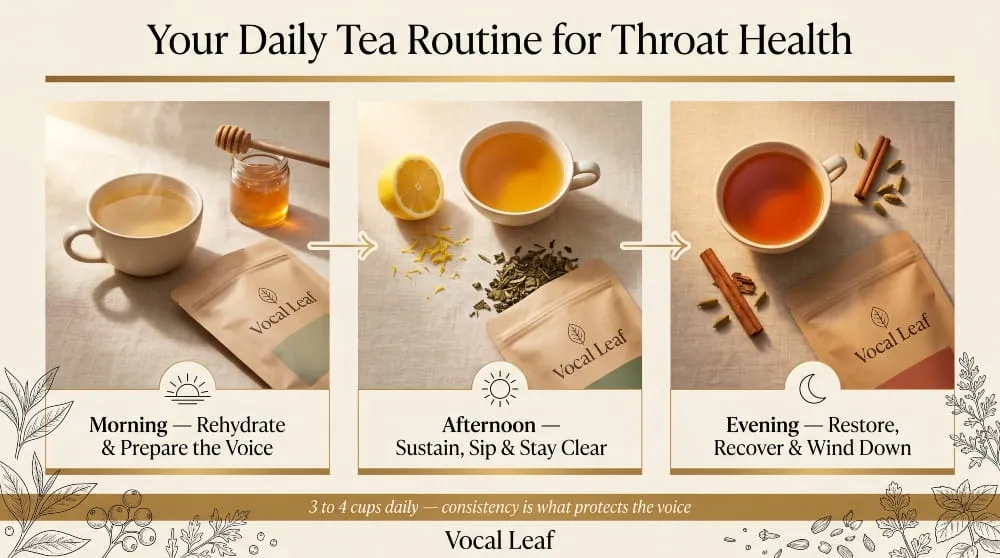
Morning, Afternoon, and Evening, When to Drink Throat Tea
Morning is when the throat is at its most vulnerable. After hours of mouth breathing during sleep, the mucosal lining is drier than at any other time of day, the vocal folds have not yet warmed up, and the tissue is more reactive to anything harsh or stimulating. The priority in the first cup of the day is gentle rehydration, something warm, smooth, and easy on the tissue that has not yet fully woken up.
This is not the moment for a strong, heavily caffeinated brew or anything with an assertive, sharp character. Vanilla Bliss earns its place here precisely because of its smooth, uncomplicated warmth. Sipped slowly before the voice is put to work, it rehydrates the mucosal lining, soothes the vocal folds, and prepares the throat for the day ahead without any compounds that add stress to tissue that is still settling.
For those who need caffeine in the morning, and there is nothing wrong with that, Organic Loose Leaf Black Tea is the right choice. Brewed at the correct temperature, not over-steeped, and paired with a glass of water, it delivers clean energy through L-theanine alongside a meaningful antioxidant contribution to the throat and respiratory tissue. The key is hydration alongside it, not instead of it.
Mid-morning through the afternoon is when the throat is under its most sustained load, teaching, speaking, recording, rehearsing, presenting, or simply navigating a full professional day. Consistent sipping through this window matters more than any single cup. The goal is to keep the mucosal lining hydrated, maintain the moisture that allows the vocal folds to vibrate freely, and prevent the gradual dryness that accumulates through heavy voice use and indoor air.
Lemon Berry Dream is ideally suited to this part of the day. Its naturally caffeine-free profile means it can be sipped throughout the afternoon without affecting sleep later, its citrus brightness keeps the throat feeling clear and fresh, and its smooth base makes it easy to drink across multiple cups without any heaviness building. A spoonful of honey in each cup adds a layer of demulcent coating that sustains the throat through a long stretch of voice use.
Evening is when the throat has taken the weight of the day and the body begins its recovery cycle. The priority shifts from active support to quiet restoration, warmth, anti-inflammatory depth, and the kind of soothing that prepares the vocal tissue for the overnight rest it needs to repair.
Organic Rooibos Chai is the natural choice for this window. Its rooibos base delivers anti-inflammatory compounds without caffeine, and its warming spice character produces a depth of comfort that winds the body down rather than keeping it alert. Sipped slowly in the hour before bed, with honey and a squeeze of fresh lemon if the throat needs extra attention, it closes the day on the strongest possible note for vocal recovery.
How Many Cups Per Day for Consistent Throat Comfort
Three to four cups across the day is the practical sweet spot for most people. That volume is enough to maintain consistent mucosal hydration, deliver a meaningful daily intake of anti-inflammatory and antioxidant compounds, and establish the routine repetition that makes a habit stick, without tipping into excess that could produce diminishing returns or, in the case of caffeinated teas, an unwanted stimulant load.
A useful framework: one cup in the morning to open the day and rehydrate the throat after sleep, one to two cups through the working hours when the voice is active and hydration matters most, and one cup in the evening to close the day and support overnight recovery. That structure adapts easily to individual schedules and preferences without requiring precise timing or measurement.
Water remains essential alongside a tea routine, not as a replacement for it. Tea contributes meaningfully to daily fluid intake, but sipping water between cups, especially when caffeinated tea is part of the day, ensures that the hydration effect is cumulative rather than partially offset. Think of water as the baseline, and tea as the layer of targeted throat support built on top.
Simple Soothing Throat Tea Recipes to Make at Home
A good throat tea does not need to be complicated. These three recipes cover the most common throat situations and work with the Vocal Leaf blends that suit each one best.
Daily Vocal Comfort, Steep one generous measure of Lemon Berry Dream in water just off the boil for three to four minutes. Add one teaspoon of raw honey and stir gently. Sip warm. This is the foundation cup, the one that can be made three times a day without thought and provides consistent, clean throat support through any demanding schedule.
Evening Recovery, Steep Organic Rooibos Chai for four to five minutes to allow the spice character to develop fully. Add one teaspoon of raw honey and the juice of half a fresh lemon. Let the cup cool to a comfortable sipping temperature before drinking. The combination of rooibos anti-inflammatory depth, honey coating, and lemon clarity makes this one of the most complete throat recovery drinks available without a prescription.
Pre-Performance Soothing, Steep Vanilla Bliss for three minutes in water at around 85°C. Add one generous teaspoon of raw honey. No lemon here, before performance, the priority is smooth, uninterrupted coating rather than the clarifying brightness of citrus. Sip slowly in the thirty to forty-five minutes before you need your voice, not immediately beforehand. Allow the warmth and the honey to do their work on the mucosal lining before the demands begin.
These recipes are starting points. The most effective throat tea routine is ultimately the one that fits your day naturally enough that you actually do it, consistently, without friction, cup after cup.
Conclusion
Your throat works every time you speak, sing, breathe, or swallow, and a simple daily tea habit is one of the most effortless ways to support it. The right cup, brewed well and sipped consistently, does more than feel good in the moment. It hydrates the mucosal lining, delivers anti-inflammatory and antioxidant compounds directly to the tissue that needs them, and builds the kind of cumulative vocal wellness that reactive remedies can never replicate.
Every Vocal Leaf blend in this guide is organic, additive-free, and formulated with that purpose in mind, whether you reach for the bright daily comfort of Lemon Berry Dream, the clean energy of Organic Loose Leaf Black Tea, the warming depth of Organic Rooibos Chai, or the gentle restoration of Vanilla Bliss.
Start with one good cup. Build from there.
Frequently Asked Questions (FAQ’s)
What tea is best for your throat?
The best tea for your throat is organic, naturally caffeine-free, and free of artificial additives, qualities that ensure every cup soothes rather than irritates. Loose-leaf teas with anti-inflammatory and antioxidant compounds, sipped warm with raw honey, consistently deliver the strongest results for throat comfort and vocal health.
Is black tea good for your throat?
Yes, brewed correctly, black tea is genuinely good for your throat, delivering a rich concentration of theaflavins and catechins with documented anti-inflammatory and antioxidant properties. The key is not over-steeping, drinking it at a comfortable temperature rather than scalding, and pairing it with adequate water intake to offset its mild diuretic effect.
Does tea actually help your throat, or is it just a placebo effect?
Tea does both, and the two are not in conflict. The warmth provides immediate physical comfort by relaxing throat muscles and coating the mucosal lining, while the plant compounds in quality loose leaf tea, polyphenols, flavonoids, and antioxidants, actively reduce inflammation and support tissue recovery in ways that go well beyond the sensation of drinking something warm.
Why does tea make my throat feel weird sometimes?
The most common causes are over-steeping, which releases tannins that dry and irritate the mucosal lining, and artificial flavourings or additives in commercial blends that can provoke sensitivity in reactive throats. Drinking tea that is too hot is another frequent culprit; scalding liquid adds thermal irritation to tissue that may already be sensitive.
What should I add to tea to soothe my throat?
Raw honey is the single most effective addition; it forms a protective demulcent coating over irritated throat tissue and brings natural antimicrobial properties to the cup. Fresh lemon juice adds immune-supporting vitamin C and helps thin mucus, while a few slices of fresh ginger contribute anti-inflammatory depth that amplifies the soothing effect of the tea itself.
Is hot tea good or bad for your throat?
Warm tea, between 55°C and 65°C, is excellent for your throat, soothing irritated tissue, supporting hydration, and delivering beneficial compounds intact. Scalding hot tea, above 65°C, is where the risk lies; at that temperature, it can further irritate sensitive tissue and, consumed habitually over many years, has been associated with increased oesophageal irritation. Let your cup cool for two to three minutes before sipping.
Can drinking tea cause throat cancer?
Tea itself is not linked to throat or oesophageal cancer. The risk identified by research applies specifically to any beverage consumed habitually at above 65°C; the temperature, not the tea, is the variable. Drunk at a comfortably warm temperature, which is also the optimal range for throat soothing, tea carries no such risk and delivers meaningful antioxidant and anti-inflammatory benefits.
What’s the best tea for long-term throat health?
For sustained, long-term throat health, the best approach is a daily routine built around organic, naturally caffeine-free loose-leaf teas that you drink consistently rather than reactively. Variety throughout the day: a smooth, soothing blend in the morning, a bright citrus option during active hours, and a warming, anti-inflammatory cup in the evening delivers a broader spectrum of beneficial compounds and keeps hydration steady throughout the day.
Top Selling Products






Best Tea for Singers | What Actually Helps Your Voice
If you sing, whether you perform professionally, teach voice lessons, or spend your weekends in rehearsal, you’ve probably wondered whether tea actually does anything useful…

Best Tea for Vocal Cords | Herbs, Hydration and Recovery
If your voice feels tired, strained, or dry, the right tea for your vocal cords can make a real difference, not by healing damaged tissue,…

Best Tea for Laryngitis | Soothe Your Voice Naturally
The best tea for laryngitis is a warm, caffeine free loose leaf blend that hydrates the throat and eases the strain on inflamed vocal cords.…

What Is Chai Tea? The Ultimate Guide to Ingredients, Benefits, Types & How It’s Made
If you’ve ever wondered what chai tea is, you’re not alone. It’s one of the most searched beverage questions online, yet the answer is often…

Best Tea for Your Voice | Does It Make You Sound Deeper
What it can do is change how your voice feels and sounds in the moment, which is where most of the confusion starts. If you…

The Best Tea for Performers & Speakers, And Why Your Voice Deserves Better
You spend hours rehearsing the words. You perfect the tone, the breath, the timing. But then you reach for whatever is nearby, a cup of…

Best Tea for Stress Relief | Calming Loose Leaf Blends
Stress is something everybody carries. It shows up in tight shoulders, restless nights, and a mind that won’t quiet down after a long day. And…

Best Tea for Dry Throat | The Teas That Help and the Ones That Hurt
The best teas for a dry throat are caffeine-free herbal blends, teas with no tannins to strip moisture from the throat lining and no caffeine…

Best Teas for Acid Reflux, Heartburn and GERD
Acid reflux doesn’t just cause heartburn. If you have searched for tea good for acidity, you are asking the same question, acidity and acid reflux…

Best Morning Tea for Energy and Focus Without Coffee Crash
The best tea to drink in the morning is black tea if you want steady, coffee level energy without the crash, rooibos chai if you…

Best Tea for Cough | The Complete Guide to Soothing Relief
The best tea for cough relief is a warm, hydrating blend that soothes irritated throat tissue while easing the reflex that triggers coughing in the…

Best Teas for a Cold That Actually Work
Best teas for a cold combines warmth, hydration and gentle steam to ease congestion, calm a scratchy throat and help your body rest while it…