
Rock Sugar for Tea | How to Use It and How Much

Rock sugar for tea is a minimally processed crystalline sweetener made from evaporated cane juice or beet sugar, formed into irregular chunks or smooth amber clusters rather than fine granules. Unlike refined white sugar, it dissolves slowly and adds a clean, rounded sweetness that enhances a tea’s natural flavor rather than masking it, which is exactly why it has been used in tea ceremonies across Asia for centuries.
If you’ve ever noticed that your tea tastes sharp or flat after adding regular sugar, rock sugar for tea is often the reason other cups taste better. Its slower release means the sweetness builds gradually as you drink, creating a more balanced cup from the first sip to the last. That’s a distinction that matters whether you’re steeping a bold black tea in the morning or winding down with something from a herbal tea at the end of the day.
This guide covers everything you need: what rock sugar for tea actually is, the differences between types, how much to use, how to dissolve it properly, and why certain teas, especially blends already built around soothing, naturally sweet ingredients, pair better with it than others.
What Is Rock Sugar for Tea?
Rock sugar for tea is a natural sweetener made by slowly crystallizing a concentrated sugar solution, typically from cane juice or beet sugar, into large, irregular formations that range in color from translucent white to deep amber. It has been a staple of Chinese, Middle Eastern, and South Asian tea traditions for hundreds of years, valued not just for its sweetness but also for how it interacts with a tea’s existing flavor compounds without disrupting them. The result is a sweetener that feels intentional rather than corrective, something you add to enhance a cup rather than rescue it.
How Rock Sugar Differs from Refined White Sugar
The core difference is processing. Refined white sugar is stripped of nearly all molasses and natural mineral content through multiple filtration and bleaching stages, leaving pure sucrose crystals that dissolve instantly and hit the palate sharply. Rock sugar for tea skips most of that processing. Crystallization occurs slowly and naturally, preserving trace minerals and forming a larger, denser crystal structure.
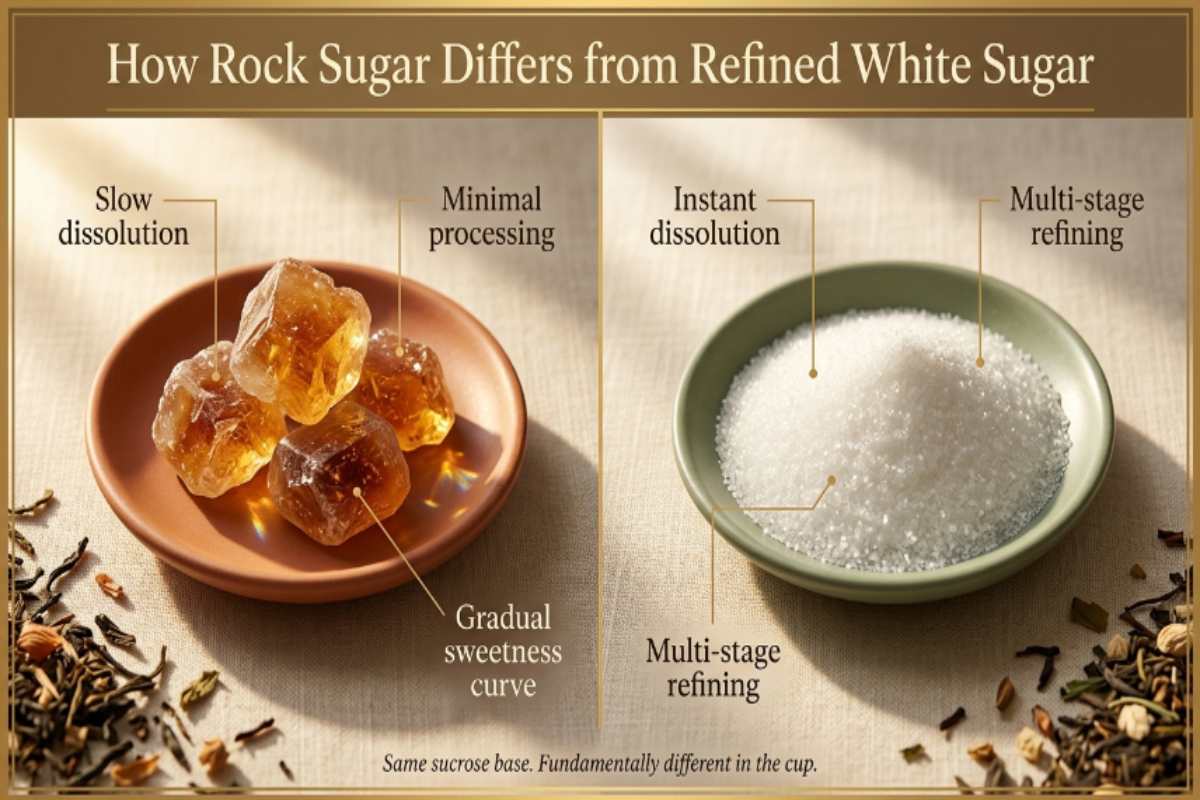
That structure matters in practice. Because rock sugar for tea dissolves more slowly than granulated sugar, it doesn’t create a sudden sweetness spike at the bottom of your cup. The flavor integrates as you drink rather than pooling, and the last few sips don’t turn cloyingly sweet, a common complaint with standard sugar in hot tea.
Amber rock sugar for tea, specifically, retains a small amount of molasses from the original cane juice, which adds a faint caramel-like depth that white rock sugar doesn’t have. Neither type has a strong flavor of its own, they’re both designed to support, not compete.
Why Tea Drinkers Prefer Rock Sugar Over Granulated Sugar
The preference comes down to control and compatibility. Granulated sugar dissolves the moment it hits hot water, which means the sweetness is fully present before the tea has finished steeping or cooling to a drinkable temperature. Rock sugar for tea gives you more time. You can stir it in partway through, let it dissolve gradually, and taste as you go, making it significantly easier to hit the right level without overshooting.
There’s also a textural and ritual dimension that serious tea drinkers notice. A small amber cluster placed in a glass teacup, dissolving slowly as the tea pours over it, is a different experience from spooning in granulated sugar. That’s not purely aesthetic, the slower dissolution genuinely produces a different sweetness curve in the cup.
For anyone who treats tea as a deliberate practice rather than a caffeine delivery system, including the voice professionals, speakers, and performers who rely on a consistent cup, that level of control matters. It’s the same reason a well-formulated tea for relaxation is built around complementary ingredients rather than maximum caffeine: the goal is a predictable, pleasurable result every time.
The Natural Sweetness Profile and Why It Doesn’t Overwhelm Flavor
Rock sugar’s glycemic sweetness is comparable to table sugar on a per-gram basis. Still, its flavor profile registers differently on the palate. Because the crystal structure releases sucrose gradually, the perceived sweetness is lower at any single moment during drinking, even if the total sugar content is similar. This is sometimes described as a “cleaner” sweetness. While that word gets overused in food writing, it reflects something real: rock sugar for tea doesn’t linger or coat the tongue the way refined sugar often does.
That quality makes it particularly well-suited to teas with delicate or complex flavor profiles, floral blends, fruit-forward teas, and lightly spiced herbal infusions where granulated sugar would flatten the top notes. A tea built around citrus, dried fruit, and botanicals loses less of its character when sweetened with rock sugar than with an equal amount of refined white sugar. The tea stays tasting like itself.
Types of Rock Sugar for Tea
Not all rock sugar for tea is the same. The type you choose affects how the sweetness develops in the cup, how quickly it dissolves, and how well it pairs with different tea profiles. Understanding the basic distinctions makes it easier to match the right sweetener to the right brew.
Amber Rock Sugar vs White Rock Sugar Flavor and Use Differences
The color difference between amber and white rock sugar isn’t cosmetic, it reflects a real difference in processing and flavor. White rock sugar is made from highly refined cane or beet sugar that has been fully stripped of molasses before crystallization. The result is a neutral, clean sweetness with no secondary flavor notes. It’s the most versatile option and the most commonly used in everyday tea preparation because it adds sweetness without influencing the tea’s existing flavor in any direction.
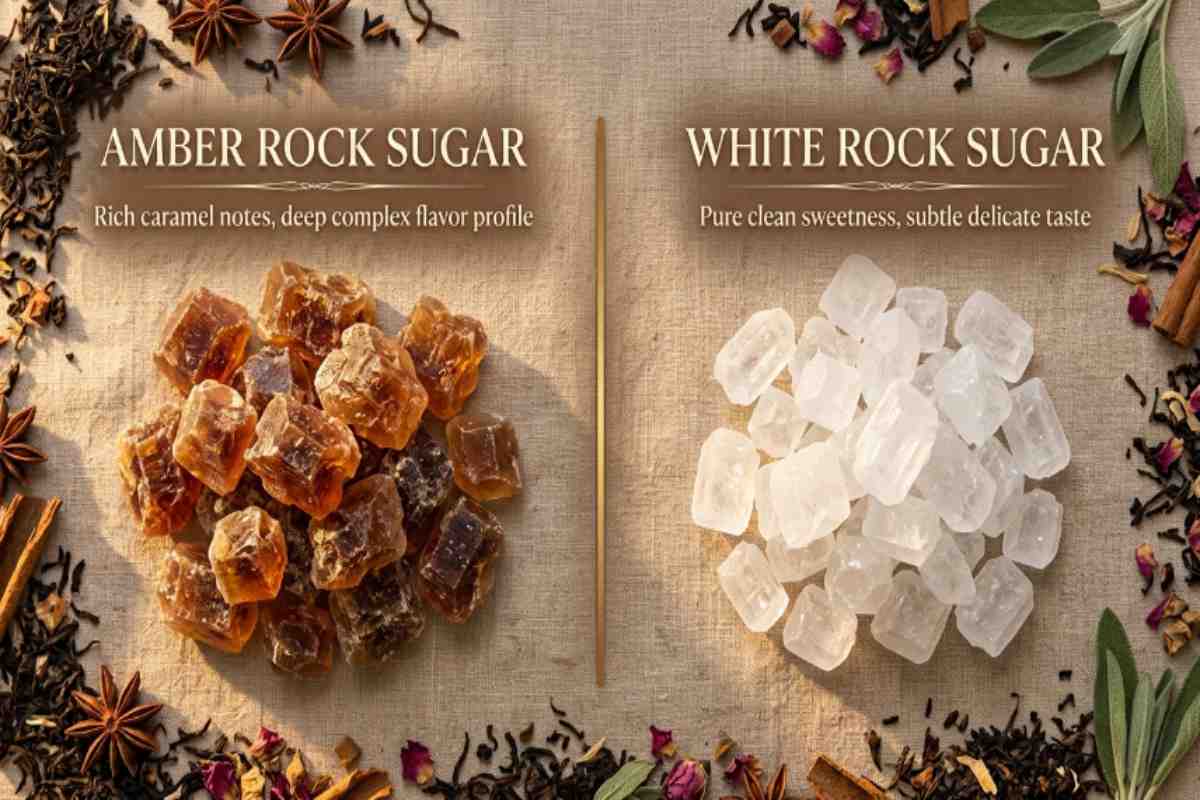 Amber rock sugar retains a small percentage of molasses from the original cane juice, which gives it a faint caramel warmth that white rock sugar doesn’t have. That depth pairs particularly well with darker, more robust teas, a strong black tea, a spiced chai, or any blend where a hint of caramel-like sweetness would feel complementary rather than out of place. It also dissolves slightly more slowly than white rock sugar due to its denser crystalline structure, which means the sweetness builds even more gradually in the cup.
For lighter blends, a fruit-forward tea, a floral herbal infusion, or anything from a loose leaf tea collection built around delicate top notes, white rock sugar is usually the better choice. Amber rock sugar can overpower subtler flavors if used in the same quantity.
Rock Sugar Sticks vs Loose Sugar Rocks Which Is Easier to Use
Rock sugar comes in two main physical formats, loose irregular chunks sold by weight, and molded sticks or lollipop-style stirrers with the sugar crystallized around a wooden or paper rod. Both are the same sweetener in different packaging, the choice is really about convenience and use case.
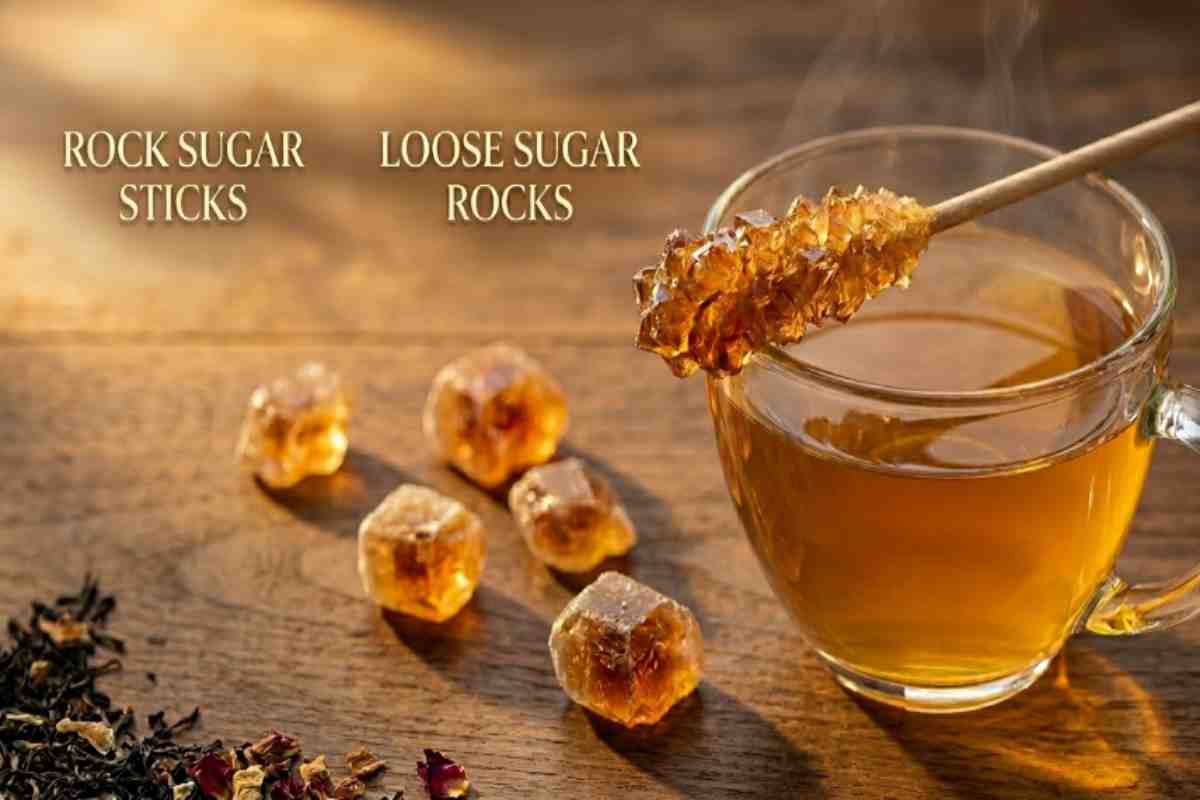
Loose sugar rocks give you more control over quantity. You can add a small piece, taste, and add more, which matters when you’re working with a tea whose flavor shifts significantly with sweetness level. The tradeoff is that you need to either break larger chunks into smaller pieces or accept some inconsistency in how much sugar goes into each cup. A kitchen scale removes that inconsistency, but most people sweeten by eye.
Rock sugar sticks are pre-portioned and easier to use on the go or when serving guests. The stick format also functions as a stirrer, which speeds up dissolution slightly by agitating the tea as the crystal melts. The downside is that you’re locked into the manufacturer’s portion size, which may be more or less than your preferred sweetness level. For home use where precision matters, loose sugar rocks are generally the more practical format.
What Natural or Raw Rock Sugar Means on Labels
The terms “natural” and “raw” on rock sugar packaging are largely unregulated and don’t guarantee any specific level of processing or mineral retention. In practice, “raw” usually indicates that the sugar went through fewer refining stages before crystallization, meaning more of the original molasses content remains, which tends to produce a slightly more complex flavor and a darker color. But there is no universal standard for what qualifies as raw, and the term can appear on products that vary widely in actual processing depth.
“Natural” is even less meaningful as a label claim. In the context of rock sugar, it typically signals that no artificial flavors, colorants, or anti-caking agents were added, which is true of most rock sugar regardless of whether the label says so. It tells you very little about how the sugar was produced or refined.
The more reliable indicator of quality is color, origin transparency, and ingredient simplicity. A rock sugar with a single ingredient, crystallized cane sugar or beet sugar, with no additives is what you want, whether or not the label uses natural or raw language. If the product lists additional flavoring agents or flowing agents, it’s a different product than traditional rock sugar, regardless of how it’s marketed.
How Much Rock Sugar to Use in Tea
How much rock sugar to use in tea depends on the tea itself, your personal sweetness preference, and whether you’re brewing hot or iced, but a reliable starting point for most cups is between 5 and 10 grams, roughly equivalent to one to two teaspoons of granulated sugar by weight. Because rock sugar dissolves more slowly than refined sugar, it’s easy to underestimate how sweet the final cup will be, so starting conservatively and adjusting as you go is always the right approach.
General Ratios for Hot Tea
For a standard 8-ounce cup of hot tea, 5 to 8 grams of rock sugar is the most common range. That translates to a small chunk about the size of a sugar cube, or roughly half a rock sugar stick if you’re using the pre-molded format. At this amount, the sweetness is present but not dominant, it rounds out bitterness and enhances the tea’s natural flavor without pushing the cup into dessert territory.
If you prefer a noticeably sweet cup, 10 to 12 grams is more appropriate. This is closer to the sweetness level of a standard sweetened café tea and works well for stronger brews where the tea’s intensity can hold up against a higher sugar level. Beyond 12 grams in an 8-ounce cup, the sweetness tends to overpower the tea rather than complement it, a threshold worth noting if you’re steeping something with subtle or layered flavor notes.
The slower dissolution of rock sugar also means timing matters. Adding it at the beginning of the steep allows it to fully integrate before you drink. Adding it after steeping gives you more control but requires active stirring, especially with larger chunks. Either approach works, the difference is whether you want the sweetness baked into the brew from the start or dialed in at the end.
How Much Rock Sugar for Iced Tea
Iced tea requires more rock sugar than hot tea, and it requires it earlier in the process. Cold water dramatically slows sucrose dissolution, rock sugar that melts in two minutes in a hot cup can take twenty or more in cold liquid. For this reason, rock sugar for iced tea should always be dissolved in the hot brew first, before chilling or pouring over ice.
A general ratio for iced tea is 8 to 15 grams per 8-ounce serving, depending on dilution. If you’re brewing a concentrate that will be poured over ice, which adds water volume as the ice melts, start at the higher end of that range. If you’re brewing at full strength and chilling without ice dilution, 8 to 10 grams is usually sufficient. Tasting before chilling is essential because cold temperatures suppress sweetness perception by roughly 10 to 15 percent, meaning a cup that tastes adequately sweet at steeping temperature will taste noticeably less sweet once cold.
A simple workaround is to make a small batch of rock sugar simple syrup: dissolve the sugar in a small amount of hot water, then stir the liquid into your iced tea. This eliminates uneven sweetness distribution entirely and gives you precise control over the final result.
Adjusting Sweetness by Tea Strength and Blend Type
Tea strength and ingredient composition are the two variables that most affect the math on rock sugar quantity. A lightly steeped Loose Leaf Hot Tea needs less rock sugar than a full-strength brew because there’s less bitterness and astringency to offset. A heavily steeped black tea, steeped at high temperature for a long time, has significantly more tannin load, and tannins register as bitterness that sugar directly counteracts. The same 8-gram portion that would oversweeten a light herbal cup might barely register in a strong black tea.
Blend composition matters just as much. A tea built around fruit pieces, dried citrus, or naturally sweet botanicals already carries inherent sweetness before any sugar is added. These blends often need half the rock sugar of a plain single-origin tea, sometimes none at all. A spiced blend with warming notes like cinnamon or cardamom sits in the middle: the spice complexity can absorb sweetness well, but those flavors are assertive enough that adding too much rock sugar dulls the spice rather than complementing it.
The practical rule is to taste first, then sweeten. Steep your tea as you normally would, take a sip without sugar, and assess where the flavor is landing, whether it reads as bitter, balanced, or already sweet on its own. That single step eliminates most of the guesswork. It consistently produces a better result than adding sugar by habit before tasting.
How to Use Rock Sugar in Tea (Step by Step)
Using rock sugar in tea is straightforward, but a few small technique decisions, when you add it, how you handle dissolution, and what format you’re working with, make a noticeable difference in the final cup. The core principle is simple: rock sugar needs more time and heat than granulated sugar to fully integrate, so the method you use should account for that from the start.
Adding Rock Sugar While Steeping vs After
Adding rock sugar at the beginning of the steep, dropping a chunk directly into the cup or teapot before pouring hot water, gives the crystal the maximum time and temperature to dissolve fully. By the time the tea has finished steeping, the sugar is completely integrated and the sweetness is evenly distributed throughout the liquid. This is the most hands-off approach and works well when you already know your preferred sweetness level for a particular tea.
Adding rock sugar after steeping gives you more control but requires more attention. The tea is fully brewed before any sweetness enters the equation, which means you can taste the tea as it is, assessing its natural bitterness, body, and flavor, before deciding how much sugar to add. This is particularly useful when you’re working with a new tea or a blend with a complex flavor profile, where the right sweetness level isn’t yet established. Understanding the base flavor of a tea before sweetening it is one of the habits that separates a deliberate tea drinker from someone who sweetens by default.
The one tradeoff with post-steep addition is that the tea has cooled slightly by the time you’re stirring in the rock sugar, which slows dissolution. If you add it within the first two minutes after steeping, the water is still hot enough to dissolve a small chunk without extended stirring. Wait much longer and you’ll need to either stir actively for several minutes or accept partial dissolution.
How to Dissolve Rock Sugar Faster in Hot Water
Rock sugar dissolves more slowly than granulated sugar because its crystal structure is denser and its surface area is smaller relative to its mass. There are four reliable ways to speed up the process without compromising the cup.

The first is temperature. Rock sugar dissolves significantly faster above 200°F than it does at 170°F, so steeping your tea at the correct temperature for the leaf type (full boil for black and herbal teas, lower for more delicate varieties) also happens to be the optimal temperature range for rock sugar dissolution. Heat and sugar work together here, not in conflict.
The second is surface area. Breaking a larger chunk into smaller pieces before adding it to the cup dramatically increases the rate of dissolution. A chunk the size of a sugar cube will dissolve in roughly two to three minutes in near-boiling water; the same mass broken into four or five smaller pieces will dissolve in under a minute.
The third is agitation. Stirring keeps fresh, unsaturated water in contact with the crystal surface, which accelerates the process. A brief stir every thirty seconds for the first two minutes is usually enough to dissolve a standard portion fully. This pairs naturally with the steeping process, stirring the tea for flavor extraction and dissolving the rock sugar happen simultaneously.
The fourth is pre-dissolving. If you’re making iced tea or a large batch, dissolving rock sugar in a small amount of near-boiling water first, essentially making a quick syrup, and then adding that liquid to the full batch is the most efficient method. It also eliminates any risk of uneven sweetness distribution, which matters more in larger volumes. This approach works particularly well with fruit-forward teas and naturally sweet blends; if you’re exploring different tea flavors and want consistent results across multiple cups, pre-dissolving is worth making a habit.
Using Rock Sugar Sticks as a Stirring Sweetener
Rock sugar sticks, sugar crystallized around a thin wooden or paper rod, are designed to dissolve while you stir, which solves the surface area problem without any prep work. As the stick moves through the hot liquid, the outer layer of crystals contacts fresh water continuously, which keeps dissolution moving at a steady pace. A standard rock sugar stick fully dissolves in a well-steeped cup of hot tea in approximately ninety seconds to two minutes of active stirring.
The practical advantage of the stick format is portion consistency. Each stick contains roughly the same amount of sugar, typically 8 to 10 grams, which takes the guesswork out of sweetening when you’re making multiple cups or serving guests. The stirring mechanic also means the sweetness integrates evenly from the moment you start, rather than pooling at the bottom and requiring a final stir before drinking.
The format is particularly well-suited to teas you drink on the go or at a desk, where measuring loose chunks isn’t practical. It also has a sensory dimension worth noting: the act of stirring with a crystal-coated stick as it slowly melts into the cup changes the experience of making tea in a way that’s hard to replicate with a spoon and a bag of granulated sugar. For something like a warm cup built around citrus and orange peel tea, where the drinking experience is as important as the flavor, that kind of small ritual detail tends to matter.
Rock Sugar Tea Recipes
Rock sugar tea recipes follow a consistent logic: brew the tea correctly first, then let the sugar do what it does best, round out bitterness, enhance natural sweetness, and bring the cup into balance. The recipes below work with loose leaf tea steeped at the right temperature and time, which matters more than any other variable in the final result.
Classic Sweetened Loose Leaf Tea with Rock Sugar
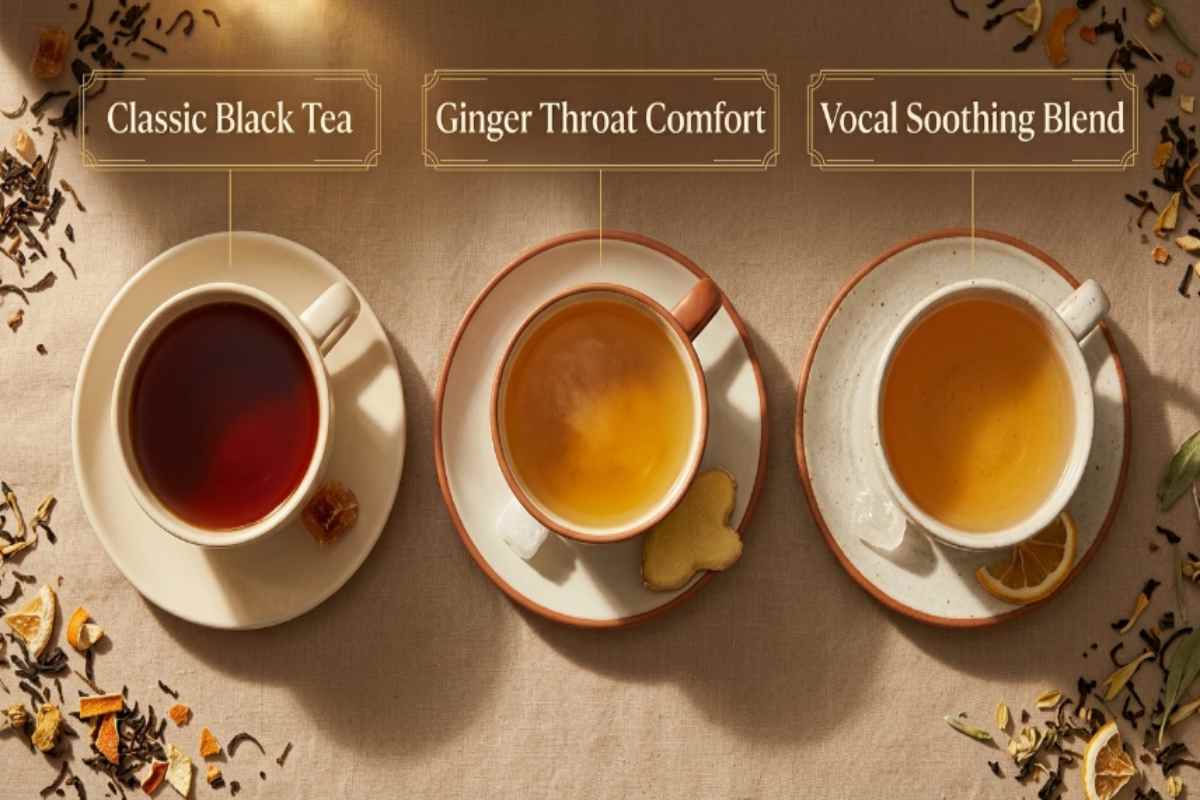
This is the foundation recipe, the one that establishes your baseline before you start adapting for specific ingredients or purposes. It works with any loose leaf tea and produces a clean, well-balanced cup where the tea’s natural flavor remains the dominant note.
Start with 2 grams of loose leaf tea per 8 ounces of water, a standard ratio that produces a medium-strength brew without excessive bitterness or astringency. Heat your water to the appropriate temperature for the tea type: a full rolling boil (212°F) for black tea and most herbal blends, slightly lower (185 to 195°F) for more delicate varieties. Add 6 to 8 grams of white rock sugar, roughly one small chunk or half a standard rock sugar stick, directly to your cup before pouring.
Pour the hot water over both the tea and the rock sugar simultaneously. Steep for the recommended time for your specific blend, most loose leaf black teas and herbal infusions fall between 4 and 12 minutes depending on the blend’s design. Stir once at the midpoint of steeping to help the rock sugar dissolve and distribute evenly. Remove the tea infuser or strain the leaves, taste, and adjust with an additional small piece of rock sugar for tea if needed.
The result should be a cup where sweetness is present from the first sip but doesn’t build into something cloying by the last. If the cup tastes flat rather than sweet, add sugar in small increments; rock sugar’s gradual dissolution means it’s easy to overshoot if you add too much at once.
Rock Sugar Ginger Tea for Throat Comfort
Ginger and rock sugar have been paired in tea preparations across Chinese and Ayurvedic traditions for centuries, and the combination holds up for a practical reason: ginger’s natural sharpness and mild heat benefit directly from rock sugar’s slow, clean sweetness. The sugar doesn’t soften the ginger’s effect, it frames it, making the warmth more pleasant to drink without dulling what makes ginger useful in the first place.
For this recipe, use 1 teaspoon of freshly grated ginger root per 8 ounces of water. Fresh ginger produces a noticeably more vibrant result than dried, the volatile compounds responsible for ginger’s warmth degrade quickly after processing, so dried ginger produces a flatter, more one-dimensional flavor. Bring the water to a full boil, add the ginger, and steep it for 8 to 10 minutes. The cover matters: it traps the volatile aromatic compounds that would otherwise escape as steam.
Strain the ginger, then add 8 to 10 grams of amber rock sugar while the liquid is still near-boiling. Amber rock sugar’s faint caramel note pairs particularly well with ginger’s warmth in a way that white rock sugar doesn’t quite replicate. Stir until fully dissolved, then let the cup cool to a comfortable drinking temperature before sipping.
This preparation works well on its own or as a base that a loose leaf blend can be steeped into, adding a tea that’s designed specifically around throat comfort and vocal soothing deepens the effect considerably. If congestion is part of what you’re addressing, the approach pairs naturally with other preparations covered in this guide to the best tea for congestion, where steam, hydration, and ingredient selection all work together.
Rock Sugar Tea Recipe for Cough and Vocal Soothing
Rock sugar has been used in traditional throat and cough preparations for generations, not as a medicinal treatment, but as a functional ingredient that makes a soothing tea easier to drink consistently and reduces the irritation that comes with repeated swallowing when the throat is already strained. A 2019 review published in the journal Primary Care Respiratory Medicine noted that warm sweetened liquids can help reduce the urge to cough by coating irritated throat tissue. This mechanism applies directly to why rock sugar for tea has earned its place in these preparations.
The recipe here is built around that principle. Use a loose leaf blend with naturally soothing botanicals, ingredients like dried fruit, citrus peel, and warming spice that support the throat without adding anything harsh or astringent. Steep at a full boil (212°F) for 10 to 12 minutes, longer than a standard cup, to extract the maximum from the ingredients. The longer steep produces a more concentrated, more viscous liquid that coats the throat more effectively than a lighter brew.
Add 10 to 12 grams of white rock sugar while the tea is still hot, at the higher end of the dosing range for this recipe, because the additional sweetness contributes to the coating effect and makes the cup easier to drink when the throat is already sensitive. Stir until fully dissolved. Sip slowly rather than drinking quickly; the goal is sustained contact with the throat tissue, not rapid hydration.
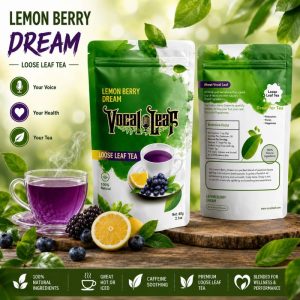
For voice professionals, singers, speakers, teachers, and podcasters who need their voice to perform consistently, this kind of preparation is worth having as a reliable ritual rather than a reactive fix. Vocal Leaf’s Lemon Berry Dream is purpose-built for exactly this use case: it already contains rock sugar for tea as a core ingredient, alongside citrus peel, lemon oil, and marigold blossoms, which means the sweetness and soothing profile are built into the blend before you add anything. It’s also naturally suited to the herbal iced tea format, steeped hot with rock sugar fully dissolved, then chilled, for performers who prefer cold hydration before or after a performance.
Rock Sugar for Tea Calories and Nutrition
Rock sugar for tea contains roughly the same number of calories as refined white sugar, approximately 4 calories per gram, or 20 to 40 calories per standard serving depending on how much you use. The nutritional profile is nearly identical to table sugar at the macro level, which means rock sugar for tea isn’t a low-calorie alternative. What it offers instead is a different sweetness experience that typically results in using less sugar overall to achieve the same perceived sweetness in the cup.
How Many Calories in Rock Sugar vs Table Sugar
On a gram-for-gram basis, rock sugar and refined white table sugar contain essentially the same caloric value, 4 calories per gram, derived almost entirely from sucrose. A 10-gram serving of rock sugar, which is on the higher end of what most people use in a single cup of tea, contains approximately 40 calories. A 5-gram serving, a small chunk, roughly equivalent to one level teaspoon of granulated sugar, sits at around 20 calories.
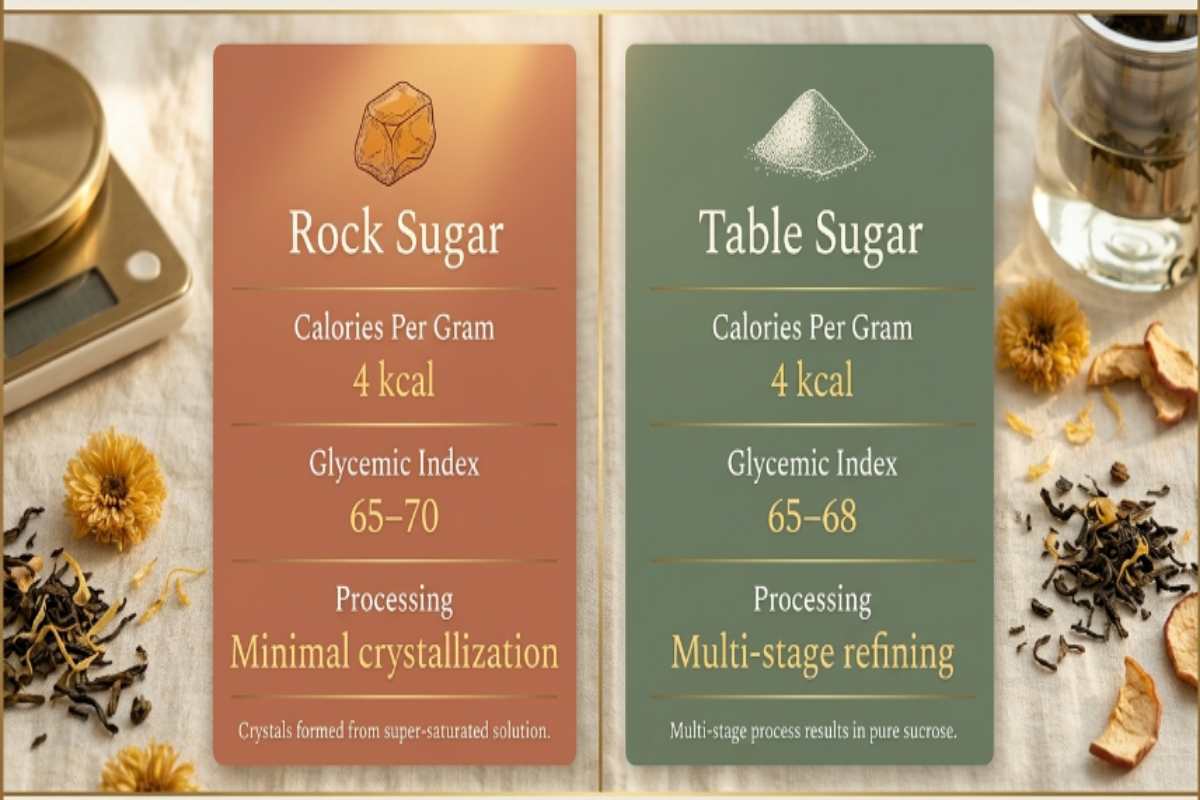
The practical difference isn’t in the numbers but in the usage pattern. Because rock sugar dissolves slowly and its sweetness builds gradually through the cup, most people use measurably less of it than they would granulated sugar to reach the same level of perceived sweetness. A tea drinker who habitually adds two teaspoons of table sugar to every cup may find that one small chunk of rock sugar for tea, roughly half the mass, produces an equivalent result. Over the course of multiple cups per day, that difference adds up without any conscious effort at reduction.
Amber rock sugar contains marginally more trace minerals than white rock sugar due to its retained molasses content, small amounts of calcium, potassium, and iron, but the quantities are nutritionally insignificant at typical serving sizes. Rock sugar for tea is not a meaningful source of micronutrients. It is a sweetener, and its nutritional story is best understood in those terms rather than through any wellness framing that overstates what it delivers.
For tea drinkers who are managing daily sugar intake carefully, particularly those who drink multiple cups throughout the day, including a caffeinated tea in the morning and additional cups later, tracking rock sugar by weight rather than by piece or chunk produces the most accurate picture of actual consumption.
Glycemic Comparison for Tea Drinkers Watching Sugar Intake
Rock sugar is composed almost entirely of sucrose, the same disaccharide found in table sugar, which means its glycemic index is comparable, typically cited between 65 and 70, similar to refined white sugar’s range of 65 to 68. For tea drinkers monitoring blood sugar response, rock sugar for tea does not offer a meaningful glycemic advantage over standard sugar. The sucrose content is the same; the crystalline format doesn’t change how the body metabolizes it once dissolved and consumed.
Where rock sugar’s slower dissolution does make a functional difference is in consumption behavior rather than biochemistry. Because the sweetness in a rock sugar–sweetened cup builds gradually rather than arriving all at once, the drinking experience feels less intensely sweet at any given moment, which tends to reduce the total amount consumed per session. This is a behavioral effect, not a metabolic one, but it’s real and worth accounting for if you’re trying to moderate sugar intake without eliminating sweetness entirely.
Tea drinkers with diabetes or those following a low-glycemic diet should treat rock sugar the same way they would treat table sugar, as a source of rapidly absorbed sucrose that will affect blood glucose in proportion to the amount consumed. The format is different; the physiological response is not. Natural sweetener alternatives with a genuinely lower glycemic index exist, but rock sugar is not among them despite its less-processed reputation.
For those who want the ritual and flavor benefit of a sweetened cup without the full sugar load, the most effective approach is to choose teas that are naturally sweet on their own, blends built around fruit, citrus, and botanicals that carry inherent sweetness before any sugar is added. A well-formulated blend in that category can be deeply satisfying with just a small amount of rock sugar for tea, or none at all. This matters particularly for recovery-focused tea drinkers who rely on consistent hydration throughout the day; if you’re building a post-performance or post-training routine around a tea for muscle recovery, managing the sugar content of each cup is part of getting the routine right.
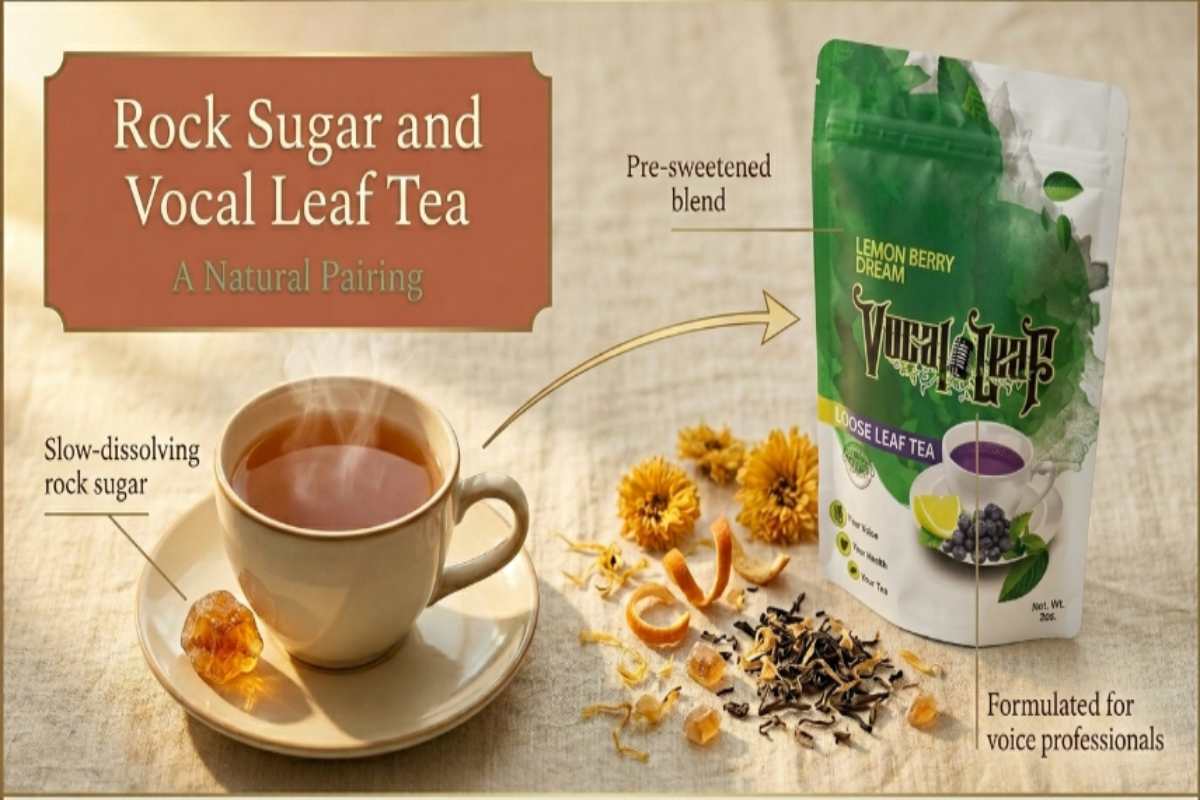
Rock Sugar and Vocal Leaf Tea A Natural Pairing
Most tea drinkers add rock sugar to their cup after brewing. Vocal Leaf’s Lemon Berry Dream skips that step entirely, rock sugar is already built into the blend, balanced against the other ingredients at the formulation stage rather than added as an afterthought at the cup. That distinction matters more than it might initially seem, and it reflects a deliberate choice about what a tea designed for voice professionals should actually deliver.
Why Lemon Berry Dream Already Contains Rock Sugar
Lemon Berry Dream includes candied sugar, the culinary term for rock sugar in its most refined crystallized form, as a core ingredient alongside apple pieces, citrus peel, lemon oil, marigold blossoms, and sweet black honey leaves. It isn’t there purely for sweetness. Rock sugar in a loose leaf blend serves a different function than rock sugar for tea added to a finished cup: it infuses slowly during steeping, releasing its sweetness gradually into the liquid in a way that integrates with the other flavor compounds rather than sitting on top of them.
The result is a tea that tastes balanced straight out of the infuser, citrus-forward, lightly sweet, with the rock sugar’s clean roundness holding the fruit and botanical notes together. For voice professionals who drink tea functionally rather than recreationally, this means one less variable to manage. You steep the tea correctly, and the sweetness is already calibrated. There’s no risk of over-sweetening a cup you’re about to drink before a performance, a recording session, or a full day of teaching.
The inclusion of rock sugar for tea also connects to the throat-soothing rationale that runs through the blend’s design. Sweet, slightly viscous liquids coat irritated throat tissue more effectively than plain water, a mechanism that’s been documented in cough and throat comfort research and that traditional tea preparations have leveraged for generations. Rock sugar for tea contributes to that coating quality in a way that artificial sweeteners, which don’t dissolve into the liquid in the same way, cannot replicate.
How the Blend’s Natural Sweetness Reduces the Need for Added Sugar
Lemon Berry Dream is built around ingredients that carry inherent sweetness before the rock sugar for tea in the blend even enters the equation. Apple pieces contribute fructose-driven fruit sweetness. Lemon peel and orange peel add aromatic sweetness from their essential oils, a brightness that registers as sweet on the palate even though it doesn’t come from sugar. Sweet black honey leaves, a specialty ingredient in the blend, add a honey-like depth that reinforces the rock sugar’s effect without duplicating it.
The cumulative result is a tea with a substantial natural sweetness base. Most people who steep Lemon Berry Dream find they need little to no additional sweetener, the rock sugar for tea already in the blend, combined with the fruit and botanical sweetness from the other ingredients, produces a cup that reads as satisfyingly sweet without anything added. For tea drinkers managing daily sugar intake, this is a meaningful practical advantage: a fully satisfying sweetened cup at a fraction of the sugar load of a conventionally sweetened tea.
This also matters in the context of inflammation, something voice professionals and performers monitor carefully because vocal tissue is particularly sensitive to systemic inflammatory load. Excess sugar consumption is a recognized driver of inflammation, which makes a tea that delivers sweetness satisfaction at lower total sugar quantities a better long-term choice than a plain tea that requires heavy sweetening to be palatable. For anyone already paying attention to teas for inflammation as part of a vocal health routine, reducing added sugar in the cup is a natural extension of the same thinking.
Ordering Vocal Leaf Loose Leaf Tea Pre-Sweetened for Voice Professionals
Vocal Leaf is the only tea brand built exclusively for voice professionals, singers, speakers, teachers, podcasters, and performers who depend on their voice and need their tea to work as hard as they do. Every blend in the lineup is formulated with that specific use case in mind, which means the ingredient decisions, including the rock sugar in Lemon Berry Dream, aren’t arbitrary. They reflect what voice professionals actually need in a cup: consistent flavor, throat-supportive ingredients, and a sweetness level that doesn’t require adjustment before every use.
Lemon Berry Dream is available in a 2-ounce loose leaf format, steeped at 203 to 212°F for 10 to 12 minutes, and works equally well hot or iced, making it practical for performers who need vocal support in warm and cold formats depending on the season or the performance context. The blend is certified 100% Certified Soothing, a designation that reflects the formulation standard Vocal Leaf holds its products to.
For those whose needs lean toward calm focus and pre-performance composure rather than citrus brightness, Vanilla Bliss is the natural complement in the lineup, a warmer, more grounding blend that pairs well with rock sugar for the same reasons Lemon Berry Dream does: naturally sweet ingredients that do most of the work before you add anything to the cup.
Conclusion
Rock sugar for tea is a simple upgrade with a lasting impact. It sweetens more gently, integrates more cleanly, and lets the tea’s natural flavor lead, which is exactly what a well-made cup deserves. The fundamentals are straightforward: start with 5 to 8 grams, add it early for hands-off sweetness or after steeping for more control, and always dissolve it in hot liquid before chilling. Get those basics right and the cup consistently improves. For voice professionals who want the soothing benefits without the extra step, Vocal Leaf adds rock sugar, so the sweetness, throat support, and flavor balance are already there before you pour.
Frequently Asked Questions (FAQs)
Is rock sugar better than honey in tea?
Neither is objectively better, they serve different purposes in the cup. Rock sugar adds clean, neutral sweetness that lets the tea’s natural flavor lead. Honey adds its own flavor on top of sweetness, which works well in some blends and competes with others. If you want the tea to taste like the tea, rock sugar is the more transparent choice.
Can you use rock sugar in cold brew tea?
You can, but it won’t dissolve in cold water without help. Rock sugar needs heat to fully integrate, cold brew temperatures are too low to dissolve even small chunks within a reasonable timeframe. The practical workaround is to make a quick rock sugar syrup by dissolving it in a small amount of hot water first, then stirring that into the cold brew once it’s finished steeping.
Does rock sugar dissolve in iced tea?
Rock sugar for tea dissolves readily in iced tea as long as it’s added while the liquid is still hot. The key is timing , add rock sugar immediately after steeping, before chilling or pouring over ice, and stir until fully dissolved. Adding it to an already-cold cup produces uneven sweetness and visible undissolved crystals at the bottom, regardless of how long you stir.
How do you store rock sugar for tea?
Rock sugar for tea stores best in an airtight container at room temperature, away from moisture and direct sunlight. Humidity is the main threat, exposure to moisture causes the crystals to partially dissolve and then recrystallize into a hardened mass that’s difficult to break apart. A sealed glass jar works well; so does any airtight container from a loose leaf tea accessories collection designed for dry ingredient storage. Stored correctly, rock sugar keeps indefinitely without quality loss.
Is rock sugar for tea the same as regular sugar?
Rock sugar and refined white sugar are both sucrose, so they’re chemically similar, but they’re not the same product. Rock sugar is less processed, forms larger crystals, dissolves more slowly, and produces a gentler sweetness curve in the cup. Regular granulated sugar dissolves instantly and delivers its full sweetness immediately. The caloric and glycemic profiles are comparable, but the brewing experience and flavor integration are meaningfully different.
Top Selling Products





Best Tea for Singers | What Actually Helps Your Voice
If you sing, whether you perform professionally, teach voice lessons, or spend your weekends in rehearsal, you’ve probably wondered whether tea actually does anything useful…

Best Tea for Vocal Cords | Herbs, Hydration and Recovery
If your voice feels tired, strained, or dry, the right tea for your vocal cords can make a real difference, not by healing damaged tissue,…

Best Tea for Laryngitis | Soothe Your Voice Naturally
The best tea for laryngitis is a warm, caffeine free loose leaf blend that hydrates the throat and eases the strain on inflamed vocal cords.…

What Is Chai Tea? The Ultimate Guide to Ingredients, Benefits, Types & How It’s Made
If you’ve ever wondered what chai tea is, you’re not alone. It’s one of the most searched beverage questions online, yet the answer is often…

Best Tea for Your Voice | Does It Make You Sound Deeper
What it can do is change how your voice feels and sounds in the moment, which is where most of the confusion starts. If you…

The Best Tea for Performers & Speakers, And Why Your Voice Deserves Better
You spend hours rehearsing the words. You perfect the tone, the breath, the timing. But then you reach for whatever is nearby, a cup of…
Best Tea for Stress Relief | Calming Loose Leaf Blends
Stress is something everybody carries. It shows up in tight shoulders, restless nights, and a mind that won’t quiet down after a long day. And…

Best Tea for Dry Throat | The Teas That Help and the Ones That Hurt
The best teas for a dry throat are caffeine-free herbal blends, teas with no tannins to strip moisture from the throat lining and no caffeine…
Best Teas for Acid Reflux, Heartburn and GERD
Acid reflux doesn’t just cause heartburn. If you have searched for tea good for acidity, you are asking the same question, acidity and acid reflux…

Best Morning Tea for Energy and Focus Without Coffee Crash
The best tea to drink in the morning is black tea if you want steady, coffee level energy without the crash, rooibos chai if you…

Best Tea for Cough | The Complete Guide to Soothing Relief
The best tea for cough relief is a warm, hydrating blend that soothes irritated throat tissue while easing the reflex that triggers coughing in the…

Best Teas for a Cold That Actually Work
Best teas for a cold combines warmth, hydration and gentle steam to ease congestion, calm a scratchy throat and help your body rest while it…